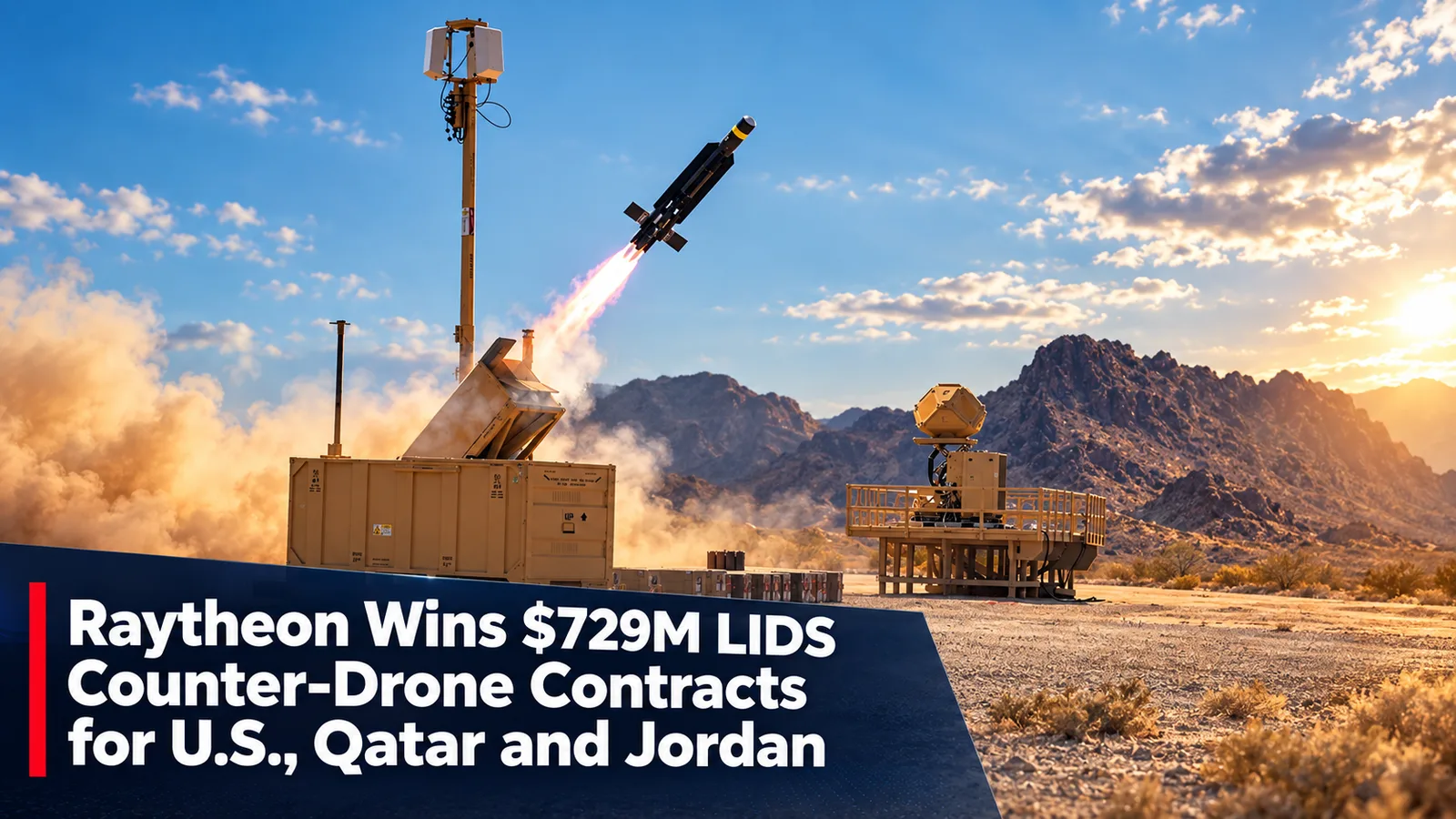
RTX’s Raytheon has secured $729 million in contracts to deliver components of the LIDS counter-drone system to the U.S. Army, Qatar and Jordan. The awards cover Raytheon’s Ku-band Radio Frequency Sensor (KuRFS) and Coyote effectors and mark the first international sales of both systems, according to RTX.
The contract package includes a mix of fixed-site and mobile LIDS configurations. Raytheon did not disclose how the $729 million total is divided among the three customers, how many radars or effectors are included, or when deliveries will be completed.
The Awards Mark KuRFS and Coyote’s First Confirmed International Sales
RTX explicitly describes the Qatar and Jordan awards as the first international sales of KuRFS and Coyote. That makes the October 2026 announcement an export milestone for a counter-UAS architecture that has previously been centred on U.S. Army requirements.
The distinction is important in Qatar’s case. The U.S. State Department approved a possible $1 billion Foreign Military Sale of ten fixed-site LIDS systems and 200 Coyote Block 2 interceptors to Qatar in November 2022. That approval authorised a potential transaction; it did not itself establish an executed export contract. RTX’s 2026 statement therefore represents the company’s first confirmed international sale claim.
KuRFS Provides the Detection Layer
KuRFS is the radar layer inside Raytheon’s LIDS contribution. RTX says the Ku-band sensor provides 360-degree threat detection, allowing operators to detect and track low, slow and small unmanned aircraft around a defended position.
In U.S. Army service, KuRFS operates as part of a wider integrated counter-UAS architecture that also includes electro-optical and infrared sensors and command-and-control systems. The Army’s current M-LIDS description shows how those sensors are fused to build a local air picture before an operator selects an appropriate defeat method.
Coyote Provides Both Kinetic and Non-Kinetic Defeat Options
Raytheon’s Coyote family provides the effector layer. RTX says the system includes low-cost kinetic and non-kinetic variants capable of defeating individual drones and swarms and credits the family with hundreds of combat intercepts.
The U.S. Army has previously described Coyote as a ground-launched, radar-guided interceptor integrated into fixed and mobile LIDS configurations. The availability of both kinetic and non-kinetic variants allows commanders to match the response to the threat rather than using the same interceptor against every target.
The Contracts Cover Both Fixed and Mobile LIDS
RTX says the $729 million award package includes a mix of fixed-site and mobile LIDS configurations. Fixed-site systems are designed to protect bases and critical infrastructure, while mobile LIDS can move with manoeuvre forces and provide local counter-UAS protection during operations.
That split matters for Qatar and Jordan because the two configurations address different defence problems. A fixed system can protect an air base, command node or critical facility, while a mobile system supports formations that need counter-drone protection as they reposition.
Qatar’s 2022 FMS Approval Shows the Long Procurement Path
The Qatar case illustrates how long counter-UAS acquisition can take. DSCA’s 2022 notification covered a possible package worth an estimated $1 billion and included ten FS-LIDS systems, 200 Coyote Block 2 interceptors, electronic-warfare systems, radars, command-and-control, electro-optical sensors, training and support.
The 2026 RTX release does not say whether Qatar’s share of the new $729 million contracts exactly matches the quantities or configuration listed in the 2022 notification. Defence Agenda therefore treats the earlier FMS approval as programme history rather than using it to infer quantities in the new award.
Jordan Adds a New Export Customer to Raytheon’s Counter-UAS Base
Jordan is also identified by RTX as one of the first international customers for KuRFS and Coyote. The public announcement does not specify whether Jordan is receiving a fixed-site package, a mobile package or a mixture of both.
That information will matter when the programme moves into delivery. Jordan’s security environment creates demand for protection of both fixed installations and mobile forces, but the current RTX disclosure is not detailed enough to assign a specific operational configuration.
Raytheon Is Scaling Coyote Production
RTX says Raytheon is accelerating production of the Coyote family in response to rising global counter-drone demand. The company is also investing in upgrades intended to reduce launch time, increase speed and extend range at higher altitude.
The production push follows several years of U.S. Army demand growth. In 2024, the Army placed a $75 million rapid-acquisition action for 600 Coyote 2C interceptors specifically to respond to increased counter-UAS demand and expand manufacturing capacity.
New Coyote Upgrades Are Moving Through Test
One day before the $729 million contract announcement, Raytheon said it had completed three tests of the new Coyote Block 2C+RM upgrade. The development adds a rocket motor for faster launch and flight, alongside a new seeker and warhead intended to address more advanced drone threats.
RTX has not stated that Qatar, Jordan or every U.S. Army delivery under the new $729 million contracts will receive Block 2C+RM. The development is therefore relevant as product-roadmap context, not as a confirmed configuration of the export awards.
Counter-UAS Is Becoming a Layered Procurement Category
The LIDS architecture reflects a broader shift in air defence. Countering inexpensive drones increasingly requires a mix of sensors, electronic attack, low-cost interceptors, guns and other effectors rather than relying only on traditional surface-to-air missiles.
Raytheon’s export breakthrough is significant because it offers allied customers a system already tied to U.S. Army doctrine and operational use. For Qatar and Jordan, the procurement also creates a path toward interoperability with U.S. counter-UAS concepts and support infrastructure.
What Remains Undisclosed
RTX has not disclosed the value assigned to each customer, the number of KuRFS radars, the number or variant of Coyote effectors, the ratio of fixed to mobile systems, delivery timing or local support arrangements.
Those details will determine how large the Qatar and Jordan deployments actually are. Until formal U.S. contract announcements, customer statements or delivery milestones provide greater granularity, the verified core is that Raytheon has secured $729 million in combined U.S. and export LIDS business and has opened the international market for KuRFS and Coyote.