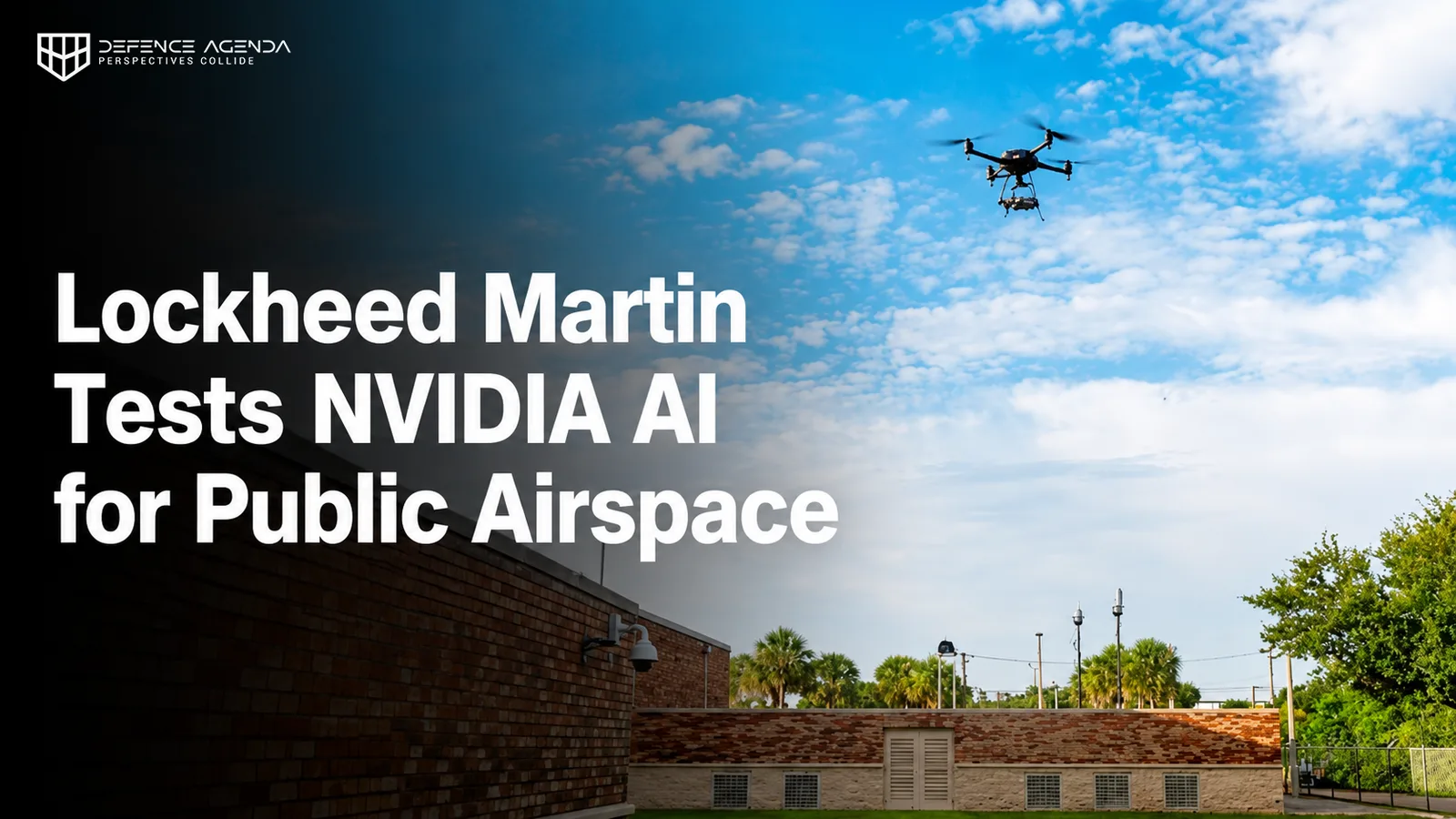
Lockheed Martin public airspace protection technology is moving deeper into the civilian security environment as the company and industry partners demonstrate an AI-enabled architecture using NVIDIA technology to improve detection and tracking of unauthorised drones.
UAS Vision reported on 14 August 2026 that Lockheed Martin and partners had demonstrated technology for protecting public airspace with NVIDIA technology. The development fits into a wider Lockheed Martin effort combining AI, distributed sensors, commercial communications infrastructure and counter-UAS command-and-control for venues, critical infrastructure and other complex low-altitude environments.
The significance is that counter-UAS is moving beyond military bases and battlefield air defence. Stadiums, airports, ports, power infrastructure and cities increasingly need systems capable of distinguishing legitimate drones from unauthorised aircraft without disrupting the wider communications and aviation environment around them.
Key Facts
- Development: Lockheed Martin and partners demonstrated technology aimed at protecting public airspace using NVIDIA technology.
- Mission: Detection, tracking and management of unauthorised or potentially threatening unmanned aircraft in civilian and critical-infrastructure environments.
- AI layer: NVIDIA provides accelerated-computing technologies used by Lockheed Martin across AI development, inference and mission-processing applications.
- Lockheed Martin ecosystem: Existing relevant technologies include NetSense, STAR.UI, STAR.OS and the Sanctum counter-UAS architecture.
- Commercial sensing: NetSense has demonstrated the ability to detect a drone that was not connected to a cellular network by analysing changes in the surrounding 5G RF environment.
- Critical-infrastructure layer: Lockheed Martin is integrating Fortem Technologies radars and autonomous DroneHunter interceptors into Sanctum.
- Deployment challenge: Civil counter-UAS systems must operate within FAA airspace-safety requirements and avoid interference with legitimate aviation, communications and navigation systems.
Public Airspace Is Becoming a Counter-UAS Mission
The rapid spread of small commercial drones has created an air-security problem that differs significantly from conventional military air defence.
A fighter aircraft, cruise missile or large military UAV presents a relatively clear threat category. A small drone flying near a stadium, airport or power facility may instead be a recreational aircraft, authorised commercial platform, police system, media drone or potential security threat.
The first challenge is therefore identification rather than immediate interception.
Security authorities need enough situational awareness to detect an aircraft, establish where it is going, determine whether it is authorised and then decide whether intervention is required.
Artificial intelligence and multi-sensor fusion are increasingly being used to accelerate that process.
Lockheed Martin Has Already Demonstrated 5G Drone Detection
One of Lockheed Martin’s most relevant technologies is NetSense.
On 19 March 2026, Lockheed Martin disclosed a prototype that turns existing commercial cellular infrastructure into an additional drone-detection layer.
The concept uses changes in the radio-frequency environment created by an object moving through signals transmitted between cellular infrastructure and connected devices.
Lockheed Martin said its AI algorithms interpret those changes and generate information indicating whether an object has entered the monitored airspace and where it is moving.
During the demonstration, the detected drone was not connected to the cellular network itself.
That distinction is important because a security architecture cannot assume that a potentially hostile or unauthorised aircraft will cooperate by broadcasting its identity or position.
Existing 5G Infrastructure Could Become a Distributed Sensor Network
The operational attraction of NetSense is infrastructure reuse.
Traditional airspace surveillance requires dedicated sensors such as radar, RF detectors or electro-optical systems. Covering a large urban area with dedicated hardware can become expensive and logistically complex.
Commercial cellular infrastructure already exists across cities, transport corridors and population centres.
If those networks can provide useful secondary sensing data, they could supplement dedicated counter-UAS sensors without requiring a new radar installation at every location.
Lockheed Martin says NetSense uses existing 5G towers and commercial devices as part of the sensing architecture and is being developed with large-scale deployment in mind.
The Telecommunications Industry Is Moving in the Same Direction
Lockheed Martin is not alone in exploring cellular networks as airspace sensors.
In July 2026, AT&T and Ericsson demonstrated drone detection outside AT&T Stadium in Arlington, Texas, using 5G-based integrated sensing and communications.
Ericsson used multiple radio sites to create a multistatic sensing configuration capable of detecting, locating and tracking drones in authorised airspace around the stadium.
The wider technology trend is known as Integrated Sensing and Communication, or ISAC. Future cellular networks are increasingly expected to provide both communications and environmental sensing.
For counter-UAS, this creates the possibility of turning telecommunications infrastructure into a large-area early-warning layer.
NVIDIA Provides the AI Computing Layer
The latest demonstration also highlights the growing role of NVIDIA technology inside defence and public-safety sensing architectures.
NVIDIA’s public-sector portfolio includes accelerated computing for radar and signal processing, autonomous machines, edge AI and real-time inference.
NVIDIA identifies drones and other autonomous systems as a major federal AI use case, with Jetson providing onboard AI computing and its broader accelerated-computing stack supporting signal processing and high-volume sensor analysis.
Lockheed Martin and NVIDIA also have a much broader technology relationship extending beyond counter-UAS.
Lockheed Martin’s internal AI Factory uses NVIDIA DGX SuperPOD infrastructure for AI training and inference, while the companies have collaborated on hardened inference software, digital twins and public-sector AI applications.
AI at the Edge Matters for Drone Defence
Drone detection creates a real-time computing problem.
A security system may receive simultaneous data from radar, cellular sensing, electro-optical cameras, RF sensors and other inputs.
Sending all raw data to a distant data centre before making a decision can introduce latency and increase network requirements.
Edge computing moves more processing close to the sensor.
This can allow AI models to classify objects, correlate tracks and prioritise alerts before transmitting only the most operationally relevant information to a command centre.
That architecture is particularly useful when a security operator must distinguish a small drone from birds, aircraft, ground clutter or other objects within seconds.
STAR.UI Turns Sensor Data Into Operator Decisions
Lockheed Martin’s NetSense demonstration also used STAR.UI to display mission-relevant information.
STAR.UI is part of the company’s STAR.OS software ecosystem and provides visualisation and AI-agent functionality for mission applications.
For public-airspace security, the user interface is not a secondary issue.
Operators may be monitoring several sensors while simultaneously coordinating with law enforcement, aviation authorities, venue security and emergency services.
An AI-enabled interface can help reduce that workload by correlating data and presenting the operator with a smaller number of relevant tracks and alerts.
Sanctum Adds the Counter-UAS Battle-Management Layer
Detection alone does not complete the counter-UAS architecture.
Lockheed Martin’s wider solution is Sanctum, a modular counter-UAS ecosystem designed to integrate different sensors and effectors through one battle-management layer.
The company describes Sanctum as an AI-enabled architecture capable of combining radar, software, electronic-warfare systems and kinetic effectors according to customer requirements.
In June 2026, Lockheed Martin demonstrated the architecture against a Group 3 one-way attack UAV at Yuma Proving Ground.
Public-Airspace Protection Requires a Different Effector Strategy
The Yuma demonstration illustrates military point defence, but protecting civilian airspace creates different constraints.
Firing a missile at a drone may be appropriate over a military test range but generally unsuitable above a stadium or densely populated city.
Authorities therefore need responses tailored to environment and legal authority.
Options can include continued monitoring, law-enforcement intervention, electronic measures where legally authorised, controlled capture or specialised interceptor drones designed to minimise collateral effects.
This makes accurate classification particularly important. The system must provide enough confidence for authorities to determine whether an aircraft represents a genuine threat before escalating the response.
Fortem Provides a Non-Missile Interceptor Layer
Lockheed Martin has been building this lower-collateral counter-UAS layer through Fortem Technologies.
In March 2026, Fortem announced a contract to provide TrueView radars and autonomous DroneHunter interceptors for integration with Sanctum to protect critical infrastructure.
Lockheed Martin subsequently announced a $25 million investment in Fortem on 22 April 2026 to accelerate production and wider deployment of the technology.
Fortem’s DroneHunter uses autonomous flight and a physical capture mechanism rather than a conventional explosive interceptor.
The company says its technology is authorised for drone-on-drone interception in U.S. airspace and has been used for security at military, government and commercial sites.
Civil Airspace Makes Identification as Important as Defeat
The ability to defeat a drone is only part of the problem around public venues.
Legitimate unmanned aircraft are becoming increasingly common for law enforcement, television production, infrastructure inspection, delivery, emergency response and commercial operations.
A scalable public-airspace protection system therefore needs to distinguish authorised traffic from suspicious activity.
This creates a requirement for data fusion across surveillance tracks, Remote ID information, authorised-flight databases and potentially air-traffic or UAS traffic-management systems.
AI can assist with correlation and classification, but engagement authority remains a regulatory and operational issue rather than simply a technical decision.
FAA Compatibility Is a Fundamental Constraint
Counter-UAS systems operating in the United States also have to coexist with the National Airspace System.
Federal law requires coordination between the FAA and relevant security agencies when counter-UAS technologies could affect aviation safety, communications, navigation or air-traffic operations.
This becomes especially important for electronic systems.
A technology intended to interfere with an unauthorised drone cannot be allowed to create unacceptable effects on nearby aircraft, navigation systems, airport radars or communications infrastructure.
This regulatory constraint is one reason detection and precise identification are becoming major investment areas alongside actual defeat technologies.
Existing Infrastructure Could Lower the Cost of Wide-Area Protection
One of the strongest commercial arguments behind technologies such as NetSense is coverage economics.
A dedicated radar may provide excellent local performance, but a city-scale network could require a substantial number of sites.
Using cellular infrastructure as an additional sensing layer creates another model: dedicated high-performance sensors around the most important locations, supplemented by wide-area awareness generated from infrastructure that already exists.
This does not remove the requirement for radar or other specialised sensors. Lockheed Martin’s own Sanctum architecture demonstrates the continued importance of those systems.
Instead, commercial infrastructure can potentially extend coverage and cue more specialised sensors toward areas requiring closer examination.
The Counter-UAS Market Is Moving Toward Sensor Fusion
The broader market is increasingly moving away from stand-alone drone detectors.
Radar provides range and tracking but can struggle with very small targets and clutter. Passive RF sensors can identify some communications links but may be ineffective against autonomous aircraft that are not transmitting. Electro-optical systems can provide visual identification but require line of sight.
Combining those sensors produces a more resilient picture than relying on one technology.
Defence Agenda’s analysis of the connected battlespace highlights the same architecture at military scale: AI-driven data fusion becomes valuable when it removes duplicate tracks, correlates independent sensors and presents operators with one coherent operational picture.
Counter-UAS Is Also Moving Toward Autonomous Effectors
The interceptor layer is evolving alongside sensing.
Defence Agenda has examined several approaches, including the STM TUNGA-X interceptor drone and Rafael’s Hunter Eagle and Ghost Hunter counter-UAS systems.
These systems demonstrate a broader shift toward using autonomous aircraft to intercept other autonomous aircraft.
For public spaces, recoverable or controlled-capture interceptors may have particular relevance because they can potentially reduce falling debris compared with missile-based engagement.
That does not make them risk-free. Safe interception still depends on target size, flight path, crowd density and the ability to control where both aircraft end the engagement.
The Main Opportunity Is Airspace Awareness as a Service
Lockheed Martin has described NetSense through an eventual “situational awareness as a service” model.
This could change how counter-UAS capability is purchased.
Instead of every stadium, municipality or infrastructure operator purchasing an independent set of sensors, users could subscribe to an airspace-awareness service built around shared commercial infrastructure and cloud-hosted analytics.
Dedicated sensors and effectors could then be added where threat levels justify them.
The result would resemble a layered security service rather than a conventional stand-alone air-defence battery.
The Main Risk Is False Identification
The biggest operational risk is not necessarily failure to detect a drone.
It is incorrectly classifying legitimate activity as a threat or failing to identify a genuinely hostile aircraft inside a crowded air picture.
Public environments contain birds, helicopters, commercial aircraft, authorised drones and numerous RF emitters.
AI models therefore need extensive validation across different environments, weather conditions, aircraft types and threat behaviours.
The acceptable false-alarm rate for a battlefield sensor may also be very different from that of a system intended to operate continuously around a major airport or city.
Public Airspace Security Is Becoming a Major Defence-Tech Market
The commercial opportunity is expanding as drone use grows around major events, airports, energy infrastructure and cities.
Fortem already markets airspace-security technology to commercial and government customers, while Lockheed Martin explicitly identifies public venues and critical infrastructure as Sanctum use cases.
At the same time, telecom operators are experimenting with network sensing, AI-chip companies are expanding edge-processing capabilities and governments are widening counter-UAS authorities.
This convergence is creating a market that sits between traditional defence, telecommunications, public safety and aviation technology.
Implications / Next
The first milestone to watch will be disclosure of detailed results from Lockheed Martin’s latest public-airspace protection demonstration, including the precise partner roles, sensor architecture and NVIDIA technologies used.
The second will be NetSense testing at major U.S. events. Lockheed Martin said in March 2026 that it planned operationally relevant, at-scale trials later in the year.
The third is integration between wide-area sensing and Sanctum. Detecting a drone through commercial infrastructure becomes considerably more useful if that track can be passed automatically into an operational counter-UAS command system.
Fortem deployment will provide another indicator. Lockheed Martin’s investment and existing infrastructure-protection agreement show that autonomous interception is becoming an increasingly important part of the wider architecture.
Finally, regulatory approval will determine how far the concept can scale. Public-airspace protection ultimately depends not only on whether the technology works but also on whether it can operate safely alongside civilian aviation and communications infrastructure.
Conclusion
Lockheed Martin’s public-airspace protection work shows how the counter-UAS problem is shifting from a military point-defence requirement into a much broader infrastructure-security challenge.
The emerging architecture combines several technology layers: commercial-network sensing, dedicated radar, AI-based classification, accelerated computing, mission management and a choice of kinetic or non-kinetic responses.
NVIDIA technology adds the high-performance computing layer required to process increasingly large sensor-data streams and deploy AI closer to the edge, while Lockheed Martin provides the integration architecture connecting detection to operational decision-making.
The strongest element of the concept may ultimately be infrastructure reuse. If 5G networks and other existing systems can contribute useful airspace sensing, authorities could expand coverage without building a dedicated radar network across every city or public venue.
The harder challenge will be ensuring that AI can distinguish real threats from legitimate drone activity with sufficient confidence to support security decisions in crowded civilian environments.
That makes public-airspace counter-UAS less a question of finding one new interceptor and more a question of building an intelligent, distributed and legally deployable airspace-awareness architecture.
For further Defence Agenda coverage, read our analysis of the Connected Battlespace, STM TUNGA-X interceptor UAV, Rafael Hunter Eagle and Ghost Hunter and ASELSAN’s Steel Dome counter-UAS layer.
Further Reading
- UAS Vision: Lockheed Martin and partners demonstrate public-airspace protection technology with NVIDIA
- Lockheed Martin: Developing 5G-Enabled Drone Detection with NetSense
- Lockheed Martin: Sanctum Counter-UAS Architecture
- Lockheed Martin: $25M Investment in Fortem Technologies
- NVIDIA: AI for the U.S. Federal Government
- Defence Agenda: Connected Battlespace — A New Era in Networked Warfare
- Defence Agenda: STM TUNGA-X Drone Debuts
- Defence Agenda: ASELSAN Steel Dome Adds New C-UAS Layer