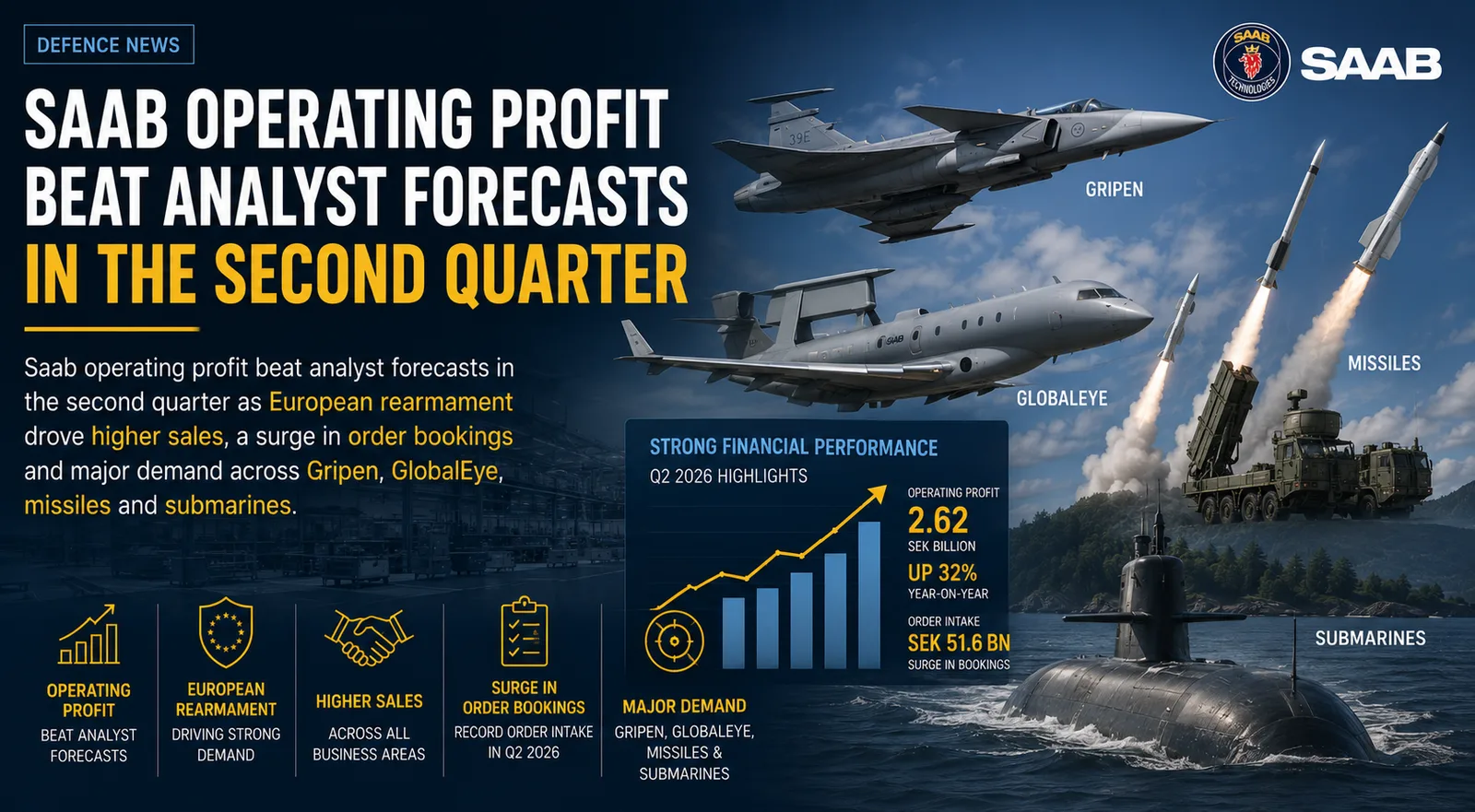
Saab operating profit beat analyst forecasts in the second quarter as defence demand continued to accelerate across Europe and other allied markets.
According to Reuters, the Swedish defence and aerospace group reported operating earnings of SEK 2.79 billion, above the SEK 2.48 billion mean forecast in an LSEG poll of analysts. Reuters said the result was driven by booming demand, higher sales and a sharp increase in order bookings.
Saab’s own Q2 results showed order bookings of SEK 68.393 billion, sales of SEK 25.453 billion and organic sales growth of 29.8%. EBIT rose 41% to SEK 2.794 billion, with an EBIT margin of 11.0%.
The quarter also included the booking of a SEK 47 billion order for A26-type submarines for Poland. That contract underlines how Saab’s growth is no longer only about aircraft. Demand now spans naval systems, missiles, sensors, command-and-control and advanced electronics.
Saab Operating Profit Reflects Europe’s Rearmament Cycle
The Saab operating profit beat reflects a wider structural shift in European defence. Governments are increasing military budgets, rebuilding inventories and seeking systems that can be delivered at scale.
Russia’s war in Ukraine has accelerated demand for air defence, combat aircraft, munitions, surveillance systems and naval capabilities. Saab is well positioned in many of these areas because its portfolio covers both high-end platforms and critical subsystems.
The company’s results therefore point to more than a single strong quarter. They show how European rearmament is turning into revenue, order intake and production pressure for suppliers with relevant capacity.
Order Bookings Surge on Major Defence Contracts
Order bookings were the clearest signal in the quarter. Saab reported SEK 68.393 billion in Q2 order bookings, compared with SEK 28.403 billion in the same period a year earlier.
The Poland submarine contract was the largest driver. The A26 order gives Saab a major naval programme in Europe and strengthens its position in the undersea warfare market.
This matters because undersea capabilities are gaining importance in the Baltic Sea and wider European theatre. Submarines support deterrence, intelligence gathering, sea denial and protection of critical maritime infrastructure.
Gripen Opportunities Add Airpower Momentum
Gripen remains central to Saab’s strategic profile. Reuters reported that Saab is set to produce new Gripen E fighters for Ukraine if the relevant deal is finalised, while Brazil could add 20 more aircraft to its existing fleet.
Gripen’s appeal is linked to cost, availability and operational flexibility. For countries that need modern combat aircraft without the full cost structure of larger fleets, Gripen can offer an attractive balance of capability and lifecycle affordability.
The aircraft also gives Saab a role in the wider European debate on future combat air. As European fighter programmes face industrial and political complexity, Saab could become an important partner for countries seeking alternative or complementary combat-air options.
GlobalEye Demand Strengthens the Surveillance Portfolio
Saab’s GlobalEye surveillance aircraft is also gaining momentum. Reuters reported that NATO plans to buy up to 10 GlobalEye aircraft, while Canada has also moved toward buying a fleet of the platform.
GlobalEye is important because modern defence operations depend on persistent surveillance and command-and-control. Airborne early warning and surveillance aircraft help detect threats, manage airspace and support joint operations across land, sea and air.
Demand for systems like GlobalEye is likely to grow as NATO countries improve situational awareness on the Eastern Flank and strengthen integrated air and missile defence networks.
Production Capacity Becomes the Main Constraint
Saab’s strong results also highlight a key challenge: capacity. Demand is rising quickly, but defence companies must convert orders into deliveries without losing margin discipline or programme quality.
Saab said it remains focused on capacity expansion, high delivery volumes and technological innovation. This is now a common theme across the defence sector. The market opportunity is large, but execution depends on supply chains, skilled labour, testing capacity and production investment.
For customers, production speed is becoming as important as technical performance. Governments need systems that can be delivered in operationally relevant timelines, not only promised in future roadmaps.
Saab’s Portfolio Fits NATO’s Capability Priorities
Saab’s product mix matches several NATO priorities. Gripen addresses combat air requirements. GlobalEye supports airborne surveillance. A26 submarines contribute to undersea deterrence. Missiles, electronics and command-and-control systems support wider air-defence and joint-force architectures.
This broad portfolio gives Saab strategic depth. It can benefit from multiple procurement cycles at once rather than relying on a single platform market.
It also strengthens Sweden’s role in European defence industry after joining NATO. Saab is now both a national champion and an increasingly important allied supplier.
Investor Confidence Tracks Defence Demand
Reuters noted that Saab shares rose after the results. The market reaction reflects investor confidence that defence demand is translating into earnings growth and order momentum.
However, the next phase will be harder. Defence groups must manage inflation, supplier bottlenecks, workforce shortages and government procurement complexity. Strong orders are valuable only if they can be converted into profitable deliveries.
Saab’s Q2 results suggest the company is managing that transition well, but the scale of demand will continue to test execution.
Conclusion
The Saab operating profit beat shows how European rearmament is reshaping the defence-industrial landscape. Higher budgets are now flowing into orders, sales and margin improvement for companies with relevant systems and expanding capacity.
For Saab, the key growth drivers are clear: submarines for Poland, Gripen opportunities, GlobalEye demand, missile systems, sensors and a broader NATO push for readiness. The company’s challenge is to scale production while protecting quality and profitability.
If Saab continues to convert order momentum into deliveries, it could become one of Europe’s most strategically important defence suppliers in the current rearmament cycle.
For further Defence Agenda coverage, read our defence industry, aerospace and naval warfare sections. Related analysis includes Farnborough Airshow 2026 and defence demand, the UK Storm Fighter CCA programme and Europe’s deep precision strike initiative.