The Partnership Connects Vessel Design With Classification From the Start
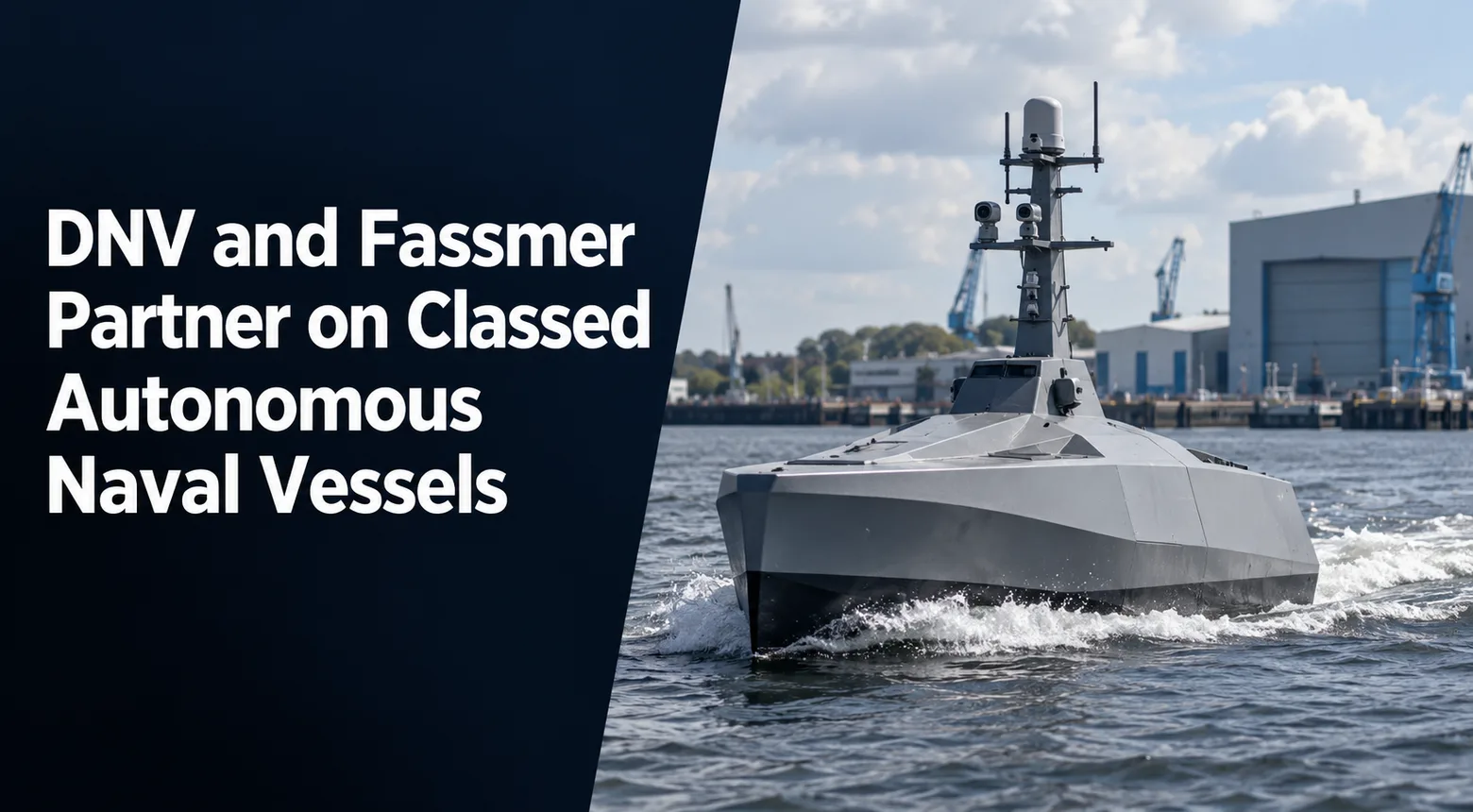
DNV and German shipbuilder Fassmer have signed a memorandum of understanding to jointly develop and classify autonomous and remotely operated vessels for naval and government customers. Announced on 8 September 2026, the cooperation is designed to apply DNV’s Autonomous and Remotely Operated Ships, or AROS, framework to Fassmer’s growing portfolio of unmanned vessel concepts. The partners plan to review concepts of operation, test enabling technologies and build a roadmap toward certification, including an Approval in Principle for a vessel design.
The significance is that autonomy is being treated as a ship-assurance problem rather than only a software feature. Naval unmanned programmes often demonstrate navigation, sensing or remote control successfully before confronting questions about failure modes, machinery control, cybersecurity, watchkeeping, communications loss and emergency behaviour. Bringing a classification society into the design process can force those requirements to be addressed earlier, reducing the gap between a technology demonstrator and a vessel that a government customer can accept into regular service.
AROS Provides a Framework for Safety and Operational Assurance
DNV introduced its AROS notations to establish requirements for autonomous navigation, engineering systems, operational control and safety. For naval users, class approval does not replace military certification or combat-system acceptance, but it can provide a common technical baseline for hull, machinery and autonomy assurance. That is particularly useful for government customers that want to integrate mission payloads onto a vessel while relying on an independent framework for the underlying platform and control architecture.
The key challenge is loss of communications. A remotely operated vessel must behave predictably if its control link is degraded, while a more autonomous craft needs validated logic for collision avoidance, mission continuation, abort and return. Those behaviours interact with propulsion, electrical power, sensors and cybersecurity, meaning software assurance cannot be separated from ship design. Fassmer and DNV’s cooperation is therefore aimed at system-level assurance rather than only navigation algorithms.
Europe’s Uncrewed Maritime Market Is Moving Toward Industrialisation
The MoU arrives as European navies increase investment in unmanned surface and underwater systems for surveillance, mine warfare, anti-submarine missions, logistics and distributed sensing. Commercial autonomy companies are also building manufacturing capacity in Europe, while shipyards are looking for ways to combine naval construction expertise with faster-moving software and robotics ecosystems. Fassmer’s participation is a sign that established shipbuilders increasingly view unmanned vessels as a durable product category rather than a niche experiment.
For DNV, the market opportunity is standardisation. If AROS or similar frameworks become accepted across multiple fleets, suppliers can design around common assurance requirements instead of creating an entirely new safety case for every customer. That could reduce integration time and make export programmes easier, although military users will still impose national security, combat-survivability and mission-system requirements beyond civil classification.
Implications / Next
The next milestone is the Approval in Principle referenced by the partners, followed by a named vessel design, prototype or customer programme. An AiP would show that the design concept has been reviewed against the selected rules, but it would still not equal final class certification or operational acceptance. Sea trials, autonomy testing and customer-specific integration would remain necessary.
If the partnership produces a classable design that can be adapted for several missions, Fassmer could offer government customers a lower-risk entry into autonomous naval operations. A repeatable approval pathway could also shorten later export campaigns by giving procurement authorities a clearer technical baseline before mission-system integration begins. The broader implication is that the competitive advantage in unmanned maritime systems is shifting from standalone autonomy software toward complete, certifiable platforms that combine ship engineering, sensors, communications, control and lifecycle support.