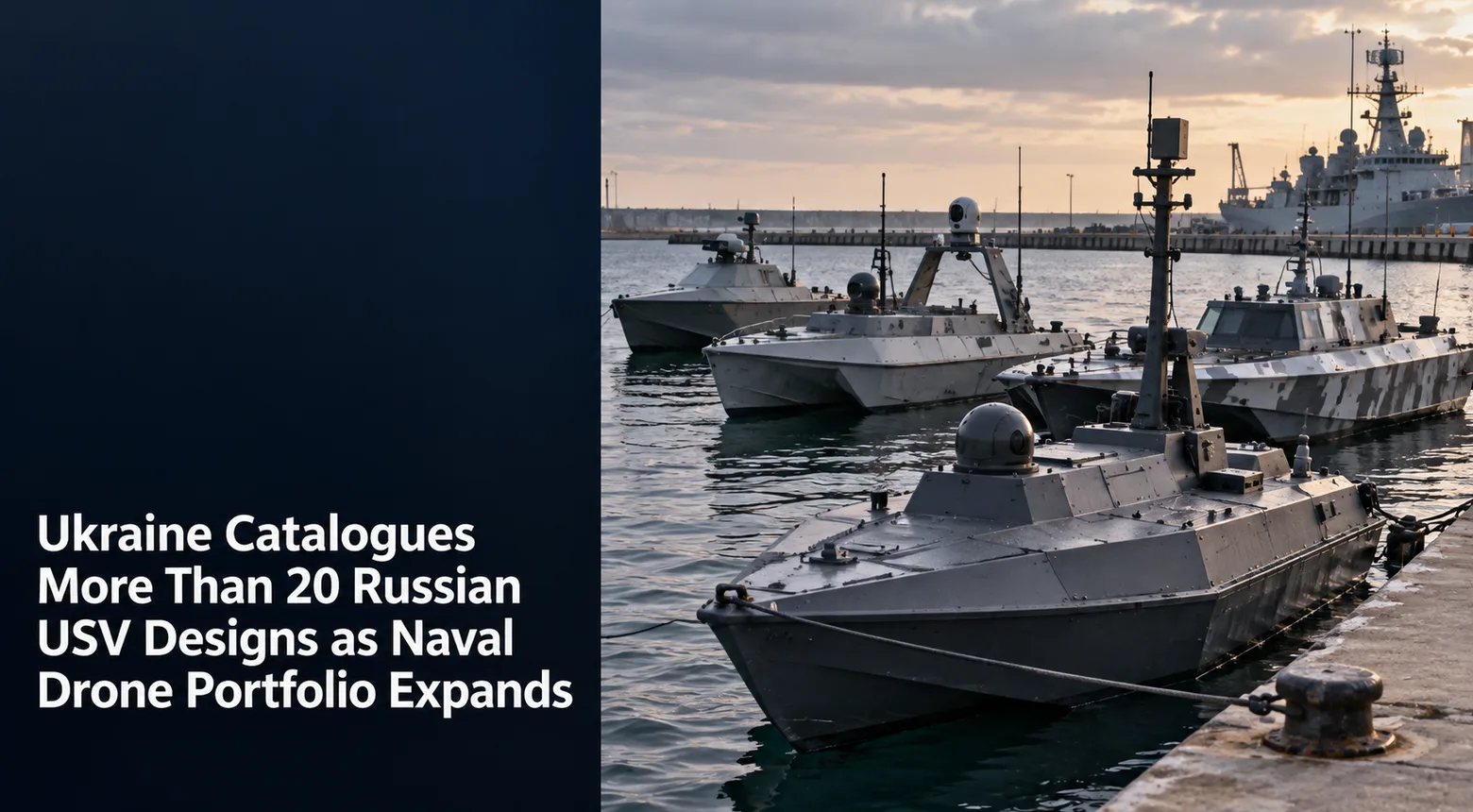
Ukraine’s Defence Intelligence has published a catalogue identifying more than 20 Russian uncrewed surface-vessel designs and projects, offering one of the clearest public views yet of Moscow’s effort to build a broader maritime-drone portfolio. The 25 August 2026 intelligence release lists systems including Skanda, Iskatel, Farvater, Trizubets, Vizir, Murena-300s and BEK-1000, while subsequent reporting has highlighted mine-warfare, logistics, reconnaissance and strike-related concepts across the set.
The catalogue is significant because Russia entered the Black Sea drone contest later and under different operational pressures than Ukraine, whose one-way attack USVs have received more public attention. A larger Russian design ecosystem suggests that Moscow is treating uncrewed boats not merely as a countermeasure to Ukrainian tactics but as a family of capabilities with potential roles in harbour defence, mine operations, cargo movement, surveillance and offensive missions.
Key Facts
- Ukrainian Defence Intelligence published its Russian USV catalogue on 25 August 2026.
- The catalogue identifies more than 20 named or distinct uncrewed-surface-vessel projects.
- Examples include Skanda, Iskatel, Farvater, Trizubets, Vizir, Murena-300s and BEK-1000.
- Ukrainian reporting says Russian 2026 production could exceed 150 craft, with state procurement potentially reaching about 230; these are Ukrainian estimates.
- The portfolio spans mine-warfare, logistics, reconnaissance and strike-related concepts.
- Programme maturity varies substantially across the designs, so catalogue inclusion should not be equated with serial production or operational fielding.
Ukraine exposes a broad Russian maritime-drone development base
The development is best assessed as a programme milestone rather than a complete operational endpoint. The verified evidence establishes the event described above, while subsequent procurement, integration, readiness or fielding claims require their own confirmation as the programme advances. That distinction is important for comparing announcements across defence programmes, where testing, production, delivery and operational acceptance are separate maturity stages with different evidentiary thresholds.
Industrial scale is growing, but maturity varies by design
Ukrainian reporting citing intelligence assessments says Russian production could exceed 150 USVs during 2026 and that state procurement could potentially reach around 230 craft. Those figures are estimates from the Ukrainian side rather than independently audited Russian procurement data, and they should therefore be treated as indicators of possible scale rather than confirmed deliveries. The intelligence material also points to development priorities including domestic components, more resilient communications, artificial-intelligence functions and longer operational range.
Equally important, a catalogue of projects is not the same as a catalogue of fielded systems. Some entries may be demonstrators, prototypes or limited-production craft, while others may exist primarily as industrial proposals. Sanctions, access to specialised electronics, secure satellite communications and reliable marine propulsion can all slow the transition from design to repeatable serial production, particularly for systems expected to operate beyond line of sight in a contested electronic environment.
Operational implications extend beyond one-way attack boats
The portfolio’s apparent emphasis on mine warfare and logistics is strategically relevant because these missions can impose persistent burdens without requiring the same terminal-guidance performance as a precision strike. An expendable or low-cost USV can deliver mines, tow sensors, move supplies or act as a decoy, allowing a navy to distribute tasks that would otherwise consume crewed patrol craft. In confined seas, even modest numbers can complicate harbour protection, route clearance and force-protection planning.
For Western and regional navies, the lesson is that counter-USV demand will not be limited to defeating fast explosive boats. Detection, classification, electronic warfare, remote weapon stations, helicopters, uncrewed interceptors and mine-countermeasure systems may all be required against different vessel types. The next useful evidence will be confirmed Russian contracts, serial-production lines, unit-level deliveries and operational deployments that show which of the more than 20 concepts are becoming sustainable military capabilities.
Implications / Next
The next publication-grade milestone will be the first independently verifiable step that moves the programme beyond the status described here—such as a follow-on test, formal contract action, delivery, operational deployment or completed transaction, depending on the story. Defence Agenda will treat each maturity stage separately and will not infer production, operational capability or procurement completion from an earlier demonstration or announcement. The most useful follow-up evidence will therefore be dated official documentation, customer acceptance, serial-production data or operational activity that can be cross-checked against the current record.