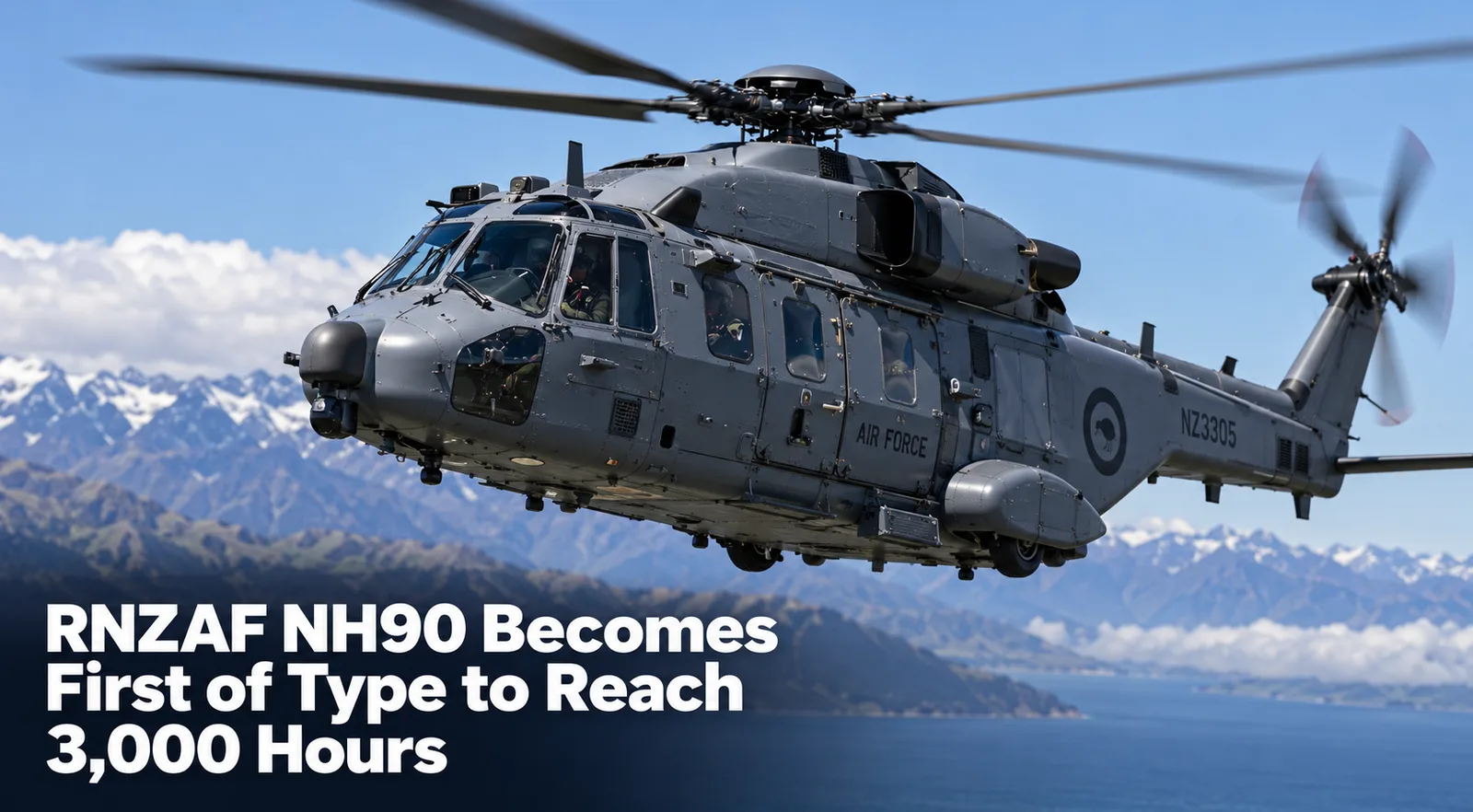
A Royal New Zealand Air Force NH90 has become the first aircraft of the type to exceed 3,000 flight hours. The New Zealand Defence Force announced the milestone on 7 September 2026, while Airbus identifies the aircraft as TNZA002 and dates the actual threshold crossing to 26 August. The helicopter was conducting a routine test flight from RNZAF Base Ohakea when the airframe passed the mark.
TNZA002 Sets a Type-Wide Flight-Hour Record
The achievement is not a new procurement or upgrade milestone. It is a utilisation and sustainment indicator that reflects how intensively New Zealand has operated a small fleet. No. 3 Squadron’s eight NH90s have together accumulated more than 20,000 flying hours, giving the service an unusually high level of experience with the platform relative to fleet size.
High Utilisation Depends on Maintenance Planning as Much as Aircrew Demand
NZDF attributes the record to maintainers, supply-chain personnel and fleet planners as well as flying crews. The service says detailed maintenance planning is used to maximise availability without allowing current flying to damage future readiness. That balance is difficult for small fleets because a major inspection or parts shortage can remove a large percentage of total capacity at once.
New Zealand’s operational pattern includes troop transport, search and rescue, humanitarian assistance and disaster relief. The fleet has supported responses to the Kaikōura earthquake and Cyclone Gabrielle and has conducted long over-water movements in the Pacific. Those missions place different stresses on the aircraft from short training sorties and help explain why sustainment discipline is central to the 3,000-hour milestone.
The Record Offers a Useful Counterpoint to Wider NH90 Availability Debates
The NH90 family has experienced differing readiness outcomes among operators, with some countries restructuring fleets or raising concerns about support cost and availability. New Zealand’s experience shows that the type can achieve sustained utilisation when maintenance, logistics and operational planning are closely managed. It does not mean every operator can reproduce the same result because fleet configurations, climates, mission sets and support contracts differ.
Airbus works alongside the RNZAF maintenance organisation, and the partnership provides a long-term knowledge base around the aircraft. The broader lesson is that platform performance cannot be assessed solely from design specifications. Availability is a system outcome involving spares, engineering authority, technicians, training and scheduling.
Future Fleet Decisions Will Determine How Long the Record Keeps Growing
New Zealand introduced the NH90 in 2011, so the fleet is now well into its service life. The 3,000-hour milestone shows that individual airframes can accumulate substantial utilisation, but it also means fatigue management and long-term support planning will become more important as hours continue to rise. Decisions on upgrades, structural life and eventual replacement will increasingly shape fleet economics.
The next meaningful indicators are availability rates, additional high-hour aircraft, major upgrade decisions and any change to the eight-aircraft force structure. For now, TNZA002’s record is best understood as evidence of sustained operational use and maintenance performance rather than a statement about a new capability entering service.
A further programme-management issue is the relationship between the announced milestone and the supporting infrastructure needed to turn it into repeatable capability. Training, maintenance, software configuration, supply-chain availability and acceptance standards can all become schedule drivers after the public announcement. For that reason, Defence Agenda will track follow-on evidence from the customer, supplier and relevant government authority rather than treating the initial milestone as the end of the acquisition cycle.
Implications / Next
The next Defence Agenda update should be tied to a dated, independently verifiable event that changes programme maturity: a delivery, exercised option, completed test, production milestone, operational acceptance or new contract action. Until that occurs, the current announcement should remain the baseline and should not be extrapolated into undisclosed quantities, performance or fielding status.