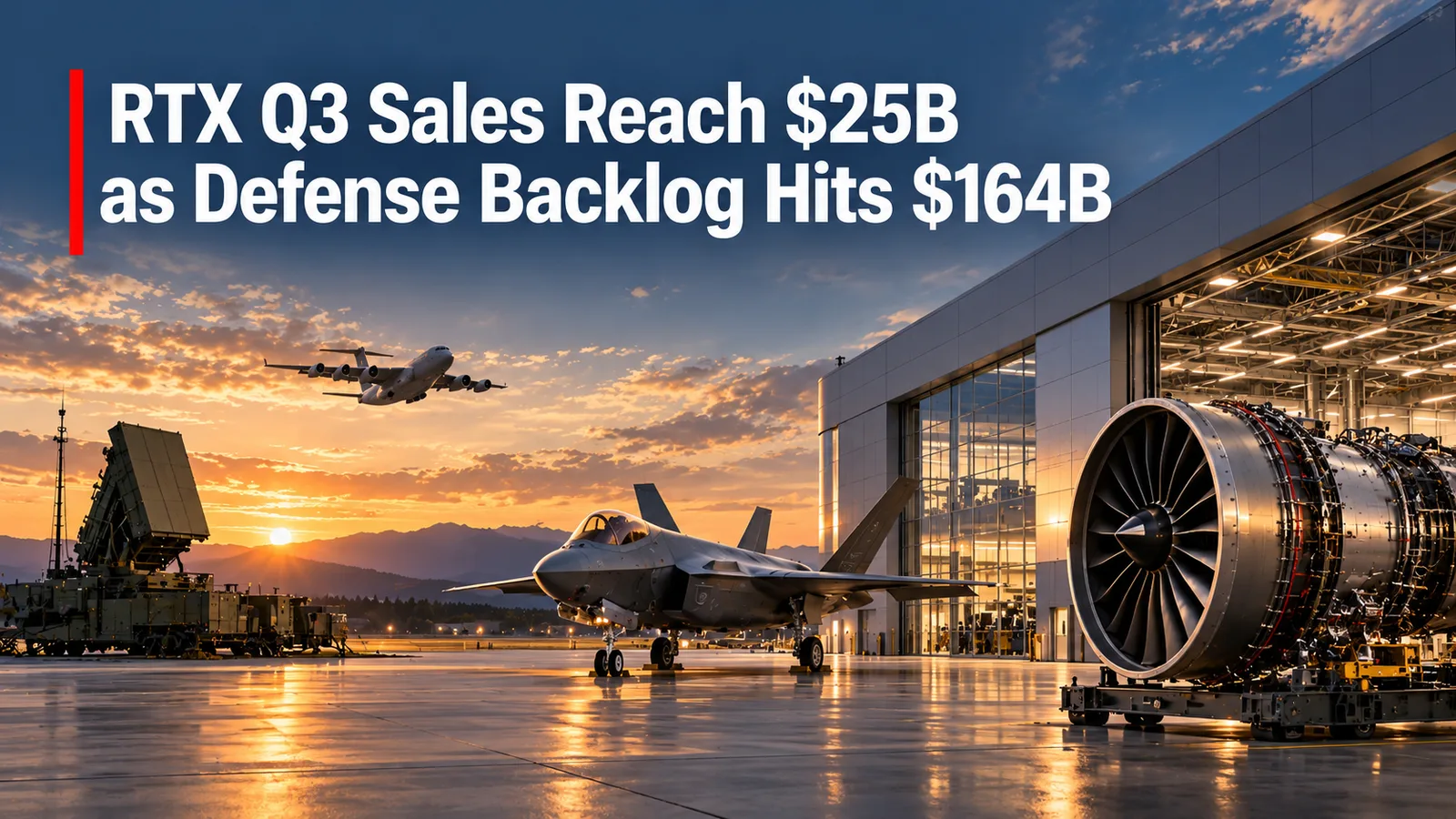
RTX reported USD 25.0 billion in third-quarter 2026 sales and a record USD 340 billion order backlog, including USD 164 billion in defence business. The US aerospace and defence group said on 20 October that revenue increased 11% from a year earlier, while its Raytheon division recorded 14% sales growth as demand for naval, land and air-defence programmes remained strong. The results also highlighted a distinction between rising earnings and cash generation: free cash flow fell sharply from the same quarter of 2025.
The USD 164 billion defence backlog is an RTX-wide figure, not Raytheon's standalone backlog. The remaining USD 176 billion of the group's USD 340 billion total relates to commercial business. Backlog represents contracted future work subject to delivery schedules and contractual conditions; it is not revenue already earned or cash received. RTX's official Q3 statement sets out the reported figures and the accompanying full-year outlook.
Key Facts
- 20 October 2026: RTX announced results for the three months ended 30 September 2026.
- Group sales: USD 24.965 billion, up 11% from USD 22.478 billion in Q3 2025; RTX reported 12% organic sales growth under its non-GAAP definition.
- Backlog: A record USD 340 billion — USD 164 billion defence and USD 176 billion commercial, across RTX rather than Raytheon alone.
- Raytheon sales: USD 8.031 billion, up 14% year on year; reported operating profit rose 32% to USD 1.133 billion.
- Adjusted EPS: USD 2.26, up 33%, including USD 0.25 from IEEPA cost recovery; GAAP EPS was USD 1.89.
- Cash generation: Operating cash flow was USD 2.868 billion and non-GAAP free cash flow was USD 2.119 billion, down 38% and 47% year on year, respectively.
- Raised guidance: RTX now projects full-year 2026 adjusted sales of USD 97.0–97.5 billion, adjusted EPS of USD 7.65–7.75 and free cash flow of USD 9.0–9.2 billion.
RTX's $25 Billion Quarter: Growth Across Three Businesses
RTX's reported quarterly sales reached USD 24.965 billion, compared with USD 22.478 billion a year earlier. Reported net income attributable to common shareholders increased to USD 2.583 billion, from USD 1.918 billion, while GAAP diluted earnings per share rose to USD 1.89 from USD 1.41. Adjusted earnings per share, a non-GAAP metric that excludes specified items, increased to USD 2.26 from USD 1.70. All these figures come from the company's 20 October results release.
The three operating segments together recorded USD 25.644 billion of sales. Consolidated revenue was lower because RTX accounts for USD 679 million in eliminations and other adjustments between its businesses. The distinction matters: simply adding Collins Aerospace, Pratt & Whitney and Raytheon revenue without eliminating intercompany activity would overstate the consolidated total.
| Business | Q3 2026 sales | Year-on-year sales change | Reported operating profit | Adjusted operating profit* |
|---|---|---|---|---|
| Collins Aerospace | $8.382bn | +10% | $1.789bn | $1.788bn |
| Pratt & Whitney | $9.231bn | +10% | $0.608bn | $0.968bn |
| Raytheon | $8.031bn | +14% | $1.133bn | $1.134bn |
| RTX consolidated | $24.965bn | +11% | Not equal to segment sum | Not equal to segment sum |
Adjusted operating profit is a non-GAAP measure. The three segment figures are shown for comparison, not as consolidated operating profit. Figures are rounded from RTX's release and SEC-filed results exhibit.
Raytheon Growth: Patriot, Standard Missile and Tomahawk
Raytheon recorded USD 8.031 billion in quarterly sales, up 14% from USD 7.045 billion in the prior-year period. RTX attributed the increase to higher volumes on naval programmes and land and air-defence systems, specifically citing Patriot, Standard Missile and Tomahawk. Raytheon's reported operating profit reached USD 1.133 billion, up 32%, and its reported operating margin increased from 12.2% to 14.1%.
The operating-profit improvement reflected net productivity gains, higher volumes and a favourable sales mix, including Patriot programmes, according to RTX. The company also identified approximately USD 85 million of productivity benefits relating to an international contract modification and an offset-obligation adjustment. Those benefits are not automatically recurring production gains and should not be read as evidence that every additional programme will earn the same margin.
RTX said it was awarded multi-year undefinitized production contracts for Tomahawk and AMRAAM during the third quarter. The company's Q3 highlights did not provide separate final values or delivery quantities for those two arrangements. “Undefinitized” means contractual scope or pricing has not been fully finalised; the announcement should not be interpreted as a statement that all future missile deliveries have already taken place.
For comparison with programme-level developments reported separately by Defence Agenda, see the recent coverage of Raytheon's $6.3 billion SM-3 Block IB agreement and Patriot demand in Europe. These are distinct awards and should not be summed as though they represent new Q3 revenue.
Collins and Pratt & Whitney Add Commercial and Defence Exposure
Collins Aerospace generated USD 8.382 billion in sales, up 10% year on year, with 12% organic growth after excluding divestitures. RTX said its commercial original-equipment activity rose 23%, commercial aftermarket increased 9% and defence sales rose 7%. The company linked the improvement in Collins' adjusted operating profit — up 50% to USD 1.788 billion — to higher commercial volumes and mix, as well as approximately USD 250 million in IEEPA recovery.
Pratt & Whitney recorded USD 9.231 billion in sales, a 10% increase. Commercial aftermarket activity rose 21%, while military sales grew 2% and commercial original-equipment sales declined 5%. Its reported operating profit fell 19% to USD 608 million, in part reflecting a USD 363 million charge related to a customer bankruptcy. The segment's adjusted operating profit instead increased 29% to USD 968 million and included approximately USD 160 million of IEEPA recovery.
This gap between reported and adjusted measures is important when judging industrial momentum. The aftermarket expansion supports engine maintenance and overhaul demand, but reported profitability also reflects one-off and legal or contractual factors. Pratt & Whitney's F135 Engine Core Upgrade design-review milestone is another example of long-term programme work whose progress cannot be inferred solely from a single quarter's sales.
$340 Billion Backlog: What It Says — and What It Does Not
RTX reported a record USD 340 billion backlog, split between USD 176 billion in commercial business and USD 164 billion in defence. Chief executive Chris Calio also referred to more than USD 81 billion of new commercial and defence awards in the company's results announcement. The report does not establish that the entire backlog will be converted to revenue in any one year, or how much of the total will be delivered in the next quarter.
A defence backlog is a measure of contracted future demand and programme commitments, not a count of missiles in service or factory output. For missile manufacturers, translating orders into deliveries depends on qualified suppliers, production facilities, material availability, testing, customer acceptance and sustainment capacity. For operators, the relevant question is whether larger order books can produce consistently available interceptors and missiles on the required schedules.
The same distinction applies to exports and counter-drone products. Defence Agenda's report on Raytheon's USD 729 million LIDS counter-drone contracts for the United States, Qatar and Jordan describes separately announced demand; the Q3 results release does not allocate this entire amount to recognised quarterly revenue.
Cash Flow and IEEPA Recoveries Complicate the Earnings Picture
Despite stronger sales and adjusted profits, RTX's operating cash flow dropped 38% to USD 2.868 billion, from USD 4.639 billion a year earlier. Non-GAAP free cash flow fell 47%, to USD 2.119 billion from USD 4.025 billion. The company reported capital expenditure of approximately USD 0.7 billion for the quarter. These reductions are important alongside the record backlog and improved earnings per share: recognised sales and future orders do not automatically translate into higher near-term free cash flow.
RTX also disclosed benefits from IEEPA (International Emergency Economic Powers Act) cost recovery. Approximately USD 0.25 of third-quarter adjusted EPS, around USD 0.4 billion of adjusted segment operating-profit growth and about USD 0.3 billion of operating cash flow were associated with recovery effects, according to the company's disclosures. These amounts refer to different financial measures and should not be added together as a single separate revenue item. IEEPA-related recoveries contributed to the quarter, so the reported growth rate is not a pure measure of underlying recurring production efficiency.
RTX Raises Its 2026 Outlook
After the quarter, RTX increased its outlook for adjusted 2026 sales to USD 97.0–97.5 billion, from USD 95.0–96.0 billion. Its projected organic sales growth rose to 10–11%, from 8–9%; adjusted EPS guidance increased to USD 7.65–7.75, from USD 7.10–7.25; and projected free cash flow rose to USD 9.0–9.2 billion, from USD 8.50–8.75 billion.
| Full-year 2026 metric* | Previous RTX outlook | Updated RTX outlook |
|---|---|---|
| Adjusted sales | $95.0–96.0bn | $97.0–97.5bn |
| Organic sales growth | 8–9% | 10–11% |
| Adjusted earnings per share | $7.10–7.25 | $7.65–7.75 |
| Free cash flow | $8.50–8.75bn | $9.0–9.2bn |
All four guidance measures are non-GAAP or otherwise company-defined. They are forward-looking estimates, not completed full-year results; RTX's release explains why forward-looking GAAP reconciliations are not available without unreasonable effort.
What the Results Mean for Defence Industry Suppliers
The latest RTX report points to simultaneous commercial-aerospace recovery and sustained demand for missile and air-defence products. Raytheon's growth confirms that higher Patriot, Standard Missile and Tomahawk volume affected reported quarterly revenue, while the company's backlog offers a longer horizon for procurement and supply-chain planning. Collins and Pratt & Whitney show that the group's financial performance is not exclusively driven by missile production.
The main unresolved issue is execution. RTX has not broken the USD 164 billion defence backlog into a publicly complete, programme-by-programme delivery timetable in this earnings summary. Analysts and customers therefore need to distinguish new contract awards, orders already included in the backlog, recognised revenue, adjusted profitability, cash recovery and hardware delivered to end users. That distinction provides a more credible assessment of whether industrial expansion is keeping pace with demand.
Conclusion
RTX's third-quarter 2026 results show USD 25.0 billion of sales, a USD 340 billion total backlog and USD 164 billion in defence backlog, alongside strong Raytheon sales growth and a higher full-year forecast. The figures confirm significant contracted demand and rising revenue across the group. Lower year-on-year cash flow, identified recovery benefits and contract execution requirements remain material caveats. For the aerospace and defence sector, the key test is how reliably RTX converts its order book into qualified deliveries, cash generation and supported capability.
Sources & Further Reading
- RTX — Reports Q3 2026 Results (20 October 2026)
- U.S. Securities and Exchange Commission — RTX Q3 2026 results, Exhibit 99
- Raytheon Newsroom — RTX Q3 2026 results (company republication)
Further reading on Defence Agenda: Patriot European demand, SM-3 Block IB award, LIDS counter-drone contracts and F135 Engine Core Upgrade.