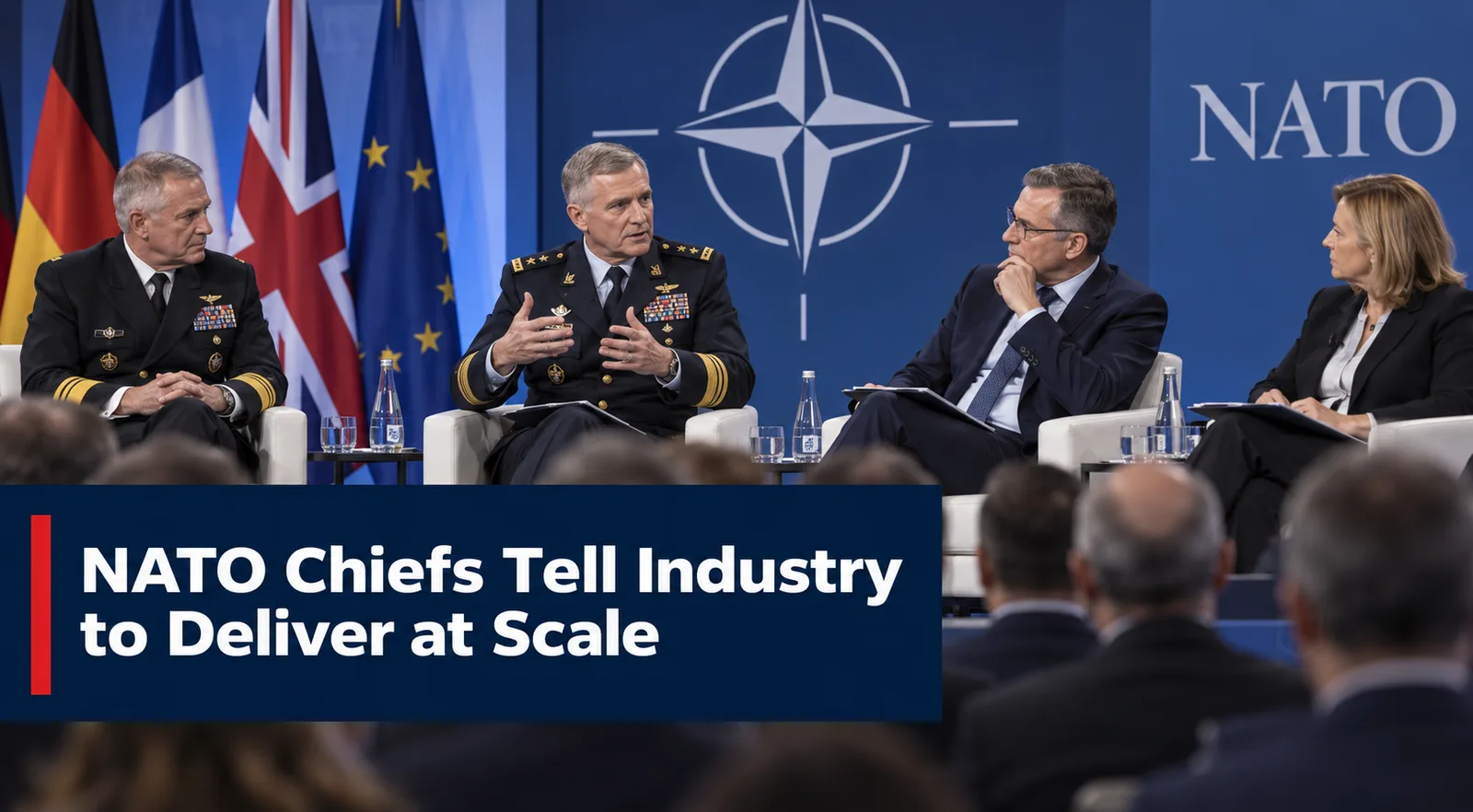
NATO’s 32 chiefs of defence used the Military Committee Conference in Copenhagen on 18–19 September 2026 to send a direct industrial message: Allies are ready to buy at scale, but suppliers must deliver with greater speed, scale and predictability. The statement matters because it links NATO’s post-Ankara capability agenda to industrial output rather than to another specific procurement award, putting production capacity, supply resilience and delivery tempo at the centre of the Alliance’s readiness debate.
Copenhagen meeting turns capability targets into an industrial demand signal
NATO said the Copenhagen conference brought together all 32 Allied chiefs of defence with the Chair of the Military Committee, the Supreme Allied Commander Europe and the Supreme Allied Commander Transformation. The military leaders reviewed the security environment, readiness and capability development after the Ankara Summit, where Allies had already agreed a higher level of ambition for collective defence. The industrial message was unusually explicit: NATO said the chiefs delivered a direct and united signal that Allies are prepared to purchase at scale and that industry must respond with faster, larger and more predictable output.
That wording should not be read as a single contract notice or as confirmation that every Ally has funded identical quantities. NATO capability targets are translated into national procurement decisions, multi-national projects and common-funded programmes through different budget cycles. The significance is therefore upstream: military requirements are being paired with a political and operational expectation that production lines, workforces, suppliers and inventories can support sustained demand rather than episodic peacetime ordering.
Scale and predictability are becoming procurement requirements
The emphasis on predictability reflects a recurring defence-industrial problem. Suppliers can add shifts, tooling and capacity only when they can see credible demand far enough ahead to justify investment, while governments need competitive pressure and delivery assurance before committing public funds. Longer production runs, aggregated orders, common standards and earlier contracting can reduce unit-cost volatility, but they also expose bottlenecks in energetics, propulsion, electronics, castings, semiconductors and skilled labour that cannot be expanded instantly.
For programme offices, the important distinction is between a demand signal and an obligated award. Copenhagen creates pressure for follow-on decisions, but it does not disclose a NATO-wide contract value, quantity or delivery schedule. The measurable milestones will be national appropriations, framework agreements converted into task orders, exercised options, multi-year buys, new factories or lines, and verified increases in monthly or annual output.
Industrial readiness is now part of deterrence
NATO’s military leadership is treating industrial capacity as an operational variable because stockpile depth and replenishment speed affect how long forces can sustain high-intensity operations. A larger standing order book can also improve interoperability if Allies converge on common munitions, maintenance arrangements and component standards. Conversely, fragmented requirements can disperse investment across too many configurations and slow the production gains that the Copenhagen message is seeking.
The Alliance also has to balance urgency with resilience. Faster procurement can increase dependence on single-source suppliers if expansion is concentrated in one country or one plant. The stronger industrial outcome is therefore not simply more output, but additional qualified suppliers, secure raw-material flows, resilient logistics and contracts that preserve competition where feasible. Those are the indicators Defence Agenda will watch as Allies convert the political message into executable procurement.
Implications / Next
The next substantive milestones will come from procurement authorities rather than from NATO rhetoric alone. Watch for coordinated ammunition and air-defence purchases, new multi-year production agreements, capacity investments tied to guaranteed demand, and Alliance mechanisms that aggregate requirements across several customers. Each of those would show that the Copenhagen message is becoming contractual demand.
Until those decisions are published, the correct maturity label is industrial and procurement signalling. NATO has stated that Allies are ready to buy at scale; it has not announced one consolidated purchase covering the Alliance. That distinction matters for suppliers evaluating capital expenditure and for readers comparing political ambition with actual obligated spending.