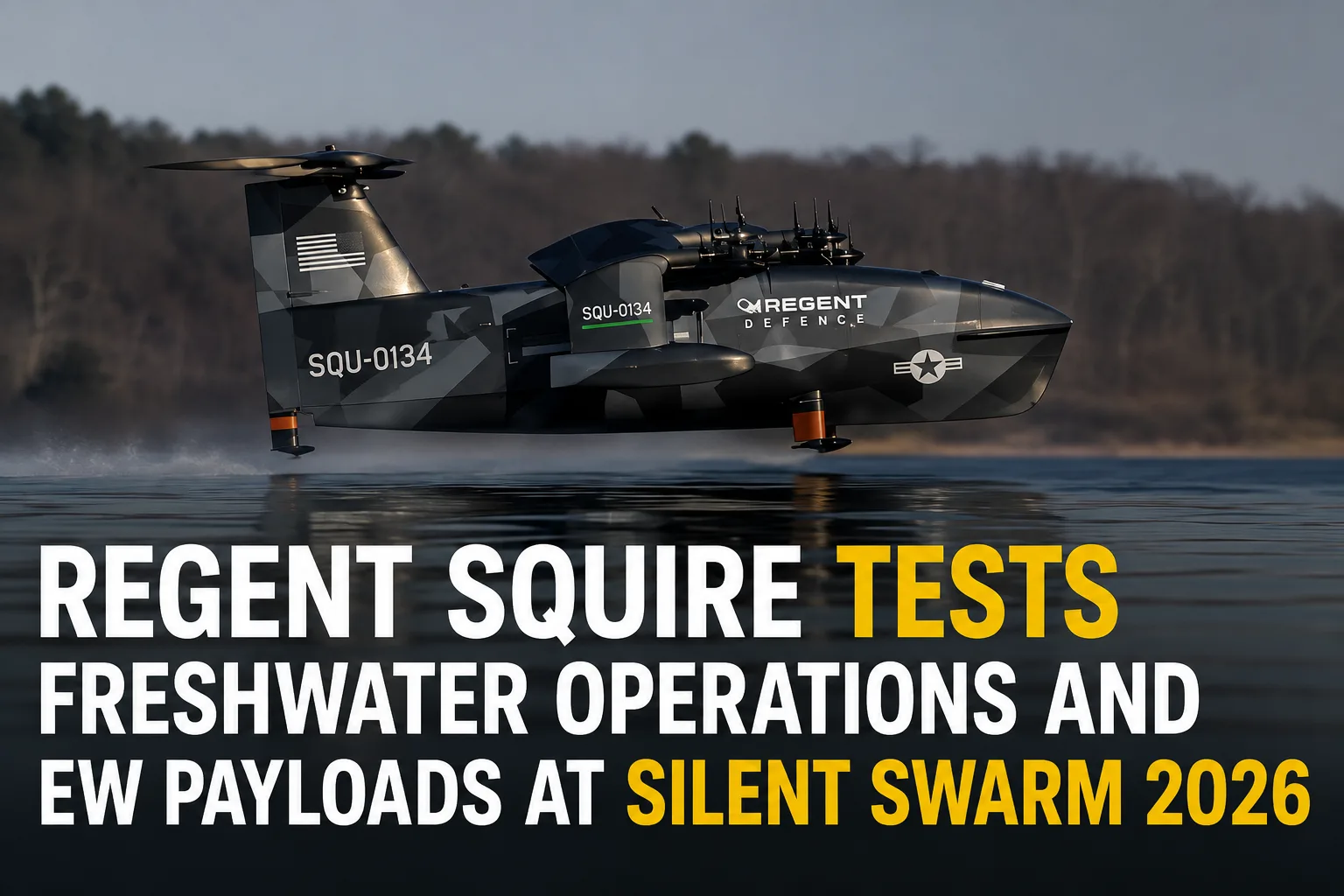
REGENT Craft’s Squire autonomous seaglider has completed its first freshwater test campaign during the U.S. Department of Defense’s Silent Swarm 2026 experimentation event, demonstrating how the wing-in-ground-effect platform could support electronic warfare, ISR and distributed maritime missions.
The event, conducted from 13–24 July 2026 across Michigan’s Northern Lower Peninsula, Alpena Combat Readiness Training Center and associated ranges and waterways, gave REGENT its first opportunity to operate Squire outside the saltwater environment used near its Rhode Island headquarters. Janes reported on 1 September that the freshwater trials helped the company assess changes in launch height, wave tolerance and handling caused by the lower density of freshwater, while the platform also carried internally and externally mounted experimental payloads.
Key Facts
- Platform: REGENT Squire Seaglider USA-V
- Event: Silent Swarm 2026
- Event dates: 13–24 July 2026
- Location: Michigan, United States
- Lead organisation: Naval Surface Warfare Center Crane Division
- Primary experiment focus: Electromagnetic Spectrum Operations on multi-domain uncrewed systems
- Latest milestone: First freshwater tests of Squire
- Company-stated speed: Up to 70 knots
- Planned operational range: 100+ nautical miles
- Payload: 50 lb configurable payload
The New Milestone Is Freshwater Operation
Squire had already completed a ground-effect flight in Rhode Island in April 2026. The Silent Swarm campaign added a different environmental variable: freshwater.
REGENT’s Director of Defense Mission Integration, Becky Russo, told Janes that previous Squire testing had been conducted in saltwater near the company’s headquarters. The Michigan event therefore allowed engineers to measure how the less dense freshwater environment affected operating characteristics including launch height and wave tolerance.
This is a meaningful engineering step for a vehicle that transitions through three modes: hull-borne movement, hydrofoiling and low-altitude wing-in-ground-effect flight.
The result should not be interpreted as final environmental qualification. Public reporting does not provide the freshwater performance margins, wave-height limits achieved, launch-distance changes or detailed handling data.
Squire Is Both a Surface and Aerial Vehicle
REGENT describes Squire as a Seaglider USA-V, or Unmanned Surface and Aerial Vehicle.
The vehicle begins operation on its hull, accelerates onto hydrofoils and then transitions into wing-in-ground-effect flight within roughly one wingspan of the water surface.
This hybrid operating model gives Squire a different mission profile from conventional UAVs or USVs. It can use maritime infrastructure and waterborne loitering while moving at aircraft-like speeds during the flight phase.
The company’s current defence product page lists a top speed of 70 knots, a range of 100 nautical miles and a 50 lb payload. Earlier company material referred to operational range exceeding 100 nautical miles.
Silent Swarm Tested More Than Mobility
The Silent Swarm experiment was built around Electromagnetic Spectrum Operations, not merely autonomous navigation.
REGENT said Squire partnered with different payloads across 13 days of varying mission types, including systems intended for electronic attack, electronic protection and electronic warfare support.
Janes added that Silent Swarm allowed the company to mount equipment both internally and externally and assess the platform’s versatility with industry partners.
This is significant because the military value of an uncrewed platform depends heavily on what sensors, communications systems or effectors it can carry and how easily those payloads can be integrated.
Neither Janes nor REGENT publicly identifies the specific EW payload manufacturers or performance achieved during the event.
Silent Swarm Is an Experimentation Pipeline, Not a Procurement
NSWC Crane issued the Silent Swarm 2026 notice in September 2025 as a request for submissions for an experimentation event.
The notice explicitly stated that it was for planning and participation purposes and did not constitute a Request for Proposal, Request for Quotation or contractual commitment.
The programme focuses on early-development EMSO capabilities that can be employed on attritable, multi-domain uncrewed systems.
Participants gain access to an operationally relevant sandbox, government modelling and simulation support, uniformed operators, engineers and documented feedback.
Squire’s participation therefore provides a development and user-feedback milestone, but it should not be presented as a U.S. Navy procurement decision or programme-of-record selection.
The Event Was Multi-Domain by Design
Silent Swarm is intended to connect uncrewed systems across land, air, sea, undersea, cyber and space-related mission functions.
REGENT said the 2026 event brought together small multi-domain systems to test both the employment of and defence against electromagnetic-spectrum capabilities.
The event was led by NSWC Crane with participation from the Michigan National Guard, Naval Information Warfare Center Atlantic, NOAA, Army C5ISR Center and Air Force Test Center.
That joint structure matters because Squire’s potential value is not limited to independent maritime movement. It can act as a node inside a larger network carrying payloads, relaying information or supporting distributed sensing and EW effects.
Freshwater Testing Exposes a Real WIG Engineering Variable
Freshwater and saltwater do not have the same density.
For a vehicle that relies on hull displacement and hydrofoil lift before transitioning to flight, density affects the forces generated during the waterborne stages.
REGENT’s comments to Janes indicate that Silent Swarm was used to observe how these differences changed launch height and wave tolerance.
The company has not released engineering data quantifying those changes, so the Defence Agenda article does not infer improved or degraded performance.
The important point is that Squire has now been tested across a broader environmental envelope than its earlier Rhode Island saltwater campaign.
The WIG Flight Mode Reduces Radar-Horizon Exposure
REGENT markets Squire as a low-signal maritime platform because it operates very close to the water surface.
Flying inside ground effect can reduce aerodynamic drag while the low altitude also limits line-of-sight detection by some surface-based radars until the vehicle approaches the radar horizon.
This does not make Squire invisible or stealthy in the same sense as a purpose-designed low-observable combat aircraft.
Detection will depend on radar height, airborne sensors, infrared systems, electronic emissions, sea state, weather and the platform’s own signature.
Claims that Squire can operate “below radar” are therefore best treated as manufacturer positioning about low-altitude geometry rather than a guarantee of non-detection.
The Platform Is Being Positioned for ISR and ASW
REGENT publicly identifies intelligence, surveillance and reconnaissance, logistics, search and rescue and anti-submarine warfare among Squire’s intended missions.
For ISR, the company illustrates Squire carrying EO/IR sensors to collect imagery of surface combatants and feed updates into a common operating picture.
For ASW, REGENT depicts active or passive sonar arrays, deployed sonobuoys and mesh networking as potential payload concepts.
Those roles are currently manufacturer concepts and experimentation pathways. Public sources reviewed for this package do not confirm that Squire has completed an operational anti-submarine warfare evaluation or deployed a production-standard sonar package.
Payload Flexibility May Be More Important Than the Airframe
One of the strongest takeaways from Silent Swarm is the emphasis on payload integration.
Squire’s 50 lb payload capacity is modest compared with larger aircraft or maritime vehicles, but a small modular payload can still support communications relay, RF sensing, EO/IR collection or other distributed effects.
A platform able to carry different payloads between missions can serve as a relatively inexpensive test and deployment vehicle for technologies that would otherwise need dedicated aircraft or surface craft.
The 2026 experiment’s electronic-attack, protection and support tasks therefore provide a more useful measure of military relevance than speed or range alone.
Squire Builds on an April 2026 Ground-Effect Flight
REGENT announced on 13 April 2026 that Squire had completed its first ground-effect flight in its defence-focused configuration.
The company described that flight as the first in the United States by a defence-specific WIG craft.
That claim is a manufacturer assertion and should be treated as such; no independent government certification reviewed for this article establishes a formal national “first.”
The April test nevertheless confirmed that the Squire test vehicle could transition into its intended WIG flight mode before the Silent Swarm deployment.
The U.S. Marine Corps Is a More Concrete Defence Customer
REGENT’s most mature public U.S. defence relationship is with the Marine Corps Warfighting Laboratory.
The company states that its U.S. Marine Corps contracted work totals $15 million.
REGENT Defense’s mission page also identifies a 2025 $9.5 million Other Transaction Agreement for experimentation with the full-scale Viceroy prototype, including hydrofoiling, flight testing, contested logistics and casualty-evacuation demonstrations.
REGENT has additionally conducted Squire prototype trials under an earlier phase of its defence work.
These relationships provide an operational experimentation path, but they should not be conflated with a Marine Corps production contract for Squire.
Rescue and Logistics Trials Expand the Mission Set
REGENT has also demonstrated Seaglider concepts for medical evacuation and logistics with the Marine Corps Warfighting Lab.
The company reported dockside litter boarding, beach extraction and open-water life-raft rescue scenarios during 2025.
These tests used the wider Seaglider family and demonstrate the company’s focus on contested mobility rather than only sensing or electronic warfare.
Squire itself is smaller and unmanned, so the exact mission set differs from the crewed Viceroy platform.
A New Manufacturing Base Supports Scale Ambitions
REGENT completed a 255,000-square-foot Seaglider manufacturing facility in Rhode Island in June 2026.
The site is intended to support both commercial production and the company’s defence business.
REGENT also announced a $240 million Series B funding round on 27 August 2026, bringing total equity and debt raised to $340 million.
Those industrial developments matter because emerging defence platforms often struggle to move from small-scale demonstrations into repeatable manufacturing.
However, financing and factory capacity do not prove military demand. Squire still requires mission validation, customer adoption and production orders.
Silent Swarm Gives REGENT Direct User Feedback
One of the main benefits of Silent Swarm is access to operational users and government technical teams.
The original DoD notice said participants would be able to conduct multi-domain experiments, run risk-reduction simulations, receive real-time feedback and obtain a final report documenting assessor, spectrum-manager and modelling-team comments.
That feedback can identify integration problems before a system enters a formal acquisition process.
For Squire, it is particularly relevant to payload fit, electromagnetic compatibility, networking and the practical usefulness of WIG mobility in mixed unmanned operations.
Regulatory Treatment Remains Distinct From Conventional UAVs
REGENT has previously stated that the U.S. Coast Guard is the regulator for its Seaglider vessels and cleared the Squire prototype for Rhode Island testing in 2025.
This reflects the platform’s hybrid maritime character.
The Silent Swarm trials should not be interpreted as changing that regulatory status or constituting an FAA military-aircraft certification.
Public sources do not describe a final certification pathway for operational military deployment in all U.S. or allied environments.
Limitations and Counterpoint
The Silent Swarm demonstration did not result in a publicly announced procurement.
No government test report has been published detailing Squire’s performance.
The exact freshwater launch-height changes, wave-tolerance values and payload results are undisclosed.
The company’s 100+ nm range and 70-knot speed remain manufacturer specifications rather than independently released DoD test results.
Squire’s ASW and some EW mission descriptions remain developmental concepts rather than confirmed operational capabilities.
Finally, WIG vehicles remain highly dependent on maritime conditions, and public data do not yet establish how the platform performs across high sea states, icing, heavy precipitation or sustained contested-spectrum conditions.
Implications / Next
The first indicator to watch is whether REGENT receives follow-on government experimentation or prototype contracts specifically tied to Squire after Silent Swarm.
The second is payload disclosure. Identification of operational EW, ISR or ASW payload partners would show how the platform is moving from a generic carrier to defined mission configurations.
The third is environmental testing. Additional freshwater, sea-state and weather trials will determine whether the vehicle can operate across the geographic areas envisioned for distributed maritime operations.
The fourth is production. A customer-backed Squire build plan would mark the transition from test asset to military product.
The fifth is interoperability. Silent Swarm places a premium on cross-domain networking, so future demonstrations that show Squire exchanging mission data with other uncrewed systems or command networks will be particularly important.
Conclusion
Silent Swarm 2026 gave REGENT’s Squire its most operationally relevant public test environment to date.
The platform moved beyond its earlier Rhode Island saltwater and ground-effect campaign into freshwater operations while carrying electronic-warfare-related payloads inside a joint multi-domain experiment.
The key result is not a procurement decision. It is a broader technical validation: Squire has now been exposed to a different water environment, mixed payload integration and direct feedback from military operators and government engineers.
If REGENT can convert that experimentation into defined mission payloads, repeatable environmental performance and funded customer demand, the Squire could occupy a distinctive niche between conventional UAVs and USVs as a high-speed, low-altitude maritime node for distributed operations.