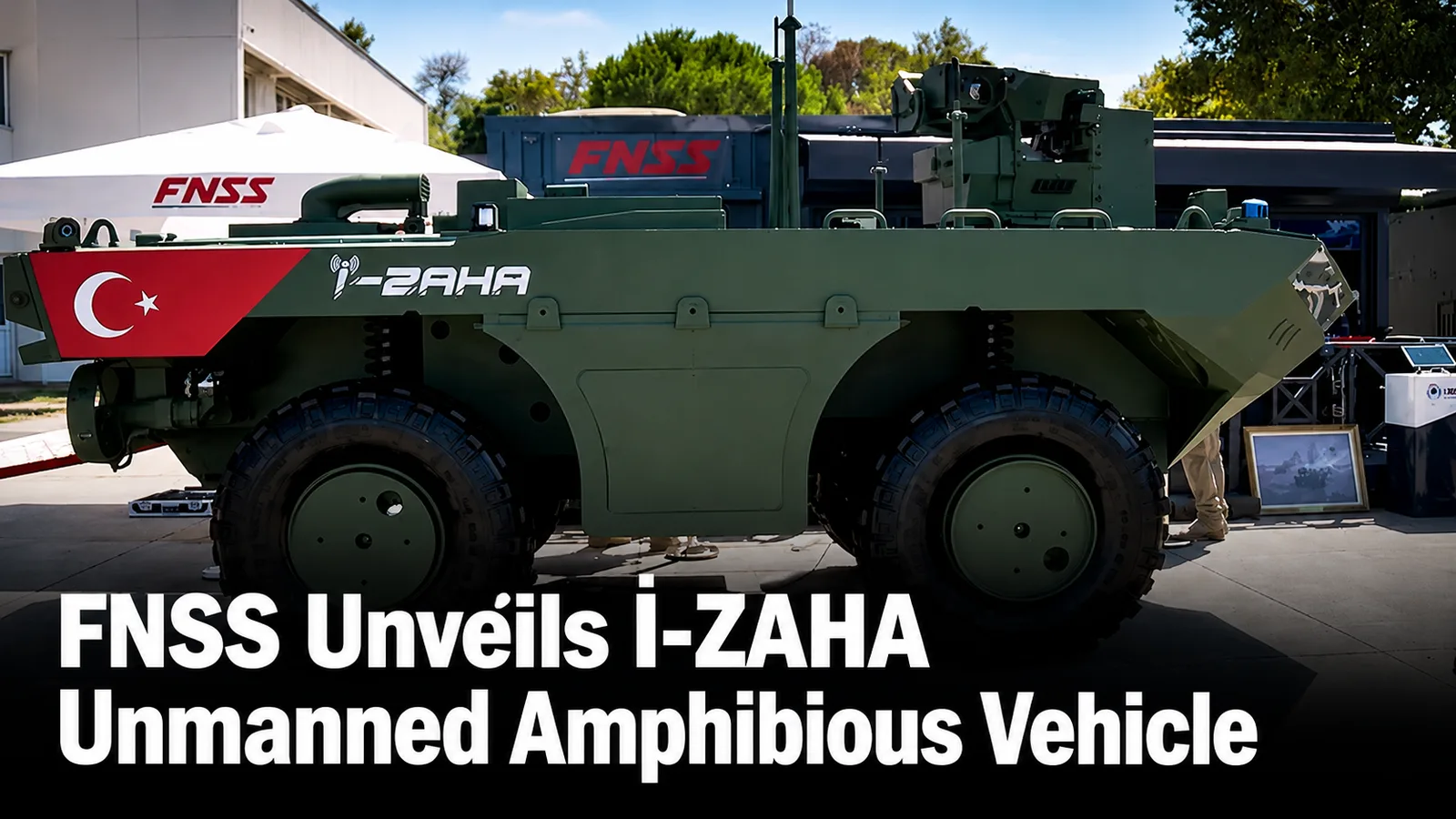
FNSS İ-ZAHA, a new multi-purpose modular unmanned amphibious vehicle developed to operate alongside Türkiye’s crewed ZAHA amphibious assault fleet, made its public debut at TEKNOFEST Mavi Vatan in Gölcük on 20 August 2026.
The 8-tonne vehicle is designed as an unmanned forward element for high-risk amphibious operations, combining autonomous, remote-controlled and hybrid control modes with interchangeable payload modules. FNSS says İ-ZAHA can be configured for ten missions ranging from reconnaissance and engineering support to electronic warfare, logistics and casualty evacuation.
The programme is important because it extends Türkiye’s amphibious modernisation beyond replacing legacy crewed vehicles. İ-ZAHA introduces a manned-unmanned teaming architecture intended to place robotic systems ahead of crewed ZAHA formations during the most exposed phases of an amphibious operation while retaining a common industrial and logistical base.
Key Facts
- Public debut: 20 August 2026 at TEKNOFEST Mavi Vatan, Gölcük Naval Shipyard Command.
- Developer: FNSS.
- Combat weight: Approximately 8 tonnes.
- Water speed: 7 knots.
- Road speed: Up to 70 km/h.
- Power: 300 hp powerpack; manufacturer states a 37.5 hp/tonne power-to-weight ratio.
- Mission architecture: Ten interchangeable payload configurations, with module changes taking approximately 40 minutes according to FNSS.
- Control: Autonomous, remotely controlled or hybrid operation.
FNSS Unveils İ-ZAHA at TEKNOFEST Mavi Vatan
Anadolu Agency reported on 20 August 2026 that FNSS unveiled İ-ZAHA during TEKNOFEST Mavi Vatan at Gölcük Naval Shipyard Command.
Minister of National Defence Yaşar Güler attended the presentation and received a briefing on the vehicle from FNSS CEO and Board Member Selim Baybaş.
FNSS describes İ-ZAHA as a next-generation heavy unmanned amphibious vehicle designed to work directly with ZAHA-equipped naval infantry units.
The platform is intended to move ahead of crewed ZAHA vehicles during high-risk phases and perform missions that would otherwise expose personnel and crewed vehicles to coastal defences.
The 20 August event was a product unveiling rather than an inventory-entry ceremony. FNSS has not announced that İ-ZAHA itself has entered Turkish Armed Forces service.
İ-ZAHA Builds on the Crewed ZAHA Programme
The new vehicle is closely connected to FNSS’s existing Zırhlı Amfibi Hücum Aracı, or ZAHA, rather than being a completely separate amphibious programme.
ZAHA is already in Turkish Naval Forces inventory and provides protected ship-to-shore mobility for amphibious forces.
FNSS says İ-ZAHA was specifically designed to cooperate with those crewed vehicles through a manned-unmanned teaming, or MUM-T, concept.
This approach changes the purpose of the unmanned system. Rather than replacing every crewed amphibious vehicle, İ-ZAHA is intended to perform higher-risk or specialist missions while ZAHA continues carrying personnel and performing the core amphibious assault role.
Defence Agenda previously reported that Türkiye’s Ministry of National Defence used SAHA 2026 to announce a contract connected with 27 additional ZAHA vehicles for the Turkish Naval Forces, underlining that the crewed platform family itself remains under continued development and production.
The İ-ZAHA Concept Was Developed in Around Six Months
The development timeline is particularly notable.
Baybaş told Anadolu Agency on 21 August 2026 that the idea for an unmanned ZAHA derivative had emerged approximately six months earlier.
FNSS then developed the vehicle using its existing amphibious engineering experience and subsystems that the company says have already been proven through other Turkish Armed Forces programmes.
This is one reason İ-ZAHA could progress faster than a completely clean-sheet vehicle programme.
The approach reuses industrial knowledge, qualified components and the operational lessons generated by the crewed ZAHA family while introducing a different unmanned architecture.
An 8-Tonne Amphibious Unmanned Platform
FNSS’s official İ-ZAHA product page lists an amphibious combat weight of approximately 8 tonnes.
The vehicle uses a 300 hp powerpack and has a manufacturer-stated power-to-weight ratio of 37.5 hp per tonne.
FNSS states that the platform can reach 7 knots in water and 70 km/h on land, allowing it to transition directly between sea and shore without changing vehicles.
An independent suspension arrangement supports manoeuvrability on land, while the vehicle can be fitted with different tyre configurations according to terrain requirements.
FNSS also emphasises a relatively low silhouette, thermal signature and noise profile. These remain manufacturer-described design characteristics rather than independently published detection measurements.
Ten Missions From One Common Vehicle
Modularity is central to the İ-ZAHA concept.
FNSS says mission modules can be exchanged in the field in approximately 40 minutes, allowing a common chassis to support ten published configurations:
- Fire Support
- Mine Clearing
- Combat Engineering
- Electronic Warfare
- Reconnaissance
- Tactical Deception
- Counter-UAS
- Navigation and Marking
- Logistics Support
- Casualty Evacuation
This architecture reduces the requirement to maintain a completely different vehicle family for every specialist role.
More importantly, it gives commanders the option to change the mix of vehicles before an operation according to the threat environment.
The potential limitation is that a modular platform still requires each mission package to be separately developed, tested and integrated. Announcing ten configurations therefore does not necessarily mean that every variant has already reached the same technical or operational maturity.
İ-ZAHA Can Operate Remotely or Autonomously
FNSS describes three principal control options: remote operation, autonomous operation and a hybrid mode combining the two.
The platform incorporates encrypted mesh communications alongside GNSS/INS navigation and identification functions.
Its inertial-navigation architecture is intended to maintain position estimation when satellite navigation is degraded or unavailable.
FNSS lists a direct line-of-sight communications distance of approximately 3 km and says UAV relay can extend connectivity beyond that figure.
Those features are increasingly important for unmanned land systems because maintaining a permanent high-bandwidth link cannot be assumed in a contested electronic-warfare environment.
AI-Assisted Processing Reduces Operator Workload
İ-ZAHA also incorporates AI-supported image processing, according to FNSS.
The system analyses camera feeds and presents detected objects and prioritised information to the operator, reducing the requirement for personnel to manually monitor every video frame.
This is particularly relevant if several unmanned vehicles operate simultaneously.
Without automation, expanding from one remotely operated vehicle to a larger formation can simply shift the personnel burden from vehicle crews to remote-control stations.
Meaningful scaling therefore requires autonomy not only for driving but also for navigation, perception, task management and operator-alert prioritisation.
FNSS Adds Structural Health Monitoring
Another unusual element is the integration of Nurol Teknoloji’s Armor Integrity structural-health-monitoring system.
FNSS says İ-ZAHA is the first unmanned vehicle to integrate the technology.
Because there is no crew inside the vehicle to physically assess damage, the system is designed to use sensors to monitor structural effects and provide status information back to the operator and command network.
The concept addresses an important unmanned-vehicle problem: removing personnel from the platform also removes their ability to hear, feel and visually inspect vehicle damage during a mission.
Digital health monitoring can partly replace that human feedback and support decisions on whether a damaged vehicle remains available for further tasks.
Why Manned-Unmanned Teaming Matters
İ-ZAHA illustrates a broader transition in military robotics away from treating unmanned vehicles as isolated experimental assets.
The more consequential model is to integrate them directly into existing formations.
For Türkiye, this means combining crewed ZAHA vehicles carrying personnel with unmanned vehicles configured for specialist support missions.
The operational logic is similar to developments in aerial combat and naval autonomy: send lower-risk or unmanned systems into the most exposed areas while maintaining crewed platforms further back until the situation is better understood.
Defence Agenda has tracked the same trend across other Turkish platforms, including the expansion of unmanned land and maritime systems showcased at IDEF 2025.
Phase 1 ZAHA Deliveries Are Complete
The maturity of the crewed ZAHA programme provides important industrial context.
Baybaş said on 21 August that FNSS had completed the first phase of ZAHA deliveries and had moved into Phase 2 production.
He also indicated that the company expects potential Phase 3 and Phase 4 requirements as Türkiye continues building its amphibious fleet.
This existing production line provides İ-ZAHA with a different starting position from many experimental unmanned combat vehicles.
FNSS already possesses an established amphibious engineering base, an active vehicle programme and a customer operating the related crewed platform.
FNSS Is Also Positioning İ-ZAHA for Export
FNSS is not limiting the programme to Türkiye.
Baybaş said the company had started export activity covering both the crewed ZAHA and unmanned İ-ZAHA families.
The strategy fits FNSS’s wider internationalisation model.
Defence Agenda recently reported that FNSS and CSG Defence established Danube Defence Systems to expand localised production and marketing of armoured vehicles in Europe.
İ-ZAHA could offer a more specialised export proposition because relatively few land-systems manufacturers operate in the intersection between amphibious mobility, heavy unmanned vehicles and modular mission systems.
However, export potential will depend on whether prospective customers already possess suitable amphibious ships, marine formations and command architectures capable of integrating the vehicle.
Transportability Expands Deployment Options
FNSS also emphasises transportability as part of İ-ZAHA’s design.
The company says the vehicle can move by road, rail and sea and is dimensioned for transport by several heavy-lift helicopters and military transport aircraft.
At approximately 8 tonnes, İ-ZAHA is substantially lighter than a crewed amphibious assault vehicle, providing more options for strategic movement and rapid deployment.
This could be important for expeditionary operations in which specialist unmanned vehicles need to be moved independently from the main amphibious vehicle fleet.
Counterargument: Modularity Can Add Integration Complexity
The breadth of İ-ZAHA’s advertised mission set is a strength, but it also creates programme risk.
Ten payload configurations require more than mechanical interchangeability.
Each mission package needs software integration, power and data interfaces, operator training, testing and sustainment.
A reconnaissance configuration and an engineering or electronic-warfare configuration can place very different requirements on sensors, communications and vehicle control.
The real measure of modularity will therefore be whether military units can switch roles quickly without creating an excessive maintenance, training or software-management burden.
Unmanned Does Not Remove Amphibious Engineering Challenges
Autonomy also does not remove the physical difficulty of amphibious operations.
The vehicle must transition between water, surf, wet sand and harder terrain while maintaining communications and navigation.
Sea state, currents, beach gradient and obstacles can all affect performance independently of autonomous software.
As a result, the most important future tests will involve increasingly realistic environmental conditions rather than static exhibition demonstrations alone.
Implications / Next
The first milestone to watch is prototype testing. FNSS has publicly unveiled the platform, but has not announced Turkish Armed Forces inventory acceptance for İ-ZAHA.
The second is MUM-T validation. Joint operation with production ZAHA vehicles will be more significant than standalone mobility demonstrations because teaming is central to the programme’s stated purpose.
The third is mission-module maturity. FNSS advertises ten configurations, but future demonstrations should clarify which variants are fully integrated and which remain developmental.
The fourth is autonomous operation under degraded communications. Reliable navigation and control without uninterrupted external connectivity will be essential if İ-ZAHA is to deliver the risk-reduction benefits claimed for the concept.
The fifth is procurement. An official Turkish Naval Forces or Presidency of Defence Industries order would move İ-ZAHA from company-funded rapid development into a defined force-structure programme.
Finally, FNSS’s export campaign will show whether the platform addresses a broader international requirement or remains primarily tailored to Türkiye’s expanding ZAHA fleet.
Conclusion
İ-ZAHA represents a different direction in Türkiye’s unmanned-systems development: rather than creating a small robotic vehicle operating independently, FNSS has built a comparatively heavy amphibious platform around an existing crewed force structure.
The 8-tonne vehicle combines 7-knot water mobility, 70 km/h land speed, autonomous and remote operation and a modular architecture covering ten published mission configurations.
Its most important feature, however, is the intended relationship with ZAHA.
If FNSS can demonstrate reliable manned-unmanned teaming, İ-ZAHA could allow Türkiye’s amphibious forces to move selected reconnaissance, engineering, electronic-warfare and support tasks away from crewed vehicles while retaining a common operational ecosystem.
The 20 August 2026 unveiling marks the beginning of that validation process, not its completion. The next meaningful milestones will be joint ZAHA trials, mission-module qualification and a formal procurement decision.
Further Reading
- FNSS: İ-ZAHA Unmanned Amphibious Vehicle Unveiled
- FNSS: İ-ZAHA Official Product Page
- Anadolu Agency: İ-ZAHA Unveiled at TEKNOFEST Mavi Vatan
- Anadolu Agency: ZAHA Experience Opens Way for Unmanned Variant
- Defence Agenda: MSB SAHA 2026 Briefing Highlights New Systems
- Defence Agenda: FNSS and CSG Defence Form Danube Defence Systems
- Defence Agenda: IDEF 2025 Unveils Next-Generation Unmanned Systems