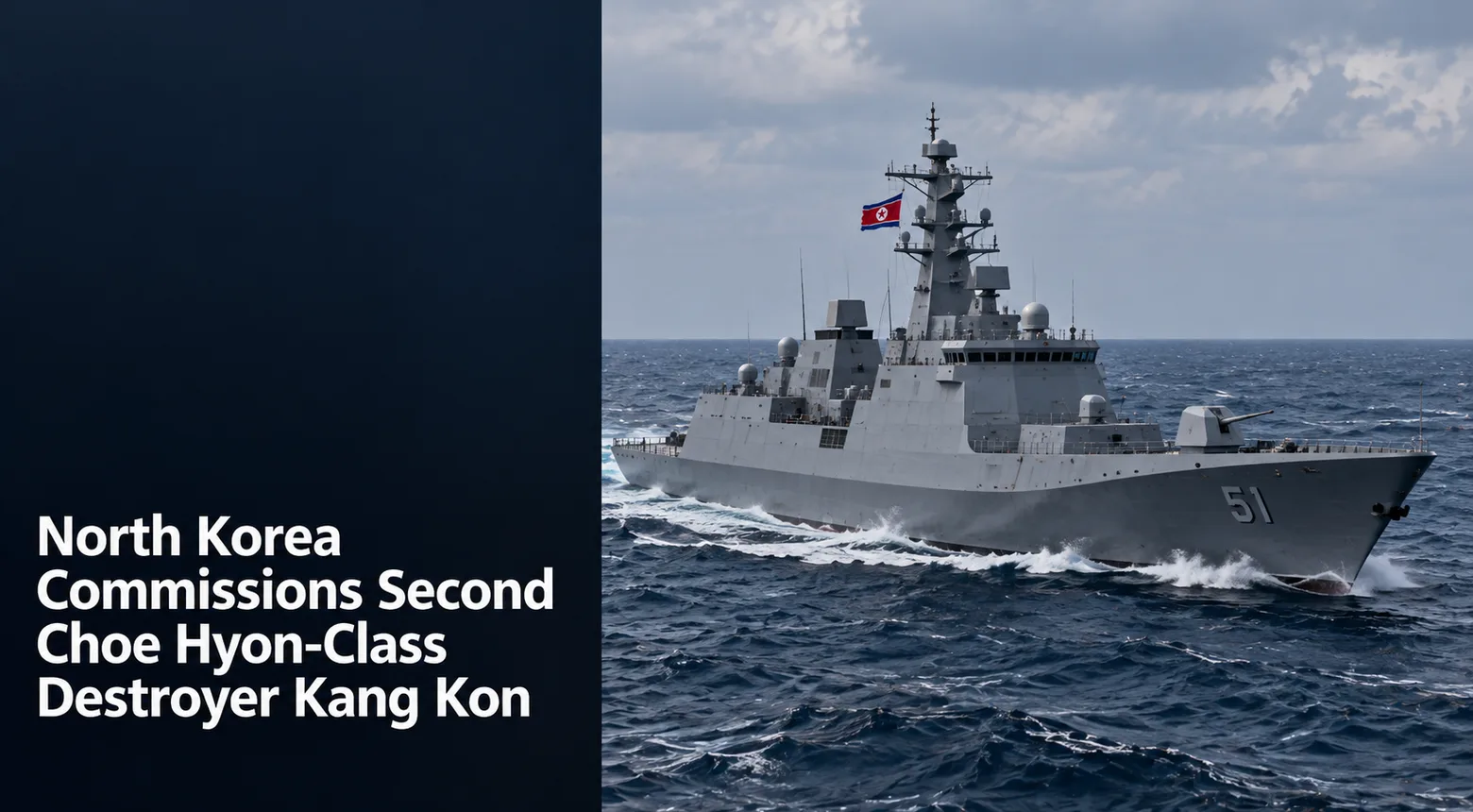
North Korea commissioned Kang Kon, the second ship of its new Choe Hyon class, during a ceremony at Wonsan on 6 September 2026. Yonhap and international news agencies report that the approximately 5,000-tonne destroyer was assigned to the Korean People’s Army Navy’s East Sea Fleet, giving Pyongyang a second large modern surface combatant only months after the lead ship Choe Hyon entered service.
The pace is notable because North Korea has historically operated a navy dominated by smaller coastal combatants, submarines and patrol craft rather than large multi-mission surface ships. A two-ship class does not by itself transform the balance of naval power around the Korean Peninsula, but it creates a new platform for longer-range sensors, vertical-launch weapons and more complex command-and-control functions than those available on most of the country’s legacy surface fleet.
Key Facts
- Commissioning ceremony: 6 September 2026 at Wonsan, according to South Korean and international reporting.
- Displacement reported by Yonhap: approximately 5,000 tonnes.
- Kang Kon is the second vessel of the Choe Hyon class.
- The ship was assigned to North Korea’s East Sea Fleet.
- The lead ship Choe Hyon entered service in June 2026.
- North Korean state media describes the class as part of the country’s nuclear counteraction system; that is a state claim, not independent confirmation of deployed nuclear armament.
Kang Kon enters service as the second new destroyer
The development is best assessed as a programme milestone rather than a complete operational endpoint. The verified evidence establishes the event described above, while subsequent procurement, integration, readiness or fielding claims require their own confirmation as the programme advances. That distinction is important for comparing announcements across defence programmes, where testing, production, delivery and operational acceptance are separate maturity stages with different evidentiary thresholds.
Weapons architecture and operational claims
Open-source analysis of the Choe Hyon class indicates a substantial vertical-launch architecture and a mix of anti-ship, land-attack and air-defence roles, although the exact missile load and combat-system performance remain difficult to verify independently. U.S. Naval Institute Proceedings has described the class as a naval strike destroyer and assessed the lead ship’s vertical-launch capacity at 88 cells after changes observed during fitting-out. The precise configuration of Kang Kon may evolve as North Korea continues trials and weapons integration.
North Korean state media has gone further, describing the destroyer as an 'offensive' asset associated with the country’s nuclear counteraction system. That wording should be treated as an official North Korean strategic claim rather than proof that the ship has entered service with an operationally certified nuclear payload. The more defensible conclusion at this stage is that Pyongyang is building surface ships designed to carry a broader and potentially longer-ranged missile inventory than its older combatants.
Programme maturity and constraints
Kang Kon’s commissioning follows a compressed period of sea and weapons activity. Reporting by Janes indicates that the ship began sea trials in June 2026 and subsequently conducted weapons tests, while the lead ship Choe Hyon was commissioned on 23 June 2026. The class therefore appears to be moving rapidly from construction into service, but commissioning is not equivalent to demonstrating sustained fleet readiness, integrated air defence performance or reliable long-range strike capability under contested conditions.
North Korea also faces constraints in propulsion, sensor quality, crew proficiency, maintenance and networked operations that cannot be assessed from ceremonial imagery alone. The key indicators to watch are repeated deployments away from home waters, multi-ship exercises, live missile firings, helicopter or uncrewed-air integration and evidence of reliable radar and combat-management performance. Those milestones will show whether the Choe Hyon class is becoming an operationally mature force element or remains primarily a strategically visible but limited surface-combatant programme.
Implications / Next
The next publication-grade milestone will be the first independently verifiable step that moves the programme beyond the status described here—such as a follow-on test, formal contract action, delivery, operational deployment or completed transaction, depending on the story. Defence Agenda will treat each maturity stage separately and will not infer production, operational capability or procurement completion from an earlier demonstration or announcement. The most useful follow-up evidence will therefore be dated official documentation, customer acceptance, serial-production data or operational activity that can be cross-checked against the current record.