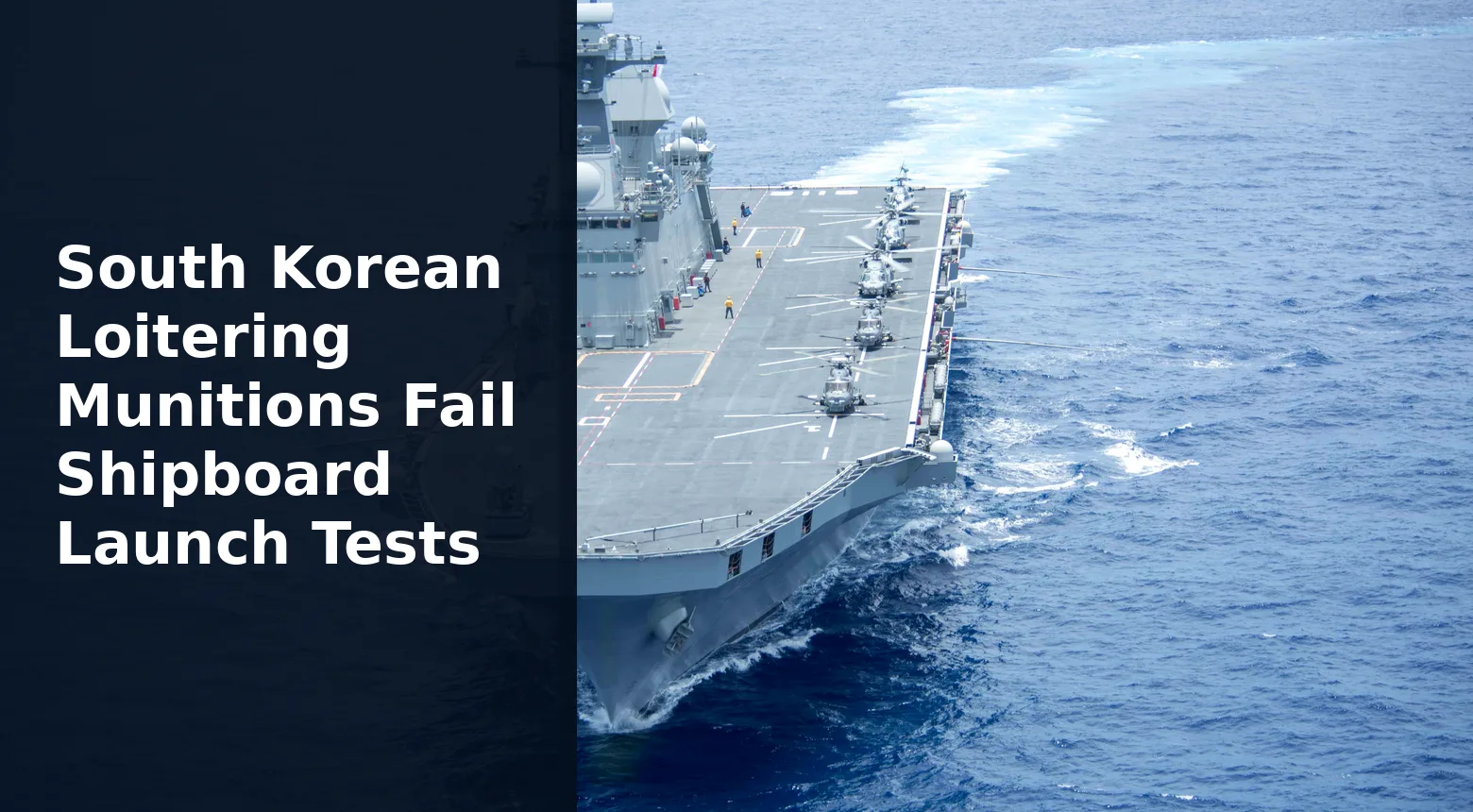
Two domestically developed South Korean loitering-munition prototypes crashed into the sea within seconds of launch during an August 2026 experiment from the amphibious assault ship ROKS Marado. Reporting points to launcher integration as the immediate problem, but the complete official investigation and a revised test schedule have not been published. The failures show that a viable air vehicle is not enough for a naval weapon: launch dynamics, heat, deck integration and transition to powered flight must work as one system. Transparent correction could still make the test valuable to the programme.
Both attempts failed during the launch sequence
Reports state that the aircraft entered the water within seconds, before completing a stable transition to propeller-powered flight. A repeated failure in the same phase points toward a common integration problem. It does not by itself prove that the air vehicle or guidance package is fundamentally unworkable.
Shipboard launch creates unique loads
Hot exhaust, launcher-door alignment, ship motion and airflow around the superstructure can produce conditions absent from land tests. Investigators reportedly focused on deformation and thrust imbalance in the launcher. Corrective work must be validated across representative sea states rather than only in a static environment.
Prototype cost increases pressure for disciplined testing
Industry reporting placed the prototype price near 800 million won per unit, though a final procurement price has not been established. Expensive test losses can still be justified when they expose a design flaw before production. The lesson is to connect ground qualification, instrumented trials and configuration control.
Failure reporting should avoid premature programme judgement
The incident is a setback and may delay operational deployment. It is not evidence that South Korea has abandoned ship-launched loitering munitions. A revised launcher, successful relaunch and subsequent guided mission would be the relevant indicators of recovery.
Programme and procurement context
This development must be read at its exact maturity level. Two domestically developed South Korean loitering-munition prototypes crashed into the sea within seconds of launch during an August 2026 experiment from the amphibious assault ship ROKS Marado. Reporting points to launcher integration as the immediate problem, but the complete official investigation and a revised test schedule have not been published. Defence programmes pass through distinct stages: policy announcement, requirement definition, competition, contract, testing, production, delivery, acceptance and operational fielding. Collapsing those stages into a single claim can overstate both near-term military utility and industrial certainty.
For acquisition teams, the decisive evidence is funded scope, customer acceptance, integration responsibility and a supportable schedule. The failures show that a viable air vehicle is not enough for a naval weapon: launch dynamics, heat, deck integration and transition to powered flight must work as one system. Transparent correction could still make the test valuable to the programme. Public announcements rarely resolve every dependency. Training, secure data, range access, infrastructure, export approval and supplier capacity can delay useful capability even after a technically successful milestone.
Source discipline is equally important. Company releases naturally emphasise momentum; government notices may describe only funded scope; exercise reports show activity without proving full readiness. Values should be labelled as contract ceilings or estimates when appropriate, performance figures as manufacturer claims until independently demonstrated, and dates as targets unless a customer confirms completion. Later primary records should replace early reporting as the programme matures.
The operational question is not whether the technology can be shown once, but whether users can employ it repeatedly under representative conditions. That requires realistic testing, configuration control, trained personnel, spares and an accountable command chain. Industrial significance also depends on repeatable production and quality assurance rather than prototype output alone.
Implications / Next
Track the official root-cause report, launcher redesign, replacement prototypes, the next shipboard test and any production decision. Keep alleged unit cost and failure cause attributed until government documentation is released.
This item remains a draft pending final image-rights review, CMS media assignment and canonical publication data. A later report should be treated as a separate update only if it materially changes the programme status described here.
Further Reading
Bayraktar KALKAN DİHA Operates From TCG Anadolu