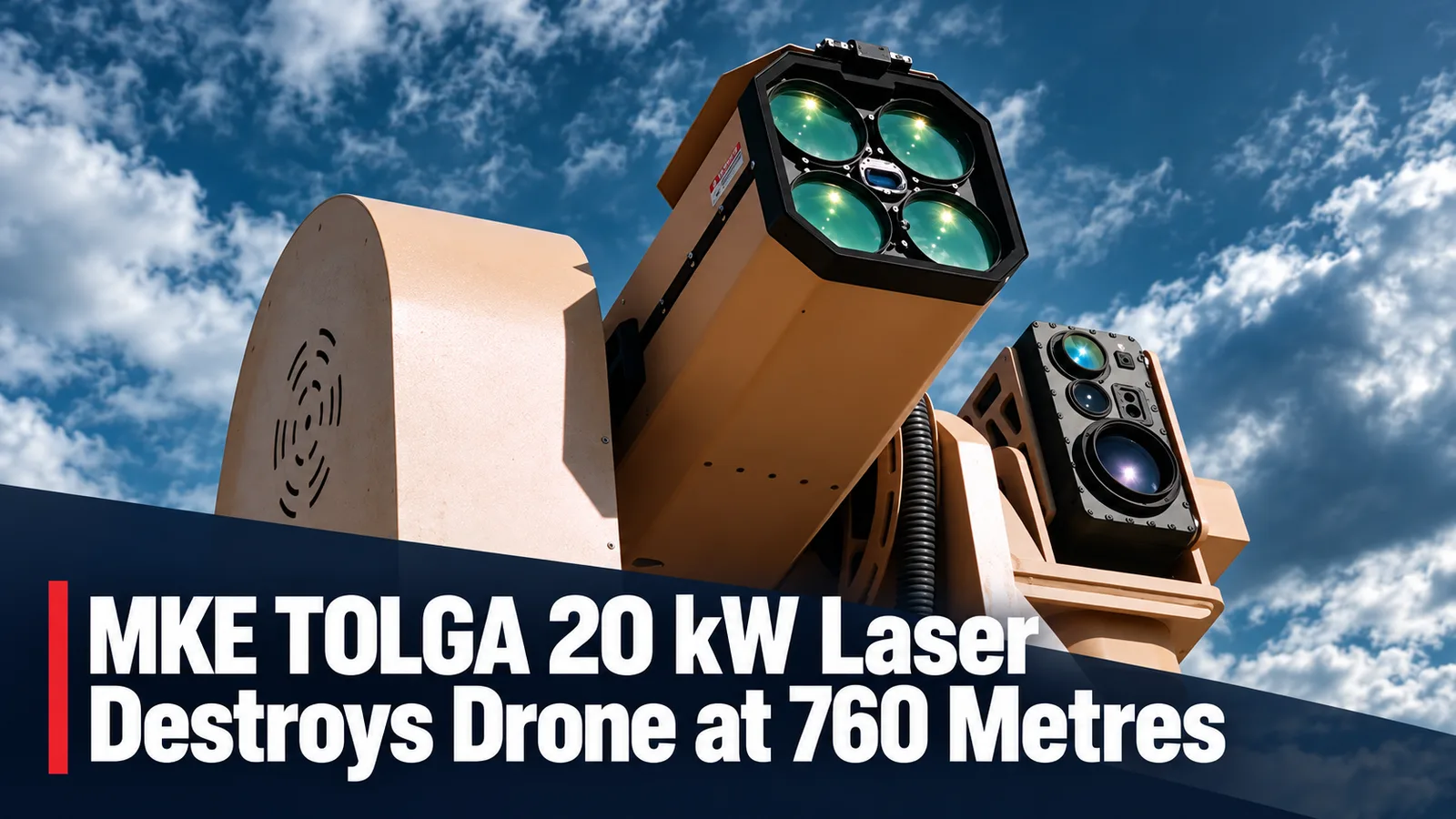
Makine ve Kimya Endüstrisi (MKE) has demonstrated the new 20 kW fibre-laser weapon within its TOLGA short-range air-defence architecture, destroying a drone at 760 metres during Ateş Serbest 2026 in Polatlı. The firing adds a directed-energy hard-kill option to a system already built around radar, electro-optical sensing, electronic attack, guns and missile effectors.
MKE’s current TOLGA product material confirms that the laser provides three response modes — dazzling, blockout and destruction — while the wider system is designed to protect the approximately 3,000-metre-and-below layer against low-altitude aerial threats.
The 760-Metre Kill Validates TOLGA’s New Directed-Energy Layer
DefenseHere reported that the 20 kW fibre-laser system destroyed the drone with a direct engagement during Ateş Serbest 2026. Specialist Turkish defence reporting adds that the laser architecture combines four 5 kW fibre-laser modules to provide a total output of 20 kW.
The test is important because TOLGA had previously been demonstrated primarily through electronic attack and conventional kinetic effectors. Adding a laser gives the architecture another way to defeat low-cost UAVs without relying on ammunition for every engagement.
TOLGA Is Built as a Layered Counter-UAS Architecture
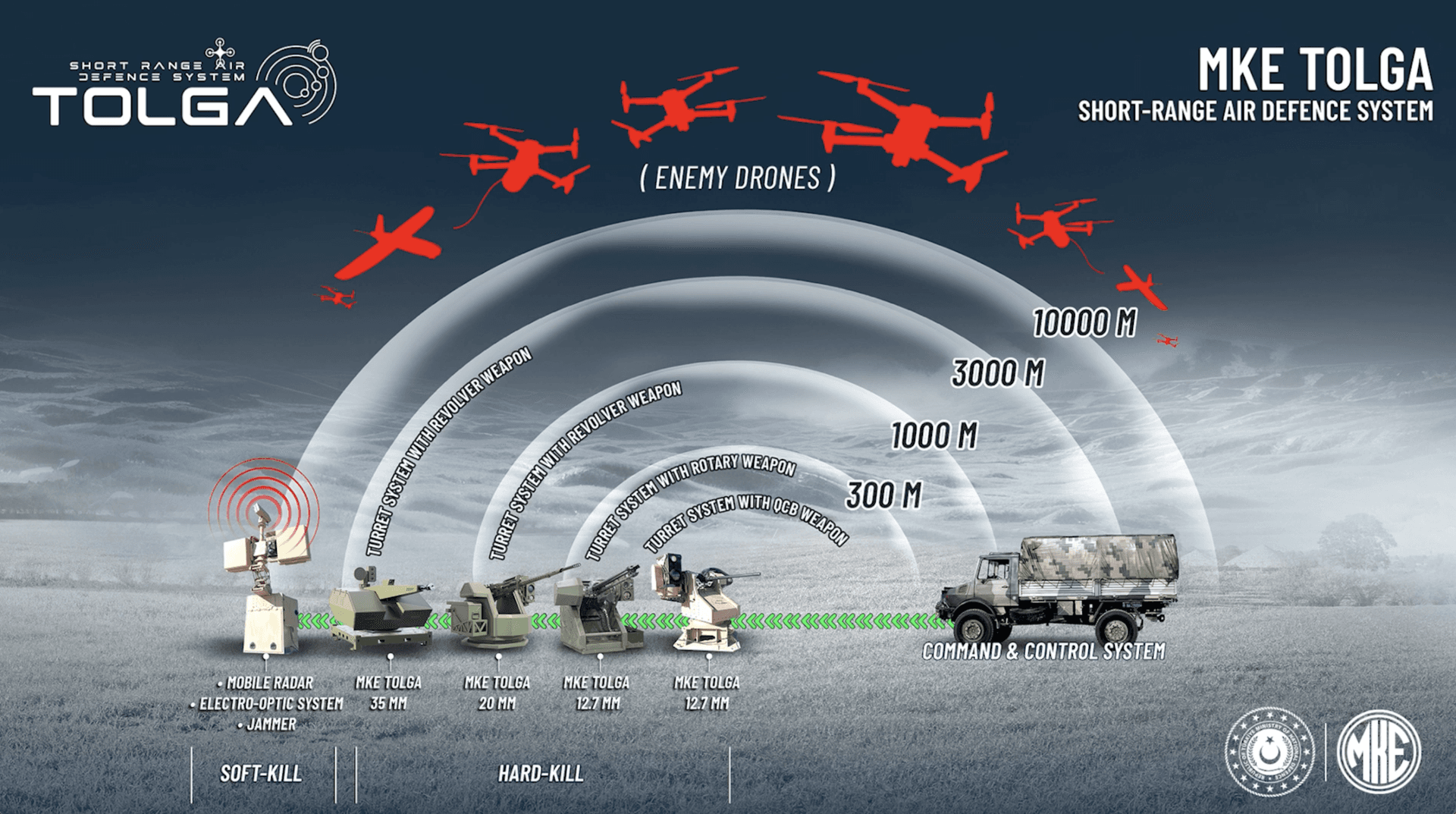
MKE positions TOLGA as a complete short-range air-defence and counter-UAS system rather than a single weapon. Its published architecture includes the GÖKBÖRÜ AESA radar, electro-optical tracking, an electronic jammer, acoustic detection, several gun calibres, a high-energy laser and the ENFAL electro-optically guided missile.
The company says TOLGA is intended for protection of land units, critical facilities, moving convoys, bases and naval platforms. This modular structure allows the command-and-control layer to select an effector according to target type, range, susceptibility to electronic attack and the cost of the engagement.
The Laser Adds an Engagement Option Between Soft Kill and Ammunition-Based Hard Kill
Electronic attack is usually the cheapest engagement path when a drone depends on vulnerable command, navigation or data links. It becomes less useful against autonomous, pre-programmed or fibre-optic-controlled threats. Guns and missiles can address those targets, but every engagement consumes finite ammunition.
A directed-energy weapon can fill part of that gap. Once electrical power and thermal management are available, repeated shots do not depend on a conventional ammunition magazine. That can be particularly valuable against repeated low-cost drone attacks, where the defender’s cost per engagement and magazine depth become operational constraints.
MKE Describes Three Laser Effects: Dazzling, Blockout and Destruction
MKE’s official product material identifies three laser effects: dazzling, blockout and destruction. Specialist reporting on the Ateş Serbest demonstration describes different engagement bands for those effects, with non-destructive optical effects used at longer distances and physical damage used at closer range.
DefenceTurk reports a 4,500–2,500 metre band for temporary optical dazzling, 2,500–1,500 metres for permanent optical damage and 1,500–100 metres for destructive engagement. These detailed bands are not shown on MKE’s current public product page, so they should be treated as event-level reported parameters rather than manufacturer-published permanent performance guarantees.
The 760-Metre Shot Falls Inside the Reported Destructive Envelope
The Ateş Serbest engagement at 760 metres sits well inside the 1,500–100 metre destruction band reported by specialist media. That makes the test consistent with the reported concept of employment: use the laser for physical damage once a target enters the closer hard-kill zone.
However, one successful engagement does not define the system’s maximum effective destruction range. Laser lethality depends on target material, vulnerable aim point, beam quality, tracking stability, dwell time and atmospheric transmission, so a single distance should be treated as a demonstrated point rather than the complete operational envelope.
Tracking Precision Is as Important as Raw Laser Power
High-energy lasers must keep sufficient energy concentrated on a vulnerable point long enough to produce the required effect. MKE’s TOLGA architecture therefore combines the effector with radar and electro-optical tracking rather than treating the laser as an independent weapon.
Specialist reporting says the laser turret uses linear-motor technology to support high-precision, high-acceleration tracking through 360 degrees. The significance is straightforward: increasing optical power alone does not create a useful counter-drone weapon unless the beam can remain stabilised on a small, moving target.
Weather and Atmospheric Conditions Remain the Main Directed-Energy Constraint
Laser weapons do not share the same environmental independence as guns or missiles. Fog, heavy rain, dust, smoke, turbulence and other atmospheric effects can reduce beam propagation or increase the dwell time required to damage a target.
That limitation helps explain why MKE is integrating the laser inside a multi-effector architecture instead of presenting it as a replacement for every other weapon. When laser conditions are poor, TOLGA can retain other engagement paths through electronic warfare, 12.7 mm, 20 mm or 35 mm guns and the ENFAL missile.
TOLGA’s Existing Gun Layers Cover Different Ranges
MKE’s current product page lists the 12.7 mm weapon systems for engagements out to around 300 metres, the 20 mm revolver weapon system to around 1,000 metres and the 35 mm system to around 3,000 metres. The jammer forms the soft-kill layer, while the laser and ENFAL expand the choice of effectors available to the command-and-control system.
This overlapping structure is operationally important. It gives the defender alternatives against different drone classes and preserves higher-cost or scarcer interceptors for threats that cannot be handled by a cheaper engagement method.
The Test Strengthens TOLGA’s Role Inside Türkiye’s Çelik Kubbe Architecture
MKE explicitly positions TOLGA within Türkiye’s wider Çelik Kubbe air-defence architecture as the system responsible for the approximately 3 km-and-below layer. The 20 kW laser adds a directed-energy component to that lower-tier defensive mix.
TOLGA has also been moving across platform classes. Defence Agenda has previously tracked its 20 mm integration on a European unmanned ground vehicle and the installation of stabilised TOLGA weapon stations aboard the Turkish Navy corvette TCG Beykoz. A mature laser layer could eventually expand the architecture’s flexibility further, although each land or naval integration would require its own validation.
Ateş Serbest Is a Demonstration Milestone, Not the End of Qualification
The successful 760-metre engagement demonstrates that the 20 kW laser can track and physically defeat a drone under the conditions of the Polatlı activity. It does not by itself establish all-weather effectiveness, sustained engagement rate, power-generation requirements, cooling endurance or performance against multiple simultaneous targets.
The next meaningful milestones will be repeated firings across different weather and target conditions, evidence of rapid sequential engagements, integration with the full TOLGA sensor-to-shooter chain and confirmation of operational fielding. Those steps will determine whether the laser becomes a routine counter-UAS effector rather than a successful demonstration capability.