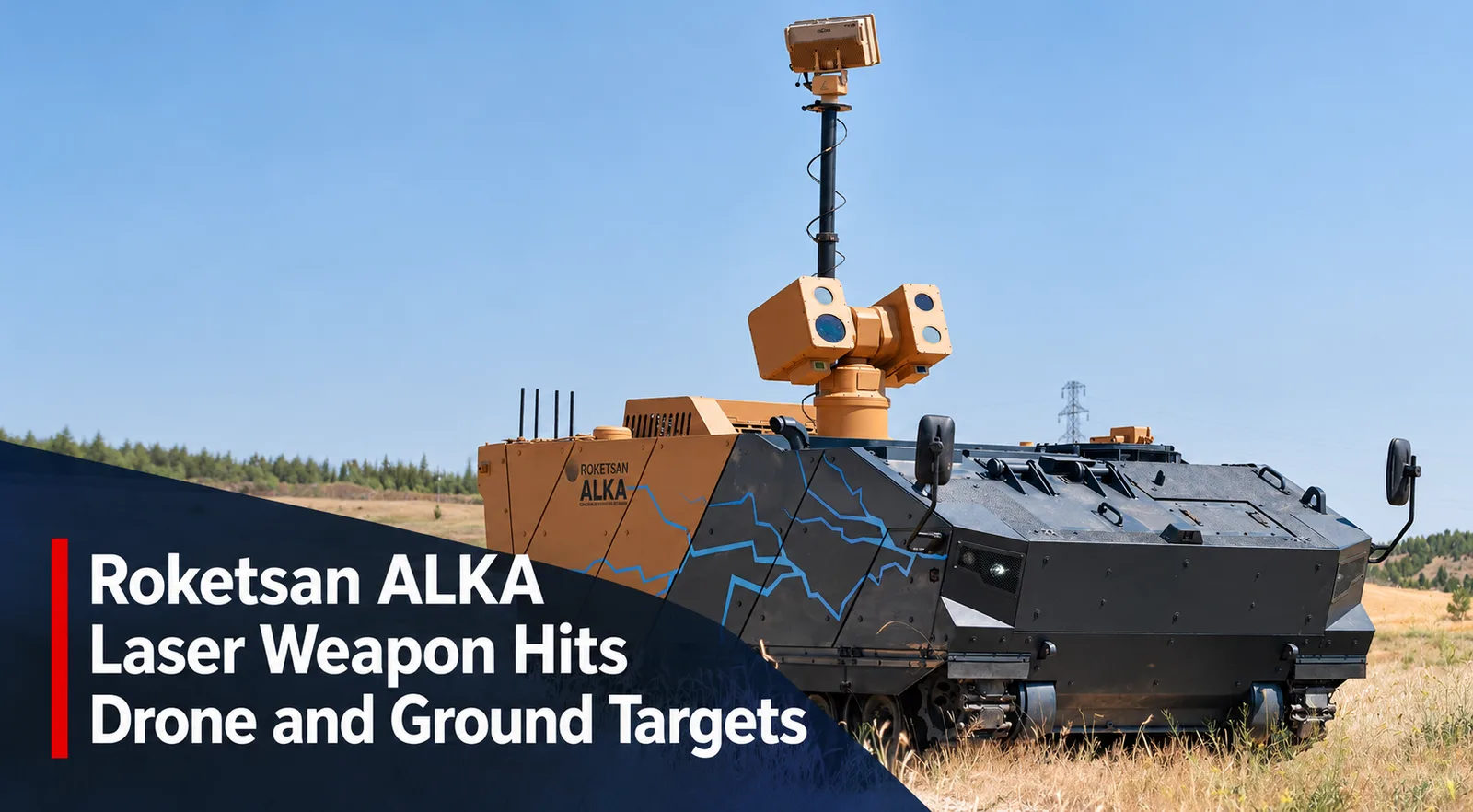
Turkish defence manufacturer Roketsan said on 23 October 2026 that its ALKA directed-energy weapon had engaged rotary-wing drones, fixed-wing drones and a stationary ground target during firings associated with the Flying Eye Drone Competition. The demonstration matters for military forces seeking alternatives to costly missile interceptors against small unmanned aircraft. Roketsan presented the event as evidence of ALKA’s laser and electromagnetic-jamming capabilities, but did not publish the test ranges, laser power used or a verified engagement count. The announcement establishes a demonstration, not a new contract, delivery or independently assessed operational success.
Key Facts
- Announcement: 23 October 2026, by Roketsan.
- Event: Flying Eye Drone Competition-related firings.
- Targets described: rotary-wing UAVs, fixed-wing UAVs and a stationary ground target.
- System: ALKA directed-energy weapon with laser and electromagnetic-jamming elements.
- Undisclosed: test distance, laser power for this event and precise target count.
- Classification: manufacturer-announced demonstration, not a procurement award.
Context
The proliferation of small unmanned aircraft has increased pressure on military air-defence networks. Conventional interceptors can be expensive to expend against relatively inexpensive drones, encouraging armed forces to examine electronic warfare, guns and directed-energy systems as complementary layers. Türkiye’s Steel Dome concept seeks to connect different sensors, command systems and effectors rather than rely on a single weapon. Roketsan positions ALKA within that broader architecture. The latest demonstration is relevant because it involved both airborne targets and a fixed target on the ground, although the public evidence does not establish performance under combat conditions.
What Happened
On 23 October 2026, Roketsan published a statement and video concerning ALKA firings conducted during the Flying Eye Drone Competition. According to the manufacturer, the system engaged rotary-wing drones, fixed-wing drones and a stationary ground target. The statement described ALKA’s combination of laser and electromagnetic-jamming capabilities. Turkish media reported the announcement the same evening, and specialist coverage followed on 24 October. These reports describe a demonstration, not a newly awarded procurement contract, a delivery or a declaration that an additional variant has entered service. The published material does not establish the precise number of engagements or the conditions for each target.
Technical and Operational Details
Roketsan describes ALKA as a hybrid very-short-range air-defence system combining electromagnetic interference with laser-based physical effects. The two mechanisms address different problems. Electronic attack can disrupt vulnerable command or navigation links, whereas a laser seeks to damage a target directly. This distinction matters as drones increasingly employ different communications and guidance arrangements. Roketsan’s product information for its network-enabled ALKA variant outlines the two-layer concept, but specifications for that product should not automatically be assigned to the configuration used in the October demonstration. In June 2026, a Roketsan executive told Anadolu Agency that the company had progressed beyond earlier 2.5-kilowatt configurations and that a version exceeding 10 kilowatts was operational. The company has not identified the power class used in the latest firings. Nor has it disclosed engagement range, atmospheric conditions, target construction or repeatability. The video therefore supports a limited conclusion: Roketsan demonstrated engagements against several target categories, not a independently measured probability of kill.
Procurement and Industry Impact
For defence procurement teams, the significance of directed-energy weapons extends beyond the laser itself. Integration with target-detection radar, electro-optical tracking, power generation, cooling, electronic warfare and command-and-control networks determines whether a system can support sustained operational use. These are also industrial opportunities for domestic suppliers. ALKA’s potential role alongside other Steel Dome layers reflects demand for a mix of low-cost engagement options and higher-end missile defence. Defence Agenda has previously covered the ALKA-KAPLAN vehicle integration and the wider expansion of Türkiye’s counter-UAS architecture. Those developments provide context but do not prove that the newly demonstrated configuration has been ordered in additional quantities. No export customer, contract value, new production milestone or delivery schedule was disclosed in the October statement. Consequently, the latest event should be classified as a manufacturer-announced live-fire demonstration, not an export or acquisition breakthrough.
What Comes Next
The next useful evidence would include detailed test conditions, independent observation, a defined configuration baseline and operational acceptance information. Defence planners will also look for evidence of performance against multiple simultaneous targets and for sustained use in poor visibility, where directed-energy effectiveness may be constrained. Any future order, fielding announcement or export agreement should be reported separately and attributed to the contracting authority or manufacturer. Until those details emerge, the October footage is best understood as a public demonstration of ALKA’s claimed multi-target-category capability within Türkiye’s developing layered air-defence ecosystem.
Further Reading
- Roketsan product information (undated product page)
- Roketsan original announcement reproduced with linked post (23 October 2026)
- Yeni Şafak (23 October 2026)
- Defence Warroom (24 October 2026)
- Anadolu Agency (4 June 2026)
Related: ALKA-KAPLAN vehicle integration, Steel Dome counter-UAS systems