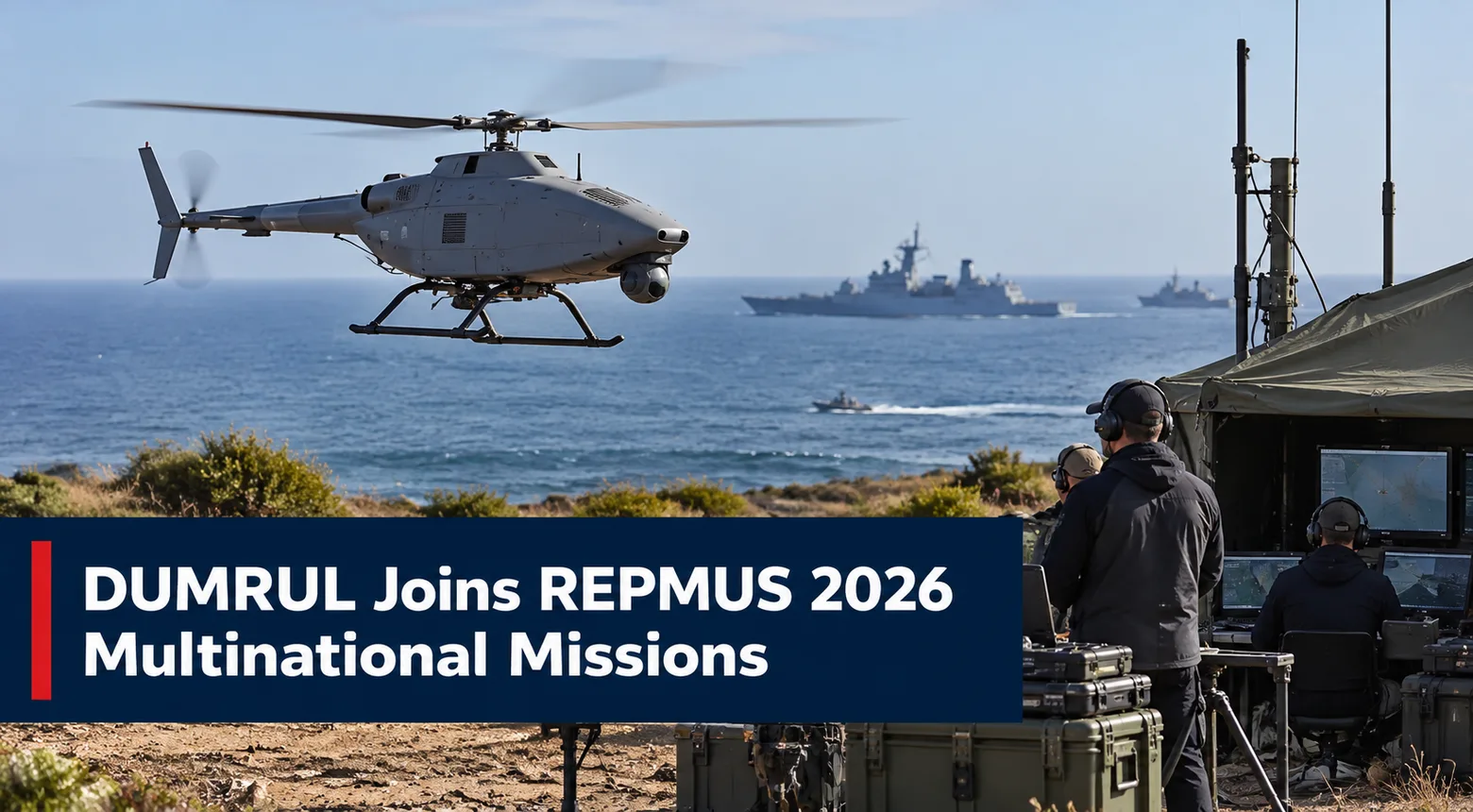
TİTRA Teknoloji’s DUMRUL mini unmanned helicopter is taking part in REPMUS 2026 in Portugal, flying in multinational scenarios that test interoperability, shared command-and-control and mission-data exchange. Pasifik Holding says the platform is already serving in the Turkish Armed Forces inventory, making the exercise an international integration milestone rather than DUMRUL’s first operational introduction.
REPMUS provides a multinational maritime test environment
REPMUS 2026 is being held in Portugal from 31 August to 25 September under Portuguese Navy leadership, with participation or organisational support from the University of Porto’s Faculty of Engineering, NATO’s Centre for Maritime Research and Experimentation, NATO JCGMUS and the European Defence Agency. The exercise is built around experimentation with maritime uncrewed systems and their integration into multinational operations.
For DUMRUL, the relevance is less about basic flight performance and more about joining that wider architecture. TİTRA is using the event to demonstrate coordinated missions with other systems, integration with common control structures and the use of mission information inside a shared operational framework.
DUMRUL was derived from experience with the larger ALPİN system
TİTRA says DUMRUL was developed using field experience gained with the ALPİN unmanned helicopter and feedback from users. The result is a more compact multi-purpose platform designed for vertical take-off and landing and a range of mission payloads. Pasifik describes it as Türkiye’s first armed mini unmanned helicopter.
The company states that DUMRUL uses electric propulsion, giving it a lower acoustic signature than a comparable combustion-powered configuration. It also has autonomous flight capability and a modular architecture intended to accept different mission equipment. Those characteristics are relevant in maritime and littoral scenarios where launch space may be limited and acoustic or visual signature can affect survivability and detection.
The platform has both surveillance and armed configurations
Pasifik says DUMRUL is intended for day and night reconnaissance, surveillance and target-detection missions and can also be adapted for armed tasks. Publicly described configurations include a six-round grenade launcher, mortar ammunition and ROKETSAN’s METE laser-guided mini missile.
Those configurations should not be interpreted as evidence that every DUMRUL in service carries each weapon. They show the range of integration options being developed for the air vehicle. The REPMUS activity is focused primarily on multinational mission execution, interoperability and control rather than on a newly announced weapons test.
Common control and data sharing are central to the exercise
During REPMUS, DUMRUL is being used in flight scenarios that involve coordination with other platforms and operational elements. Pasifik says the system is working with common ground-control infrastructure and sharing mission and status information through common communications messages. Data from different systems is then used within the joint operational structure.
That is an important maturation step for an unmanned platform. A UAV can have useful endurance, sensors and payloads but still be difficult to employ in coalition operations if it cannot exchange data or fit into shared command relationships. REPMUS gives TİTRA a venue to test those interfaces alongside systems from other countries rather than only in a national development environment.
Implications / Next
The next indicators will be any published results from the exercise, additional NATO-standard interface work, export demonstrations and contracts that require DUMRUL to operate inside a customer’s existing command-and-control architecture. Evidence of repeatable integration with third-party systems would be more significant than a one-off exercise appearance.
The maturity wording should remain precise. DUMRUL is described by Pasifik as already in Turkish Armed Forces inventory, so REPMUS is not a first-fielding story. It is an international interoperability and capability-demonstration milestone that may support export positioning and future multinational integration work.