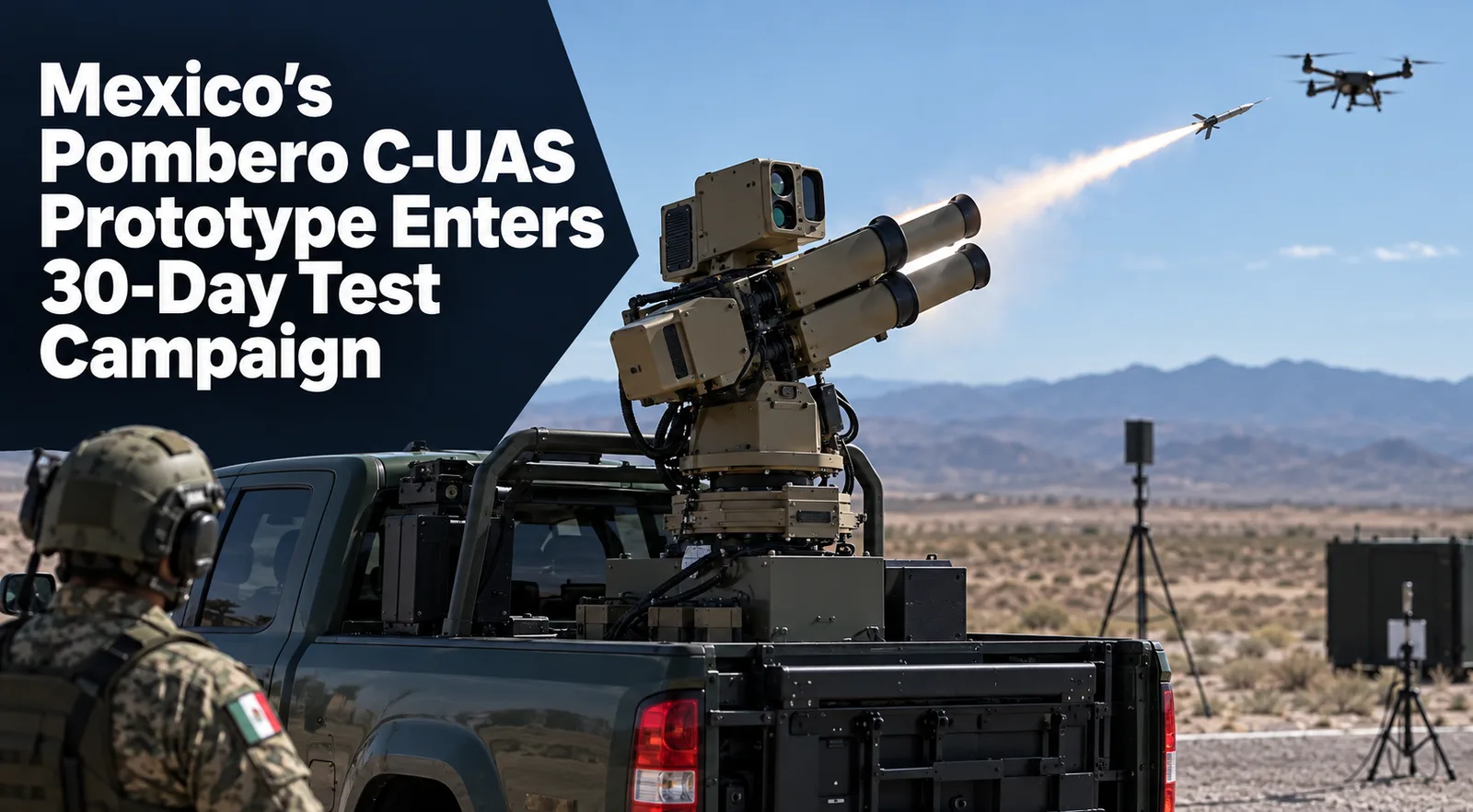
Roca Defense & Systems has presented Pombero, a low-cost counter-UAS interceptor developed with Mexico as a principal centre for prototyping, validation and planned manufacturing. The company says the system is entering a 30-day test campaign that will assess structural resistance, propulsion, manoeuvrability, stability, reliability and integration with the company’s SUPGOD operational-intelligence platform. That means Pombero remains a prototype rather than a finished operational product.
Pombero Enters Testing as a Latin American C-UAS Prototype
Roca is positioning the system for Latin American security requirements, including protection of strategic infrastructure and response to commercial drones adapted for illicit cargo or hostile use. The concept reflects a regional need that is not limited to conventional battlefields, but procurement customers and contracted quantities have not been publicly disclosed.
The Design Targets a Lower-Cost Physical Intercept
The developer describes the initial configuration as a vertical-take-off, high-speed interceptor with a target speed of up to 300 km/h, projected range of 17 km and maximum interception ceiling of 2.5 km. Maximum mass is described as approximately three kilograms depending on configuration. The prototype includes flight control, data link and a day/night camera to support visual confirmation and human oversight.
Those figures are developer targets rather than independently verified operational specifications. Roca has also discussed a future speed approaching 500 km/h but explicitly says it will not present that figure as proven until demonstrated. That distinction is important because prototype programmes often change rapidly as propulsion, control and structural limits become clearer in testing.
SUPGOD Is Intended to Coordinate the Sensor-to-Interceptor Chain
Pombero is being developed as part of a wider architecture rather than as an isolated air vehicle. The SUPGOD platform is intended to receive and correlate data from radars, cameras and other sensors, prioritise threats and support assignment of interceptors. Roca says human authority remains central to the engagement process even when the software recommends actions.
That architecture becomes more important when several drones and several interceptors are involved. A command layer must avoid duplicate targeting, maintain identification confidence and preserve operator control. The system’s effectiveness will therefore depend as much on sensor integration and decision logic as on the interceptor’s top speed.
The 30-Day Campaign Must Validate Basic Performance Before Procurement Claims
The current configuration is described as an inert interceptor without an integrated explosive payload, intended to physically neutralise hostile drones under controlled protocols. That can reduce some safety and regulatory issues compared with an explosive effector, but it also places greater importance on guidance accuracy and closing geometry. A small interceptor must repeatedly reach and contact agile targets to prove the concept.
The next milestones are completion of the 30-day campaign, publication of measured performance and any government evaluation or procurement. Until those results are available, Pombero should be described as a prototype entering validation, not as a fielded Latin American counter-drone system.
A further programme-management issue is the relationship between the announced milestone and the supporting infrastructure needed to turn it into repeatable capability. Training, maintenance, software configuration, supply-chain availability and acceptance standards can all become schedule drivers after the public announcement. For that reason, Defence Agenda will track follow-on evidence from the customer, supplier and relevant government authority rather than treating the initial milestone as the end of the acquisition cycle.
Implications / Next
The next Defence Agenda update should be tied to a dated, independently verifiable event that changes programme maturity: a delivery, exercised option, completed test, production milestone, operational acceptance or new contract action. Until that occurs, the current announcement should remain the baseline and should not be extrapolated into undisclosed quantities, performance or fielding status.