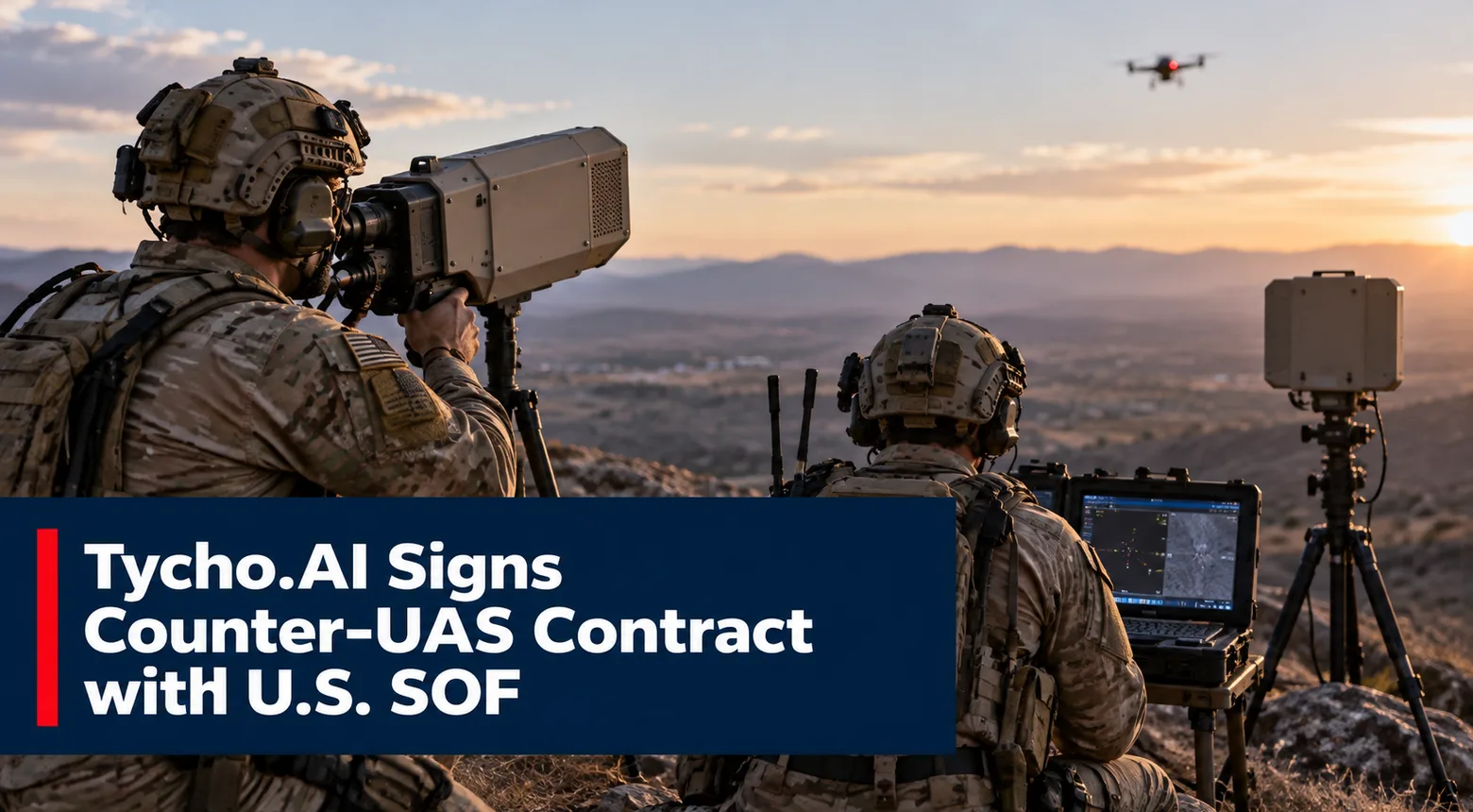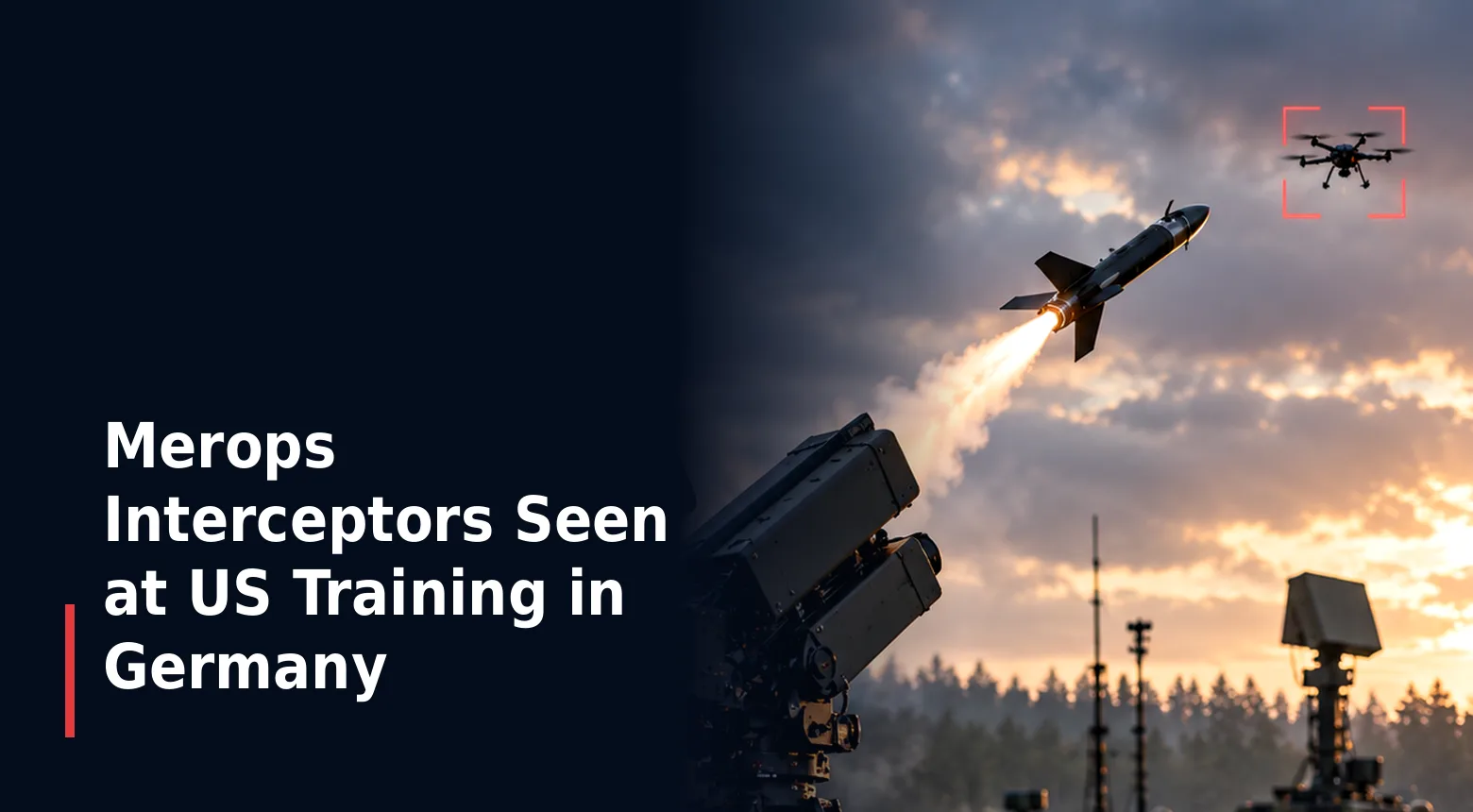
U.S. soldiers participated in counter-drone training at Grafenwoehr, Germany, and images associated with a 9 September 2026 report appeared to show Merops AS-3 Surveyor interceptor systems. The activity illustrates growing attention to low-cost counter-UAS tactics, although the public evidence does not establish that a new formal fielding decision or a successful live intercept occurred during that particular course.
A training sighting is not a procurement milestone
The Defence Blog reported that personnel trained on a counter-drone defence system at the Combined Arms Training Center in Grafenwoehr. Images associated with the account appeared to show Merops AS-3 Surveyor interceptor drones developed by Perennial Autonomy. However, the original public statement cited in the report did not identify the exact course or name the equipment. That attribution limit is important: photographs can support an equipment identification without proving the full scope of training or the result of a live-fire evaluation.
The Combined Arms Training Center operates within the U.S. Army's 7th Army Training Command network in Germany. Its wider mission is to improve soldier readiness and interoperability through specialised courses. A public U.S. Army account also documents counter-UAS instruction at Grafenwoehr earlier in 2026, providing institutional background, but it should not be presented as direct confirmation of the separate September Merops sighting.
Low-cost interceptors respond to a difficult economic problem
Military forces increasingly encounter relatively cheap one-way attack aircraft, multirotor drones and other uncrewed systems in numbers that strain conventional air-defence ammunition stocks. Using a large and expensive interceptor missile for every small threat can be operationally unsustainable. Small dedicated drone interceptors aim to change that cost-exchange relationship by pairing lower-cost effectors with appropriate detection, tracking and command systems.
The Defence Blog described Merops as a combat-experienced system used against Shahed-type threats in Ukraine and the Middle East. That background helps explain why U.S. personnel would be interested in the architecture. Nevertheless, reported unit prices and battlefield claims depend on configuration and acquisition terms, and they are not equivalent to independently verified performance of the specific items pictured in Germany.
Training must test the whole engagement chain
A counter-UAS system only succeeds if operators can detect a threat early enough, classify it correctly and give the interceptor a usable engagement solution. Small aircraft may approach at low altitude, exploit terrain and create false alarms or identification difficulties. Training must therefore include radar or optical sensing, target hand-off, deconfliction, launch procedures and confirmation of engagement results, not just familiarisation with an interceptor aircraft.
Electronic warfare and airspace restrictions add further complications. A system that performs well against an isolated target may face different conditions when several drones arrive together or when jamming affects links. Exercises can reveal these dependencies, but publicly released training photographs do not reveal the full test conditions or success rates. Any claim of operational readiness requires additional evidence from the responsible military organisation.
Industrial relevance goes beyond the hardware display
Perennial Autonomy and similar suppliers are benefiting from a growing military requirement for affordable counter-drone effects. A previous Pentagon contracting announcement described a broader acquisition pathway for multiple drone systems, but a framework ceiling must not be equated with fully funded procurement of a particular Merops quantity. Likewise, a sighting in Germany does not establish which service owns the equipment or how many units are available for operational use.
The next reportable steps would include named Army or allied training outcomes, a contract action covering quantities, formal evaluation results or public operational acceptance. Until such evidence emerges, the September activity is best categorised as training and equipment exposure, not introduction of a new deployed air-defence capability.
Implications / Next
Seek dated 7th Army Training Command records, an identified exercise report and confirmed system ownership before making stronger claims. The related January–February 2026 Army training documentation is contextual, not direct proof of the September system identification.