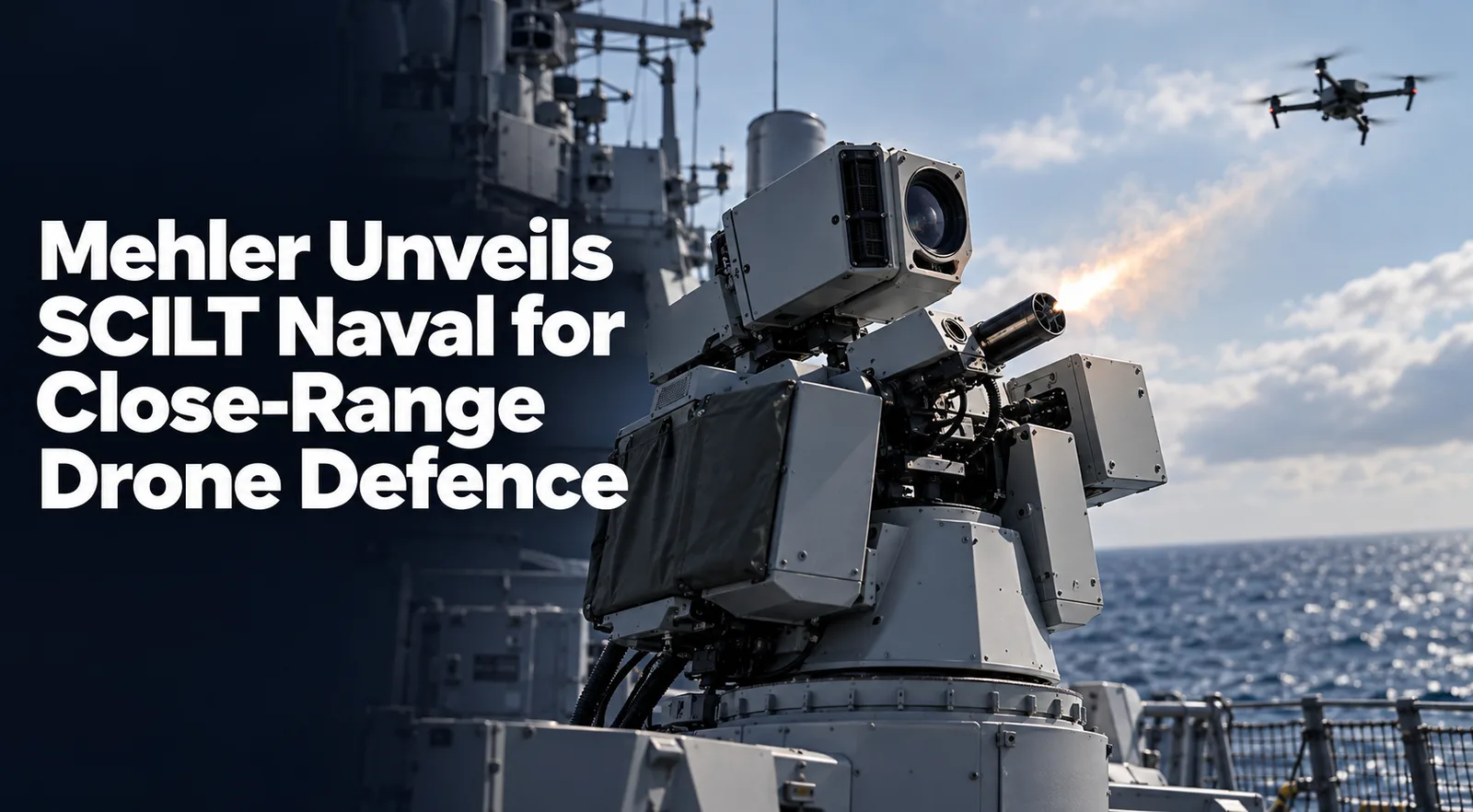
Mehler Protection has unveiled SCILT Naval, a close-range active counter-UAS system developed specifically for ship protection. The system was presented at SMM 2026 in Hamburg and is aimed at threats such as FPV drones, kamikaze UAVs and loitering munitions approaching inside the engagement envelope where larger naval air-defence systems may be inefficient or unable to react in time. Mehler positions the architecture as a last active protection layer.
SCILT Naval Targets the Final Defensive Zone Around a Ship
Some trade reporting has framed the system as a future German Navy capability, but the public sources reviewed for this package do not establish a disclosed fleet-wide procurement quantity or contract value. The confirmed milestone is the product unveiling and its maritime application. Any German Navy acquisition should therefore be treated separately when supported by an official award or service announcement.
Close-Range Drone Defence Is Becoming a Distinct Naval Requirement
Warships traditionally optimise air defence around aircraft and anti-ship missiles, with layered radars, interceptors, guns and electronic warfare. Small drones complicate that model because they can approach at low altitude, appear in clutter and cost far less than many naval missiles. A saturation attack can also force a ship to expend valuable magazine capacity on targets that are operationally dangerous but economically cheap.
SCILT Naval is intended to occupy the final defensive zone around a platform, particularly in ports, confined waterways, amphibious operations and other situations where reaction time is limited. That mission overlaps conceptually with close-in weapon systems but is tailored around the signatures and engagement economics of small uncrewed aircraft.
Sensors, Alert Logic and Effector Cost Drive the Architecture
Reporting on SCILT describes integrated sensing and multiple alert levels for detection, approach and engagement. Mehler also emphasises the use of commercially available and comparatively cost-effective effectors. The design logic is to avoid a cost-exchange ratio in which a defender repeatedly fires expensive missiles against low-cost drones.
The effectiveness of that approach will depend on detection reliability, identification, engagement authority and the ability to manage several simultaneous threats. Maritime backgrounds create clutter from waves, infrastructure, birds and other vessels, so false tracks and target discrimination matter. A last-line system must also integrate safely with the ship’s own weapons and sensors to avoid conflicting engagements.
Ship Trials and Procurement Evidence Are the Next Tests
An exhibition unveiling demonstrates product maturity only to a limited extent. The system must still prove performance in representative maritime environments, including vibration, salt exposure, electromagnetic interference and moving-platform engagement geometry. Live trials against realistic drone profiles will be more important than static display specifications.
The next publication-grade milestones are naval test campaigns, integration on a named vessel and any formal procurement decision. Until those events occur, SCILT Naval is best described as a newly unveiled maritime C-UAS product addressing a real operational gap, not as a fully fielded German Navy fleet standard.
A further programme-management issue is the relationship between the announced milestone and the supporting infrastructure needed to turn it into repeatable capability. Training, maintenance, software configuration, supply-chain availability and acceptance standards can all become schedule drivers after the public announcement. For that reason, Defence Agenda will track follow-on evidence from the customer, supplier and relevant government authority rather than treating the initial milestone as the end of the acquisition cycle.
Implications / Next
The next Defence Agenda update should be tied to a dated, independently verifiable event that changes programme maturity: a delivery, exercised option, completed test, production milestone, operational acceptance or new contract action. Until that occurs, the current announcement should remain the baseline and should not be extrapolated into undisclosed quantities, performance or fielding status.