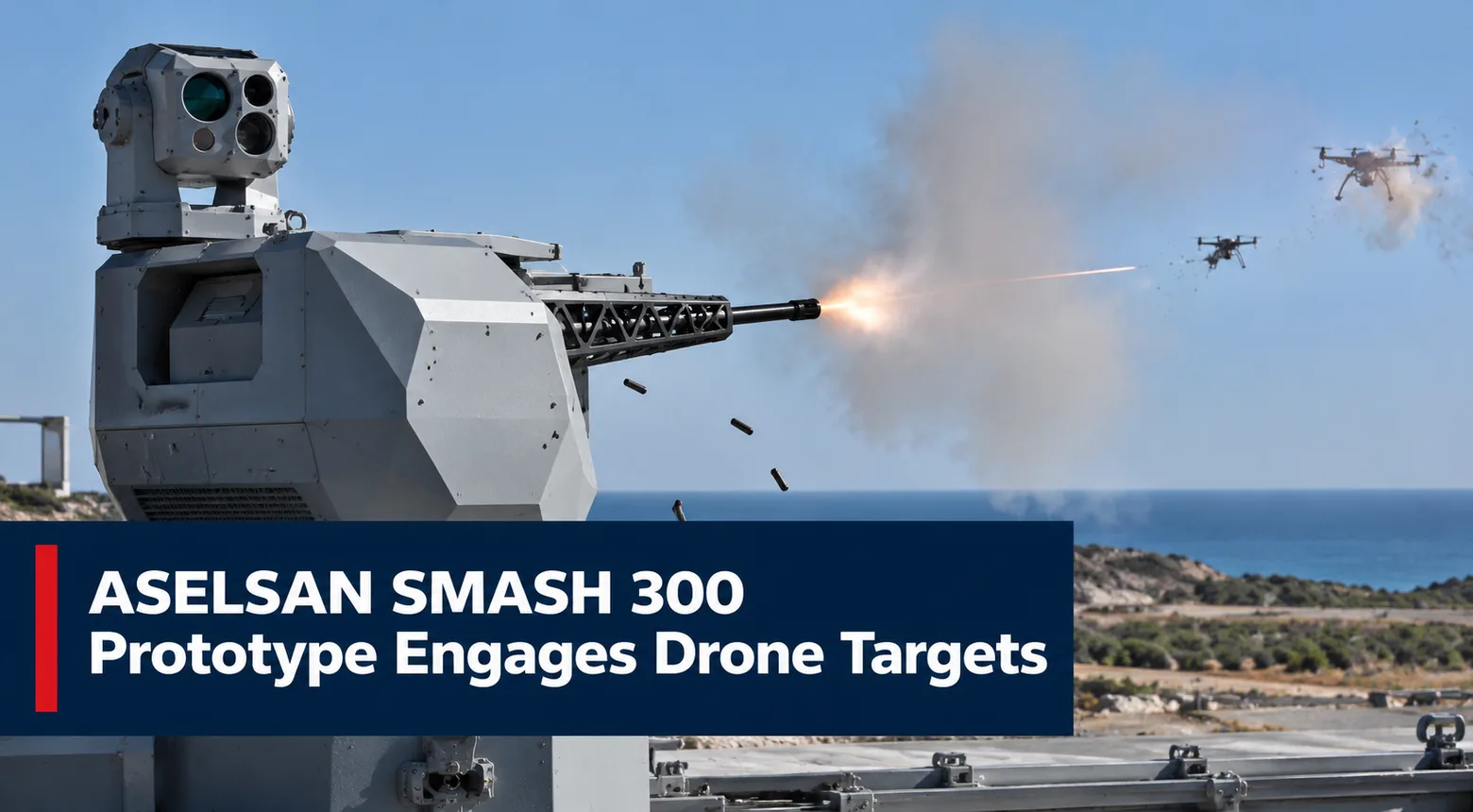
ASELSAN is testing SMASH 300, a new member of its remote-controlled stabilised naval weapon family designed to address mini- and micro-UAS as well as surface threats. The pre-prototype has been put through firing trials at Konya Karapınar, where the company demonstrated engagement of ground and airborne targets while continuing development work.
SMASH 300 builds on an established naval weapon family
ASELSAN introduced the SMASH remote-controlled stabilised naval weapon family in 2006 and has since developed four earlier solutions in the line. The company says it has delivered more than 560 SMASH systems to 18 countries and reached a 10% share of the global market in this segment. Those figures give the new variant a substantially different industrial starting point from a clean-sheet prototype.
SMASH systems are used on naval platforms, including warships and uncrewed surface vessels. The 300 variant is being developed in response to changing threats and user feedback, with the main new requirement centred on small airborne targets that are difficult to defeat with conventional surface-threat engagement logic.
AI-supported tracking and ATOM are the key additions
ASELSAN says SMASH 300 uses artificial-intelligence support for target detection and tracking. It also integrates ATOM smart ammunition, allowing the weapon to engage mini- and micro-UAS in addition to asymmetric surface threats. The combination is intended to improve the weapon station’s ability to detect, track and engage small, fast or low-signature targets.
TRT Haber’s coverage of the Karapınar trials provides an important detail on the engagement chain. After the system determines the aerial target’s position, that information is loaded into the 25 mm ATOM round before it leaves the barrel. The munition then airbursts near the target, creating a fragment pattern intended to defeat the drone without requiring a direct projectile impact.
The current milestone is a pre-prototype firing test
The system shown at Karapınar is described as a pre-prototype. Trials demonstrated effectiveness against land and air targets, with reporting also referring to tests against single and multiple UAS targets. Development and firing activity is continuing, which means the September event should not be described as formal qualification, serial-production approval or fleet-wide fielding.
That maturity distinction is important because the existing SMASH family is already mature and exported. The status of the family does not automatically transfer to the new 300 configuration. The AI-enabled tracking functions, ATOM integration and counter-UAS engagement logic still need to complete the relevant development, qualification and user-acceptance steps for the new variant.
The counter-UAS role expands shipboard close defence options
Small drones are increasingly part of the threat set facing naval forces in port approaches, littoral areas and at sea. A remote weapon station that can use programmable airburst ammunition provides an additional engagement layer below larger missile systems, particularly against targets for which a high-end interceptor may be disproportionate.
SMASH 300 also has an integration advantage if navies already operate related SMASH systems. Common support concepts, interfaces or training may reduce adoption friction, although ASELSAN has not announced a launch customer for the 300 variant. The company’s existing export footprint is therefore market context, not evidence of orders for the new configuration.
Implications / Next
The next meaningful milestones will be completion of development firing, formal qualification, integration on a representative naval platform and an announced customer or production order. Tests against denser raids, manoeuvring targets and different environmental conditions would provide a clearer picture of counter-UAS performance.
For now, SMASH 300 should be treated as a pre-prototype in active firing trials. The significant technical step is the combination of AI-supported target handling with programmable ATOM ammunition in a naval remote weapon station, while serial production and operational fielding remain to be demonstrated.