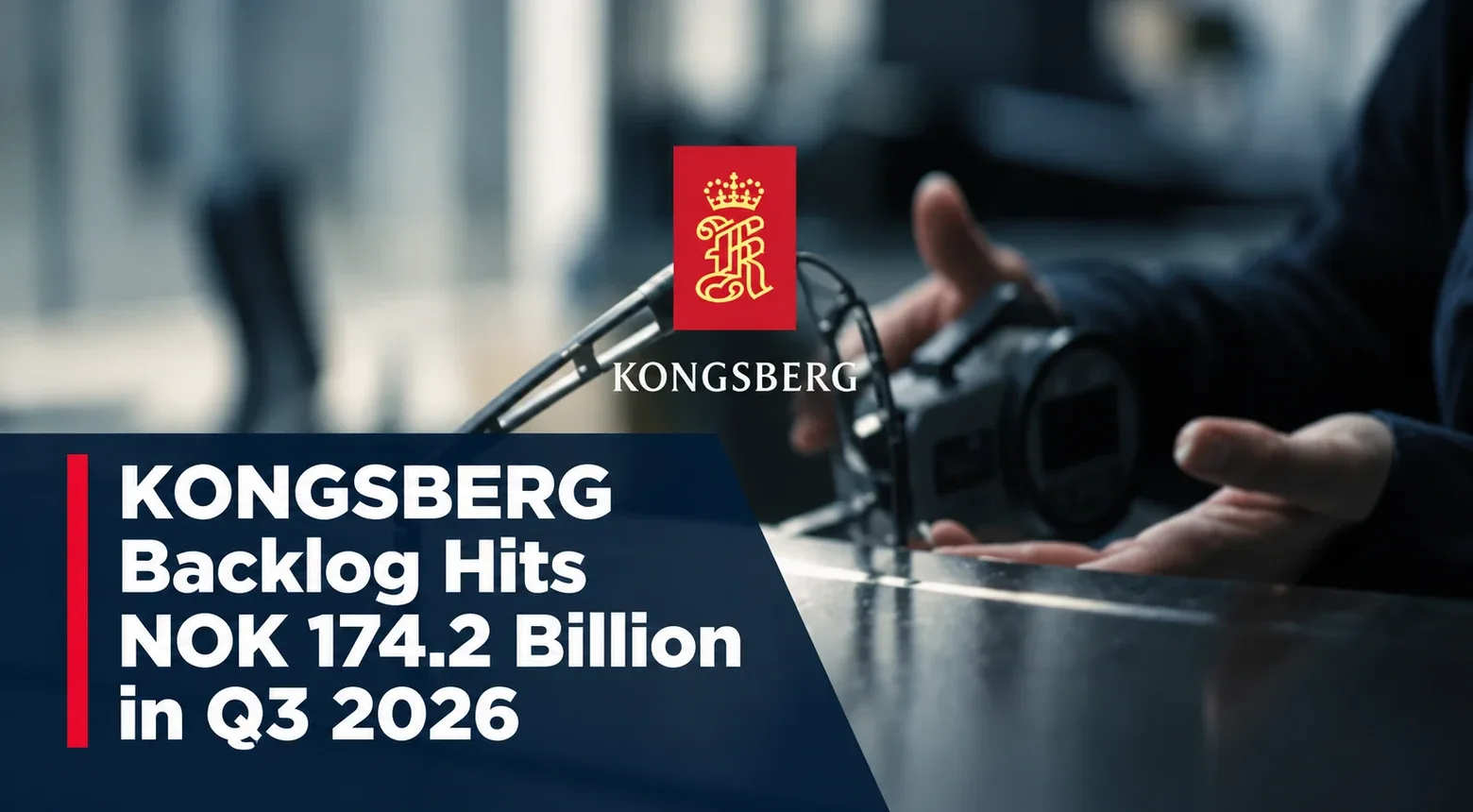
KONGSBERG’s Kongsberg Q3 2026 backlog reached a record NOK 174.2 billion at 30 September 2026, reflecting a surge in demand for air defence, missiles, remote weapon stations and underwater technology. The Norwegian defence and technology group reported NOK 23.3 billion in third-quarter orders, 50% revenue growth and a substantial investment push to expand production. For procurement authorities, the result highlights both the scale of European rearmament and a critical question: how quickly industry can convert signed contracts into delivered military capability.
Why Kongsberg's Record Order Backlog Matters
KONGSBERG published its third-quarter results on 29 October 2026, after a period of major NATO and allied procurement decisions. The company's order intake nearly doubled and a half compared with the same quarter in 2025. More importantly, the customer commitments now stretch several years ahead, making manufacturing capacity, supplier performance and contractual delivery dates central to assessing future growth.
According to the company's earnings announcement, third-quarter orders rose to approximately NOK 23.3 billion, from NOK 9.5 billion a year earlier. The reported book-to-bill ratio was 2.06, meaning that the value of orders received during the period was roughly twice the reported sales measure used for this operational ratio. It is not a cash-collection metric, and it does not establish when customers will accept finished equipment.
KONGSBERG’s structure also changed in 2026. Kongsberg Maritime became a separately listed company on 23 April 2026. Consequently, these results relate to the remaining KONGSBERG group and should not be combined with the standalone maritime company's earnings. The divisions relevant to this report are Defence Systems, Missiles & Aerostructures and Discovery.
Kongsberg Q3 2026 Revenue, EBIT and Accounting Basis
The group reported approximately NOK 11.328 billion of revenue in the third quarter on its management presentation basis, including its proportional share of joint ventures. That represented 50% growth from NOK 7.568 billion in the corresponding 2025 quarter. Reported operating profit, or EBIT, increased 66% to NOK 1.861 billion, equivalent to a 16.4% margin on that basis, compared with 14.8% a year earlier.
The distinction between headline operational figures and statutory consolidation matters. The quarterly report reconciles joint-venture-inclusive revenue of NOK 11.328 billion to NOK 10.842 billion under its IFRS reporting presentation. The same distinction applies to the order book: the widely reported NOK 174.243 billion includes proportional interests in joint ventures, while the reconciliation identifies NOK 169.788 billion attributable to the consolidated reporting basis.
These figures are not competing company results. They are different measurement scopes, and using the two bases interchangeably could distort comparisons with other defence groups. In its accompanying statement on delivery priorities, Chief Executive Eirik Lie emphasised execution of the accumulated contracts rather than treating the backlog as realised sales.
The third-quarter figures should likewise not be confused with nine-month totals. From 1 January to 30 September 2026, KONGSBERG accumulated NOK 66.956 billion in new orders, compared with NOK 33.186 billion over the equivalent 2025 period. The headline NOK 23.347 billion figure applies only to the July–September quarter.
NASAMS Orders Drive European Air Defence Demand
A major contributor was Belgium's decision to acquire the National Advanced Surface-to-Air Missile System (NASAMS). KONGSBERG disclosed a contract worth around NOK 10 billion on 29 September 2026; the quarterly report identifies the underlying contract at approximately NOK 9.8 billion. The Netherlands procurement authority is buying the system on Belgium's behalf, with the Belgian Air Force as end user. Belgium became the 18th NASAMS customer nation, according to KONGSBERG.
KONGSBERG also reported further Dutch procurement activity valued at about NOK 1.5 billion, covering additional NASAMS capability and NOMADS short-range air defence vehicles. These awards are important in the context of Europe's effort to expand defensive capacity, increase stockpiles and reduce delivery bottlenecks. Defence Agenda's earlier assessment of European air defence production constraints examines the wider industrial problem beyond any single supplier.
A large backlog can enable production investment because it gives contractors a stronger view of future demand. However, a signed contract does not necessarily indicate a complete battery has been manufactured, delivered, integrated or accepted into service. The ultimate force-generation effect will depend on phased production, radars, fire-control equipment, launchers, missiles, training and sustainment arrangements.
NSM, JSM and Remote Weapon Station Programmes
Beyond air defence, missile orders remained a central growth factor. KONGSBERG reported additional Joint Strike Missile (JSM) procurement by the US Air Force for the F-35 fleet and a framework agreement with the US Marine Corps covering support for the Naval Strike Missile (NSM). A framework agreement signals a contracting arrangement and possible future activity; it should not automatically be counted as a fully executed procurement of the maximum potential value.
The company also reported orders for remotely operated weapon stations for Canadian armoured vehicles. Such products have relevance to the growing counter-uncrewed aircraft systems (counter-UAS) market, although the precise configurations and counter-drone performance of each contract should not be inferred from a broad product-family description.
This wider market intersects with initiatives to diversify European interceptor supply, including the emerging Freyja missile-defence effort. That project is not part of KONGSBERG's quarterly contract disclosures; its relevance lies in the wider procurement push for integrated sensors, weapons and command systems.
Industrial Capacity Expands in Norway and Poland
Demand alone does not deliver military systems. KONGSBERG has therefore begun expanding facilities in Norway and abroad, while also integrating specialist businesses acquired in 2026. In October, the company opened Horten Horizon, a 45,000-square-metre campus with laboratories and production infrastructure serving its technology portfolio.
On 13 October 2026, KONGSBERG separately announced a manufacturing facility in Poland supporting counter-UAS equipment and the Polish SAN programme. The planned investment exceeds PLN 200 million, with more than 100 long-term jobs expected when the plant reaches full capacity. The company said serial production could commence in the first half of 2028. That is a forward programme target, not a completed production milestone.
KONGSBERG is also extending its undersea capabilities. The quarter included a US government contract of USD 54 million for autonomous underwater systems and regulatory approval relating to Sonatech, a specialist in underwater acoustics. The company said its earlier acquisition of Zone 5 Technologies expanded its portfolio of missiles designed for cost-effective production at scale; a related US Navy selection was valued at USD 65 million. These projects support portfolio breadth, but their values should not be added to disclosed group order intake without checking contract accounting and timing.
The company's links with maritime technology require a further qualification. Defence Agenda's coverage of Kongsberg Maritime and Steerprop concerns the separately listed maritime business, not the same consolidated entity whose order book is assessed here. Conflating their results would overstate the defence-focused group's operating scale.
Procurement Risks and Competitive Context
The industrial challenge now moves from winning work to completing it. Missile production requires long-lead components, propulsion, guidance electronics, energetic materials, specialised test infrastructure and qualified suppliers. Air defence programmes add integration dependencies across sensors, launch platforms and command networks. These factors can constrain delivery even when funding has already been allocated.
There is a positive counter-argument: a multi-year backlog improves planning visibility and supports investment in dedicated plants, supplier contracts and specialist labour. Reuters reported on 29 October 2026 that management described substantial portions of its 2027 work as covered by fixed-price contracts and supplier agreements, which could mitigate some exposure to inflation and input-price changes. It does not remove execution risk, foreign-exchange effects or the possibility of schedule adjustments.
The NOK 174.2 billion backlog is therefore best interpreted as evidence of committed customer demand, not a forecast that the full amount will become revenue in a particular year. Comparisons with peers should adjust for joint-venture treatment, currency, contract types and the mix of missiles, service work and platform systems.
Implications / Next
The principal milestones for the next reporting periods are the rate at which KONGSBERG converts orders into recognised revenue, delivers major NASAMS systems, scales JSM and NSM manufacturing, and commissions new counter-UAS production capacity. Investors and procurement agencies will also watch whether operating margins and working capital remain resilient as factory investment increases.
KONGSBERG's results show an increasingly substantial defence-industrial pipeline. They do not, on their own, prove that allied inventories or operational readiness have already increased by an equivalent amount. The strategic question for 2027 and beyond is whether delivery execution can keep pace with expanding demand.
Further Reading
- KONGSBERG: Official Q3 2026 results announcement
- KONGSBERG: CEO perspective on backlog delivery
- KONGSBERG: Q3 2026 financial report (English PDF)
- Reuters: Kongsberg Q3 orders and defence demand
- Defence Agenda: European air defence production constraints
- Defence Agenda: Freyja interceptor system
- Defence Agenda: Kongsberg Maritime–Steerprop acquisition