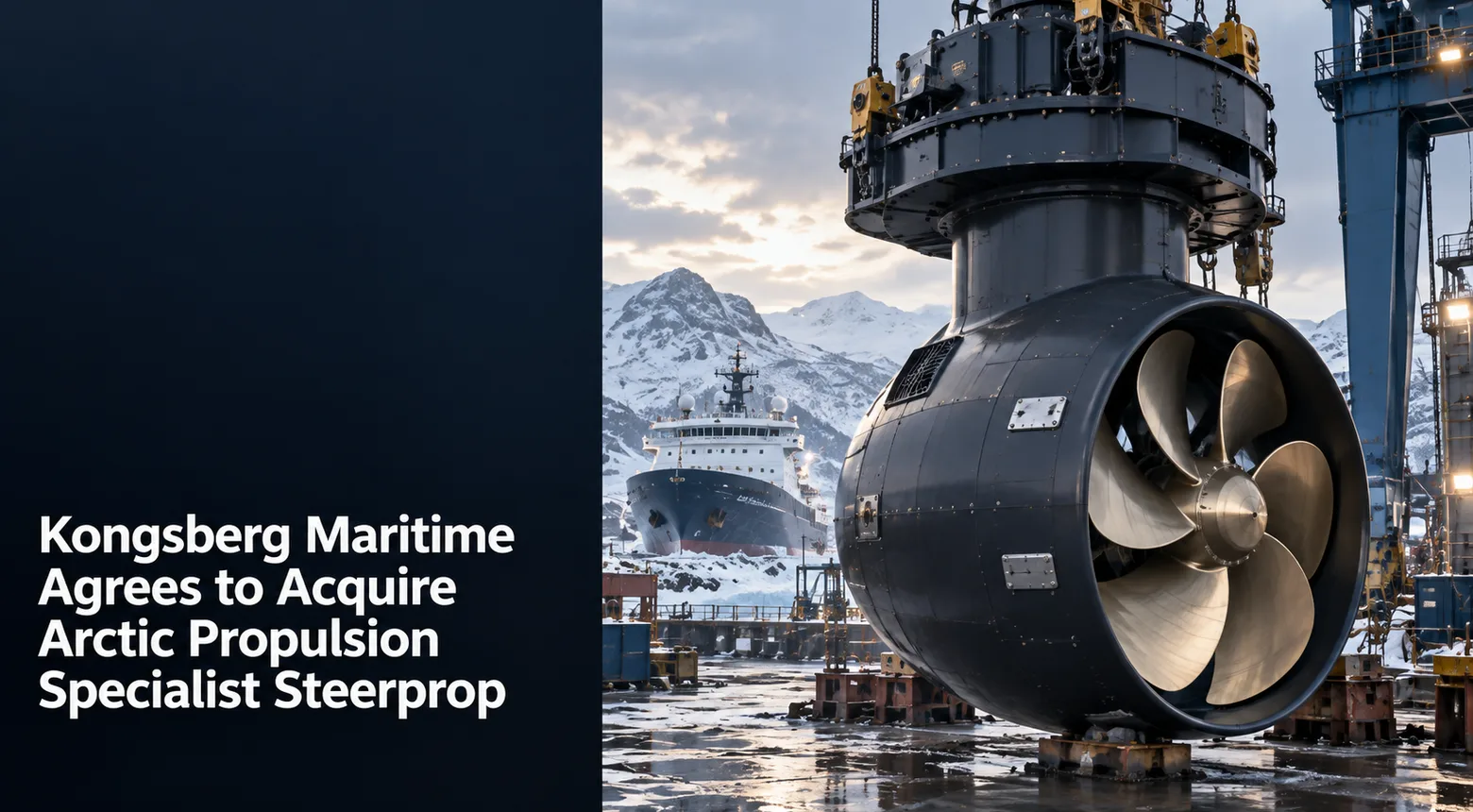
Kongsberg Maritime has entered an agreement to acquire Finnish propulsion specialist Steerprop, expanding its marine-technology portfolio into a segment with growing relevance for Arctic and high ice-class vessels. The companies announced the agreement on 7 September 2026, highlighting Steerprop’s expertise in azimuth propulsion and an installed base of more than 400 vessels worldwide.
The transaction is strategically coherent with Kongsberg’s broader systems-integration model. Rather than adding a generic propulsion supplier, the acquisition would bring a specialist product line used in demanding ice and polar environments, where propulsion units must tolerate high loads, frequent manoeuvring and complex hydrodynamic conditions. That capability can complement Kongsberg’s bridge, automation, navigation and lifecycle-support businesses on both commercial and government vessels.
Key Facts
- Kongsberg Maritime announced the acquisition agreement on 7 September 2026.
- Target company: Finnish azimuth-propulsion specialist Steerprop.
- Steerprop has an installed base on more than 400 vessels globally, according to the companies.
- The company specialises in propulsion for high ice-class and Arctic vessels.
- Steerprop’s order backlog is described as weighted toward Arctic and ice-class applications.
- The reviewed announcements do not disclose the purchase price; the agreement should not be described as a completed acquisition until closing.
Kongsberg targets a specialist position in ice-class propulsion
The development is best assessed as a programme milestone rather than a complete operational endpoint. The verified evidence establishes the event described above, while subsequent procurement, integration, readiness or fielding claims require their own confirmation as the programme advances. That distinction is important for comparing announcements across defence programmes, where testing, production, delivery and operational acceptance are separate maturity stages with different evidentiary thresholds.
Arctic demand gives the deal a defence and security dimension
Steerprop’s backlog is described by the companies as being heavily weighted toward Arctic and ice-class applications. That market is being supported by new icebreakers, research vessels, offshore support ships and government fleets as northern routes and infrastructure receive greater strategic attention. For NATO countries in particular, the ability to build and sustain ships that can operate in high latitudes has become an industrial-base issue as well as a commercial one.
The acquisition does not mean every Steerprop product will move into defence programmes, and the companies have not presented the transaction primarily as a military deal. Its relevance to the defence-and-aerospace market is indirect but material: propulsion is a long-lead subsystem that can constrain availability and design choices for ice-capable patrol ships, auxiliaries and specialised support vessels. A larger parent with global service infrastructure can also improve lifecycle support in remote operating areas.
Deal value and closing remain the key outstanding points
The reviewed company announcements do not disclose a purchase price, so no transaction value should be inferred. They also describe an agreement to acquire Steerprop rather than a completed transfer of ownership, which means the acquisition remains subject to the closing process and any applicable approvals. That distinction matters for reporting because strategic rationale and signed agreement do not yet equal consolidated operations.
After closing, the main indicators will be product-line integration, retention of Steerprop’s Finnish engineering base, investment in production capacity and how Kongsberg combines propulsion with its existing automation and vessel-control portfolio. If the companies can preserve specialist engineering while scaling procurement, service and systems integration, the deal could strengthen European capacity in a technically demanding maritime niche. Until those steps are visible, the acquisition should be treated as an agreed industrial consolidation with its operational effects still to be demonstrated.
Implications / Next
The next publication-grade milestone will be the first independently verifiable step that moves the programme beyond the status described here—such as a follow-on test, formal contract action, delivery, operational deployment or completed transaction, depending on the story. Defence Agenda will treat each maturity stage separately and will not infer production, operational capability or procurement completion from an earlier demonstration or announcement. The most useful follow-up evidence will therefore be dated official documentation, customer acceptance, serial-production data or operational activity that can be cross-checked against the current record.