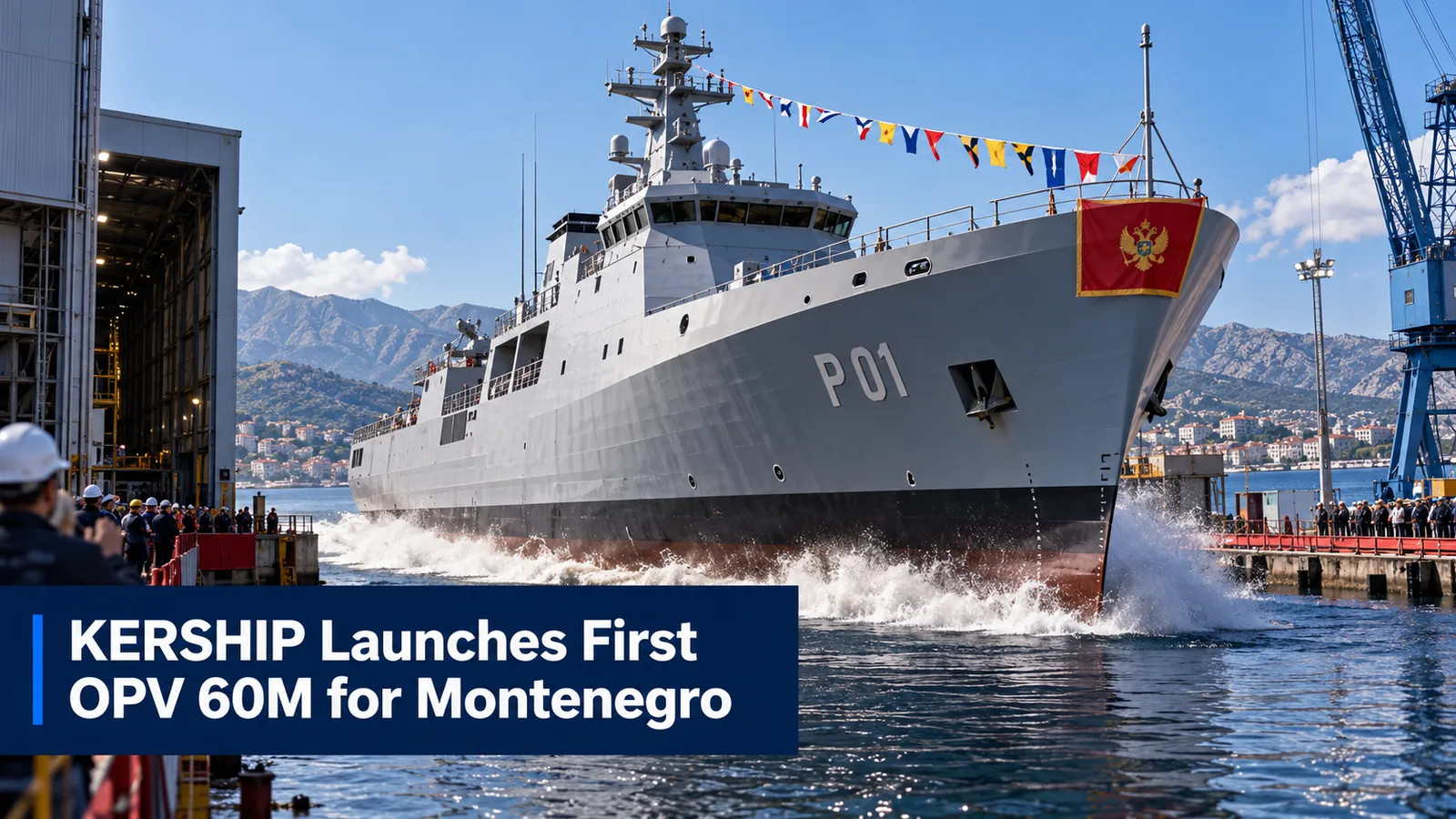
KERSHIP has launched Petar I Njegoš, the first of two OPV 60M offshore patrol vessels ordered for the Montenegrin Navy, marking the transition of the lead ship from construction to afloat completion and trials. The milestone matters because the two-ship programme is central to Montenegro’s naval recapitalisation, but launch is not delivery or commissioning: the ship still has to complete outfitting, testing and acceptance activity.
Lead ship enters the afloat completion phase
The first OPV 60M was launched in France on 11 September 2026 and named Petar I Njegoš. Montenegrin reporting citing government information says the vessel is expected to undergo several months of testing in France before reaching Montenegrin waters in early spring. The second vessel, Petar II Njegoš, is expected to follow later, with current reporting pointing to arrival in the following autumn.
KERSHIP began construction work on the programme after the November 2024 contract for two patrol vessels. The launch therefore represents a classic naval construction milestone: the hull is afloat and the programme can progress into systems completion, harbour activity and sea trials. It should not be described as a delivery, acceptance or commissioning event, because those milestones require separate completion and customer actions.
Two-ship programme refreshes Montenegro’s patrol fleet
For Montenegro, the OPV 60M programme is designed to provide a more modern platform for maritime surveillance, patrol, law-enforcement support, search-and-rescue assistance and defence tasks in the Adriatic. A compact offshore patrol vessel can sustain routine presence at lower operating complexity than a larger frigate while still providing a useful platform for sensors, small boats and mission equipment.
The programme also has an alliance dimension. Montenegro joined NATO in 2017, and a modern patrol-vessel fleet improves its ability to contribute to regional maritime awareness and allied activity while maintaining sovereign coverage of national waters. The strategic effect comes less from a single heavily armed ship and more from availability, endurance and the ability to keep a capable platform at sea for routine security missions.
KERSHIP export model remains the industrial story
KERSHIP brings together Naval Group and Piriou experience in patrol-vessel design and construction. The Montenegro order is relevant industrially because it sits in a competitive segment where European shipbuilders are offering modular patrol vessels to navies that need modern hulls without the cost or personnel burden of full-size surface combatants. Delivering both ships on the planned schedule will be important to KERSHIP’s reference base for future tenders.
The launch also illustrates why export shipbuilding milestones need precise terminology. A named vessel entering the water is highly visible, but significant technical work can remain after launch, including combat-system integration, machinery trials, communications checks, safety certification and crew familiarisation. The next phase will determine whether the construction progress converts into timely acceptance by the Montenegrin customer.
Implications / Next
The next reportable milestones are completion of outfitting, harbour acceptance activity, sea trials, formal delivery and eventual commissioning into the Montenegrin Navy. The second OPV’s own launch and trial sequence will then show whether KERSHIP is maintaining the programme cadence. Defence Agenda will treat any revised dates, weapons fit or mission-system details as confirmed only when disclosed by Montenegro, KERSHIP, Piriou or another authoritative programme source.
For Montenegro, the acquisition is also a force-structure transition rather than a simple hull replacement. A new patrol vessel only becomes an operational capability after its crew, maintenance chain, combat-management interfaces and embarked equipment are brought through acceptance and work-up. That distinction matters for a small navy because training and sustainment capacity can become pacing items even after the shipbuilder completes trials. The launch therefore marks visible construction progress, while the programme's operational value will depend on the follow-on acceptance and integration sequence.