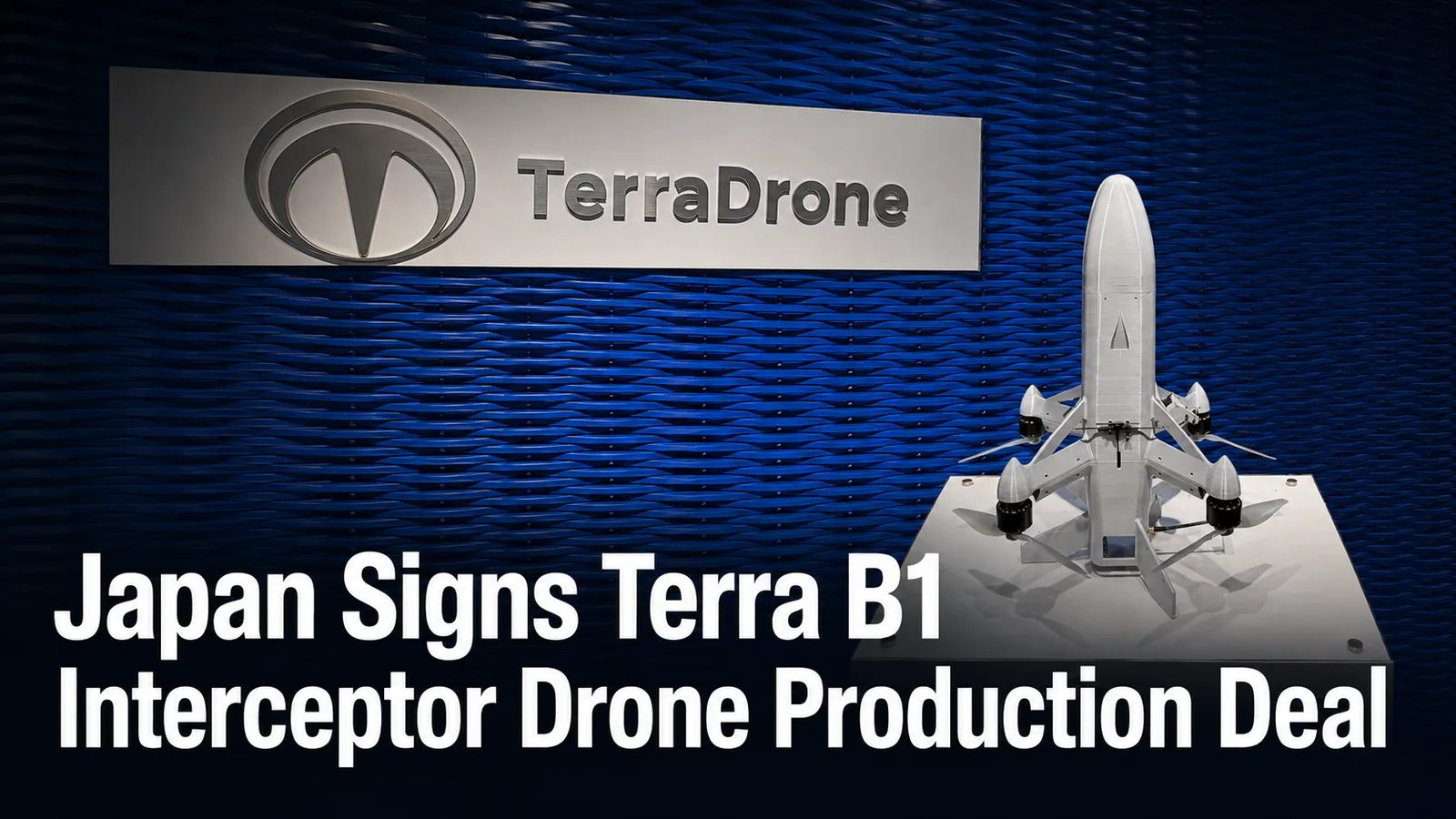
Japan’s Acquisition, Technology & Logistics Agency (ATLA) has signed a mass procurement contract with Terra Drone for the Terra B1 interceptor drone, completing a fast-track selection and demonstration cycle intended to accelerate counter-UAS fielding for the Japan Self-Defense Forces.
ATLA confirmed on 25 August 2026 that the contract followed Japan Maritime Self-Defense Force-led demonstration trials of four interceptor-drone types conducted from 15 July to 6 August. Terra Drone separately said Terra B1 was the only system to pass the demonstration stage. The award gives Japan a domestically produced interceptor intended to counter long-range one-way attack UAVs while reducing dependence on higher-cost missile interceptors.
Key Facts
- Contract date: 25 August 2026
- Customer: Japan Acquisition, Technology & Logistics Agency (ATLA)
- System: Terra B1 interceptor drone
- Manufacturer / contractor: Terra Drone Corporation
- Trial window: 15 July–6 August 2026
- Trial field: Four interceptor-drone types were demonstrated under the rapid acquisition programme
- Intended threat class: Long-range one-way attack UAVs, including Shahed-type systems
- Contract value and quantity: Not publicly disclosed
Context and New Development
Japan launched the Interceptor Drone Early Acquisition Program in June 2026 as an accelerated procurement initiative for counter-UAS equipment. ATLA’s original programme notice said the Self-Defense Forces wanted to obtain more effective interceptor drones rapidly and assess their contribution to protecting garrisons, air bases, ships and other defended sites.
The official requirement defined the target set broadly as unmanned aircraft generally operating below about 18,000 ft, at around 250 kt, and weighing no more than 600 kg, with particular emphasis on long-range one-way attack UAVs such as Shahed- and HARPY-type systems. The programme schedule called for demonstration activity in late July and early August, a mass procurement decision in late August and delivery around September 2026, subject to test results.
ATLA announced four demonstration candidates on 15 July: BVQ404, QS INTERCEPTOR, Terra B1 and IonStrike. Following the trial period, ATLA’s 25 August contract notice identified only Terra B1 and Terra Drone as the system and contractor selected for mass procurement.
This distinction is important editorially. Terra Drone states that Terra B1 was the only system to pass the demonstration test. ATLA’s public notice does not publish pass/fail scores for the other candidates; it confirms that four types were tested and that the resulting mass procurement contract was signed with Terra Drone. The official contract award therefore corroborates Terra B1’s progression to procurement without disclosing the comparative evaluation data.
Technical and Operational Impact
Public sources do not disclose Terra B1’s range, endurance, top speed, guidance architecture, warhead or precise engagement method. ATLA’s programme documents do, however, show the evaluation framework used for the interceptor category. Proposals were expected to address effective range, flight time, flight distance, maximum and cruising speed, guidance during initial, mid-course and terminal phases, simultaneous control of multiple aircraft, launch and recovery methods, interfaces with other equipment, safety measures, operational history and delivery lead time.
Those criteria indicate that Japan is treating the interceptor not as a stand-alone airframe but as part of a wider counter-UAS kill chain. Operational value will depend on how quickly Terra B1 can receive target information, transition to terminal guidance, operate around friendly aircraft and shipboard systems, and be supported by launch, control, maintenance and replenishment infrastructure.
The maritime dimension is particularly significant. Terra Drone says the initial introduction is intended to begin with the Japan Maritime Self-Defense Force, while future adaptation for the Air and Ground Self-Defense Forces is also under consideration. Shipboard counter-UAS use places additional pressure on command-and-control integration, deck handling, electromagnetic compatibility, storage, battery management and safe engagement geometry around vessels.
Programme and Procurement Dimension
The procurement model is almost as important as the interceptor itself. ATLA opened the programme in early June and signed the production contract on 25 August, compressing requirements gathering, candidate selection, trials and contracting into roughly three months. Japan’s defence minister had already described speed as one of the programme’s central objectives, presenting the effort as a trial of a faster acquisition model.
ATLA’s initial documentation also required bidders to provide indicative acquisition plans across multiple quantity bands and to address post-delivery maintenance, replenishment and training. The final contract announcement did not disclose which quantity band was selected, the contract value, unit price, delivery lot, sustainment package or the exact delivery date.
The original programme timetable targeted delivery around September 2026. That target should be treated as a programme objective rather than a confirmed final delivery date until ATLA or Terra Drone publishes the contractual schedule.
Industrial Impact
For Terra Drone, the contract converts a rapid entry into the defence market into a domestic Japanese procurement milestone. The company said it will move ahead with Terra B1 mass production, domestic production and sourcing arrangements, stronger supply chains for components, batteries, communications and control equipment, and support structures covering maintenance, replenishment and training.
Terra Drone has also been building a broader interceptor-drone portfolio through Ukrainian defence-technology partnerships. In 2026 it consolidated Amazing Drones, associated with the short-range Terra A1 interceptor, and WinnyLab, associated with the longer-range fixed-wing Terra A2. Terra Drone has reported operational deployment and interception experience in Ukraine for those systems.
There is no public evidence that Terra B1 is simply a renamed Terra A1 or Terra A2, and the systems should not be treated as identical. Terra Drone instead says it is combining knowledge gained from operational environments including Ukraine with Japanese domestic production, mass-manufacturing and regulatory capabilities. The industrial significance of Terra B1 therefore lies in transferring counter-UAS lessons into a Japan-focused production and support model rather than in a publicly demonstrated one-to-one platform lineage.
Limitations and Counterpoint
Several details required for a full programme assessment remain unavailable. Neither ATLA nor Terra Drone has publicly disclosed the contract value, number of aircraft ordered, unit cost, production rate, detailed delivery schedule, engagement performance, test scores or probability-of-kill data. The public record also does not describe the sensor package, terminal seeker, defeat mechanism or level of autonomy used by Terra B1.
ATLA’s contract announcement confirms the procurement decision but does not explicitly state that the other three demonstrated systems failed. That wording appears in Terra Drone’s own announcement. Until comparative test results are released, the strongest independently verifiable conclusion is that Terra B1 was the sole platform named in the resulting mass procurement contract.
Cost-exchange arguments also require caution. Interceptor drones are intended to reduce reliance on expensive surface-to-air missiles against lower-cost UAV threats, but no public Terra B1 unit price is available. Its actual economic advantage will depend on procurement cost, success rate, launch and support infrastructure, attrition, training and whether individual interceptors are reusable or expendable.
Implications / Next
The next milestone is whether the rapid contracting model translates into rapid field delivery. The original ATLA schedule pointed to September 2026, making production ramp-up and acceptance activity the immediate indicators to watch.
Further disclosure on order quantity and unit economics would allow a clearer assessment of whether Japan is building a limited operational evaluation stock or the first layer of a larger counter-UAS inventory. Integration with JMSDF sensors, command systems and shipboard operating procedures will be equally important because an interceptor drone only becomes an effective air-defence layer when it is connected to detection, identification, engagement authority and battle-management processes.
Follow-on demand from the Air and Ground Self-Defense Forces would signal that Terra B1 is evolving from a maritime-led rapid acquisition into a broader national counter-UAS programme. Industrially, the key indicators will be domestic production rate, battery and communications supply, quality assurance, training capacity and the ability to sustain repeated interceptor consumption at scale.
Conclusion
Japan’s Terra B1 decision is both a counter-UAS procurement and an acquisition-process experiment. ATLA moved from programme launch to a mass procurement contract in roughly three months, after testing four interceptor-drone types under a Japan Maritime Self-Defense Force-led demonstration cycle.
Terra B1 now has the strongest public procurement status among the demonstrated systems, but critical details remain undisclosed. Quantity, value, unit cost, technical performance and final delivery terms will determine whether the programme becomes a limited rapid-fielding effort or the foundation of a larger Japanese interceptor-drone layer.