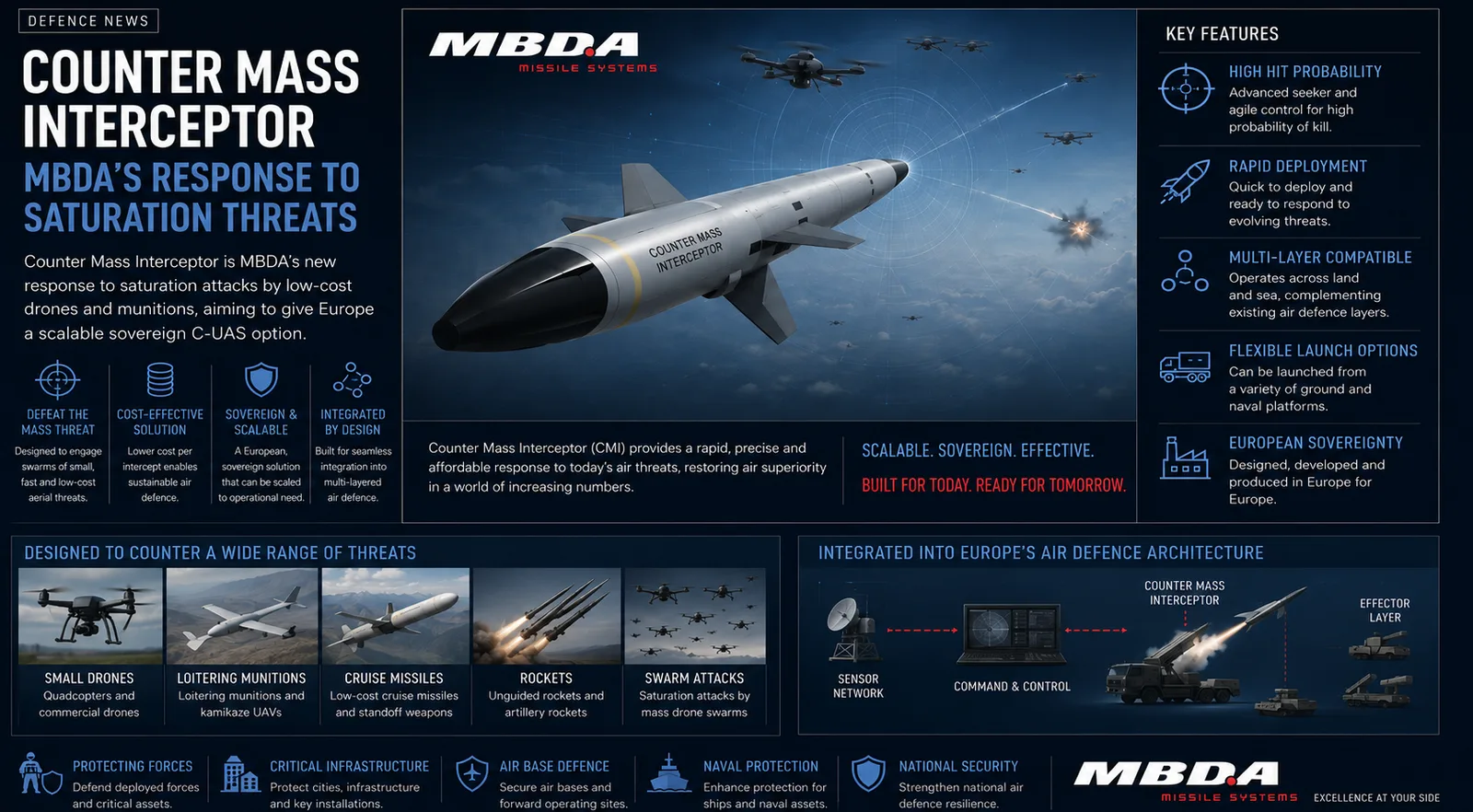
Counter Mass Interceptor gives MBDA a new European answer to one of the hardest air-defence problems of modern warfare: how to stop mass attacks by low-cost drones and munitions without exhausting expensive missile stockpiles.
Reuters reported that MBDA is launching the Counter Mass Interceptor to counter attacks by large numbers of inexpensive weapons such as drones. The system was unveiled at Farnborough Airshow and is positioned for European militaries and NATO forces facing saturation threats.
The announcement matters because the cost-exchange problem has become central to air defence. Modern armed forces cannot rely only on high-end missiles to defeat cheap drones, loitering munitions and mass-produced attack systems. They need interceptors that can be produced at scale, fired in volume and integrated into layered defence networks.
Counter Mass Interceptor Addresses the Saturation Problem
The key word in the programme is “mass.” MBDA is not only responding to individual drone threats. It is responding to saturation attacks, where large numbers of low-cost systems are used to overwhelm traditional air defences.
This is a very different problem from intercepting a small number of high-value missiles or aircraft. Saturation attacks stress sensors, command systems, launcher capacity, interceptor stocks and cost-per-kill economics at the same time.
The Counter Mass Interceptor is therefore best understood as part of a broader shift in air defence: from exquisite interceptors only toward a mixed architecture that includes cheaper and more scalable effectors.
Europe Wants a Sovereign C-UAS Option
Reuters quoted an MBDA representative saying that Europe currently lacks a sovereign system capable of addressing saturation. That is the industrial and strategic core of the announcement.
European states have access to several air-defence systems, but the mass-drone challenge creates a more specific requirement. They need a European-controlled interceptor that can be adapted to NATO needs, produced in volume and sustained through European supply chains.
This is why the Counter Mass Interceptor is not only a technical product. It is also a sovereignty statement. It aims to reduce dependence on non-European systems for a mission that is becoming central to battlefield survivability.
The First Version Targets Smaller Drones
The initial version of the Counter Mass Interceptor is focused on smaller drones. This is the right starting point because small and inexpensive UAVs are among the most urgent operational threats for forward forces, air bases, logistics hubs, critical infrastructure and civilian population centres.
Small drones are difficult to defeat economically. They can be cheap, numerous, hard to detect and tactically flexible. They can also force defenders to spend more expensive missiles or scarce ammunition unless a lower-cost interception layer exists.
By targeting this segment first, MBDA is addressing the most immediate cost-exchange gap in European air defence.
A Longer-Range Version Could Broaden the Mission
Reuters reported that the first interceptor is intended to be complemented later by a second, longer-range version. That future version could target drones as well as rockets, gliding bombs and subsonic missiles, while operating in all weather conditions.
This would move the concept beyond basic counter-drone defence. A broader version could become a lower-cost layer between very short-range air defence and more expensive medium-range missile systems.
That layered role is important because modern attacks rarely involve only one threat type. A defender may face drones, rockets, cruise-missile-like targets and glide weapons in the same operational environment.
The Cost-Exchange Problem Is Now Strategic
The economics of air defence are becoming as important as the technology. If a defender uses a very expensive interceptor against a very cheap drone, the attacker can win economically even when the drone is shot down.
This is one of the strongest lessons from recent conflicts. Large numbers of Shahed-type drones, improvised attack drones and low-cost munitions can force defenders into an expensive defensive cycle.
The Counter Mass Interceptor is designed for this environment. Its value will depend on whether it can deliver a sustainable cost-per-kill while remaining reliable enough for military air-defence operations.
Mass Production Is Part of the Concept
Reuters reported that MBDA could manufacture the interceptor directly or through industrial partners, using existing production facilities and repurposed production lines. MBDA also described the goal as moving closer to an automotive-industry model.
This is a major point. The future of counter-drone warfare will not be decided only by the best interceptor design. It will also be decided by production speed, component availability, repeatability, cost control and supply-chain resilience.
If MBDA can scale production quickly, the Counter Mass Interceptor could become more than a niche air-defence product. It could become a stockpile-rebuilding tool for European forces.
The 2028 Availability Target Is Ambitious
MBDA said an initial version of the interceptor could be available as early as 2028. That timeline reflects the urgency of the market, but it also creates pressure.
Customers will want rapid delivery, but they will also need credible testing, safety certification, integration with sensors and command systems, production assurance and operational doctrine.
The programme’s success will depend on whether MBDA can move quickly while proving the system against realistic mass-drone scenarios.
British Teams Lead the Initial Development
Reuters reported that development is currently led by MBDA’s British teams, while a future iteration will likely be led by French teams. This reflects the multinational structure of MBDA and the need to turn national expertise into a European capability.
The UK angle is significant because Britain is investing heavily in uncrewed systems, counter-drone defence, lower-cost weapons and future air-combat architectures.
A later French-led iteration could broaden the industrial base and help align the interceptor with wider European defence requirements.
NATO Demand Gives the Programme Momentum
The Counter Mass Interceptor arrives as NATO is making counter-drone capability a major priority. NATO announced in July 2026 that Allies will invest more than 40 billion dollars in counter-drone capabilities over the next five years.
This creates a strong demand signal. NATO countries are not treating drone defence as a marginal requirement. They are moving toward procurement, training, marketplace access, standardisation and operational integration.
For MBDA, this environment creates a clear opportunity. A European interceptor designed for mass attacks could fit directly into NATO’s search for scalable counter-drone systems.
Layered Defence Will Still Be Necessary
The Counter Mass Interceptor will not replace all other counter-drone tools. Instead, it should be seen as one layer inside a wider defence architecture.
Effective C-UAS defence requires sensors, electronic warfare, command-and-control software, kinetic interceptors, guns, directed-energy options, training and rules of engagement. No single effector can solve the full drone threat.
The value of the Counter Mass Interceptor will be highest if it integrates smoothly with radars, electro-optical sensors, passive detection systems, air-defence command nodes and other effectors.
APKWS Shows the Competitive Benchmark
Reuters noted that the United States uses systems such as APKWS, the Advanced Precision Kill Weapon System, against drone threats. This shows the type of low-cost precision-interceptor benchmark MBDA must address.
APKWS has become relevant because it adapts an existing rocket into a precision-guided effector. That model illustrates a wider trend: air defence is moving toward cheaper interceptors that can be produced and fired in larger numbers.
For Europe, the challenge is to create a comparable sovereign solution with European production, integration and export-control logic.
Saturation Attacks Are Changing Air-Defence Doctrine
Saturation attacks force air defenders to think differently. The question is not only whether an interceptor can defeat one target. The question is whether a defence network can survive repeated waves of low-cost targets while preserving higher-end missiles for more dangerous threats.
This changes doctrine. Commanders must decide which threats require electronic attack, which require guns or directed energy, which require low-cost interceptors and which require high-end missile defence.
A system such as the Counter Mass Interceptor can help fill the middle of that defensive ladder, especially when drones arrive in numbers that overwhelm simpler short-range systems.
The Main Technical Test Is Reliability at Scale
The main technical challenge will be reliability at scale. A low-cost interceptor must still detect, track, engage and kill targets with enough probability to justify procurement.
Mass production is valuable only if quality remains stable. Interceptors that are cheap but unreliable can create false confidence and waste launcher capacity during real attacks.
Therefore, MBDA will need to demonstrate not only cost reduction, but also a dependable kill chain against realistic drones and massed attack profiles.
The Main Industrial Test Is Supply Chain Depth
The industrial test is equally important. If the interceptor is meant to support saturation defence, Europe must be able to build it in large quantities.
This means supplier depth, component standardisation, production automation, electronics availability, explosive safety, final assembly capacity and surge manufacturing will all matter.
The reference to repurposed production lines suggests that MBDA understands the scale challenge. Future air-defence competition will be shaped by factories as much as by flight performance.
Europe’s Drone Defence Market Is Expanding
Europe’s counter-drone market is expanding because the threat is broad. Military bases, ammunition depots, logistics hubs, airfields, naval facilities, borders, energy sites and major cities all face drone-related risks.
However, these missions require different engagement models. A battlefield interceptor may not be suitable for an airport. A system used near civilians must manage debris, identification, airspace safety and legal authorities.
This means MBDA may need to position Counter Mass Interceptor primarily for military and NATO force-protection missions, while other counter-drone tools cover civilian or critical-infrastructure environments.
Why This Matters for Türkiye and NATO Partners
For Türkiye and other NATO members, MBDA’s move reinforces the importance of layered counter-drone procurement. National air-defence architectures will need a mix of soft-kill and hard-kill capabilities, including electronic warfare, guns, missiles, interceptor drones and lower-cost precision effectors.
Türkiye’s own defence ecosystem is already active in drones, electronic warfare, radars, air defence, command-and-control software and kinetic interceptors. The MBDA announcement shows that Europe’s major missile houses are also moving quickly into scalable anti-drone effectors.
This creates both competition and partnership opportunities. NATO’s counter-drone push may reward systems that can interoperate across Allied command networks and be produced at scale.
A Practical Evaluation Framework
Customers should evaluate the Counter Mass Interceptor against five practical questions. First, what is the cost per engagement compared with the drone threats it is designed to defeat?
Second, what is the realistic production rate under peacetime and wartime conditions? Third, how well does it integrate with existing sensors, C2 systems and layered air-defence networks?
Fourth, how does it perform against mixed threats such as drones, rockets, gliding bombs and subsonic missiles? Fifth, how quickly can operators be trained and sustainment networks established?
The answers will determine whether the system becomes a useful niche interceptor or a central part of Europe’s future counter-drone architecture.
Conclusion
Counter Mass Interceptor is MBDA’s response to a clear operational and industrial problem: Europe needs a sovereign, scalable and cost-effective way to defeat mass attacks by drones and other low-cost munitions.
The programme targets the cost-exchange problem at the heart of modern air defence. Its initial focus on smaller drones addresses an urgent battlefield requirement, while the planned longer-range version could broaden the system into rockets, gliding bombs and subsonic missiles.
The decisive question is execution. If MBDA can deliver reliable interception, integration with NATO-style air-defence networks and production at scale by the 2028 window, the Counter Mass Interceptor could become one of Europe’s most important new C-UAS capabilities.
For further Defence Agenda coverage, read our air defence, counter-UAS and missiles sections. Related analysis includes drone-hunting drones and Türkiye’s C-UAS roadmap, NATO counter-drone capabilities and the $40bn investment push and low-cost air defence interceptors and the UK LCADE programme.