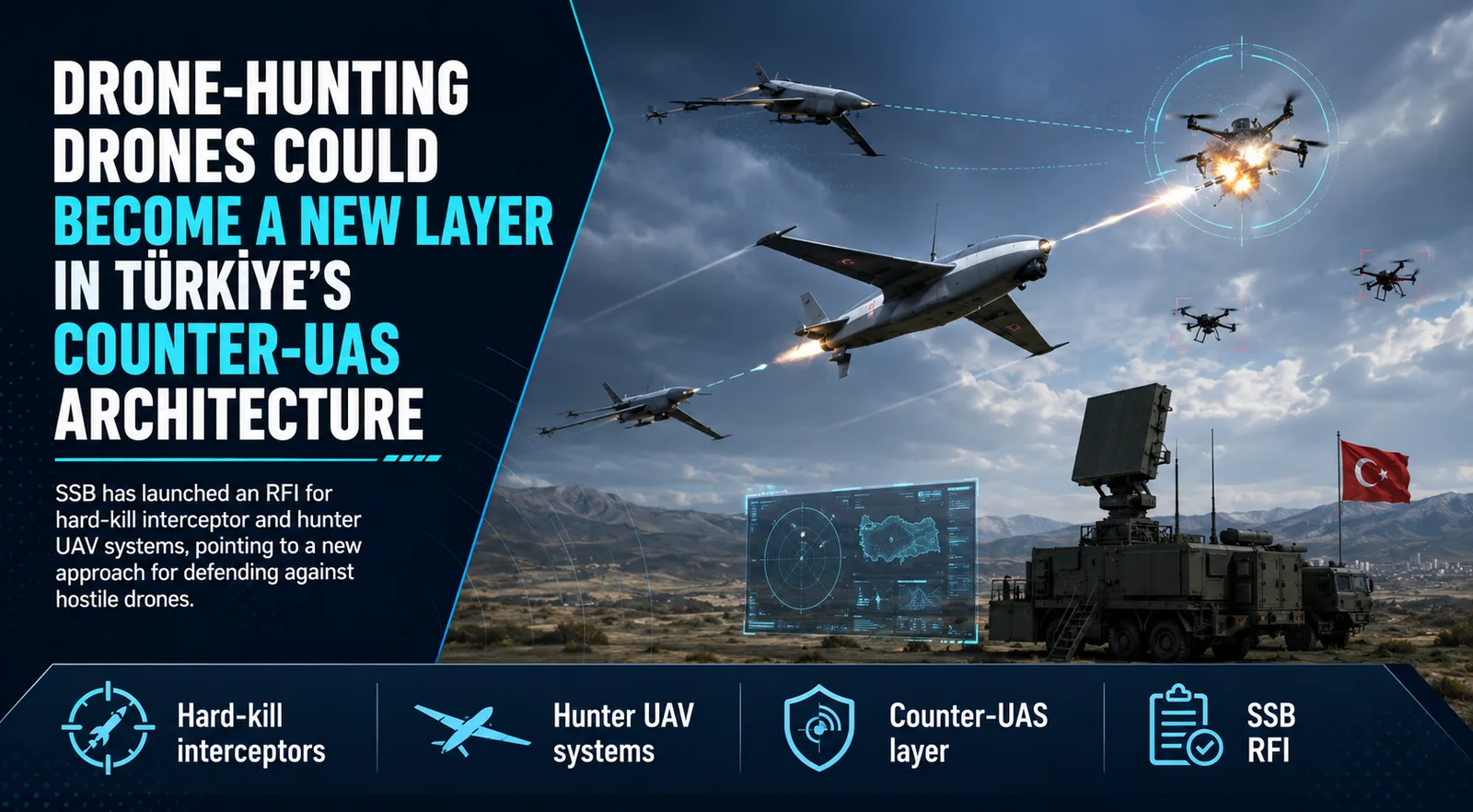
Drone-hunting drones are entering Türkiye’s counter-UAS roadmap as the Presidency of Defence Industries, or SSB, starts a new information request process for hard-kill interceptor and hunter UAV systems.
SSB published the “Dron Avlayan Dron Entegre Sistem Çözümleri Bilgi İstek Dokümanı Duyurusu” on 21 July 2026. The notice says that rising NATO Class 1 and Class 2, mini/micro and tactical UAV threats have made interceptor and hunter UAV systems a priority need for physical intervention after detection.
The request does not announce a selected supplier or a production contract. Instead, it seeks to identify domestic companies, institutions, universities, research centres and organisations that can develop integrated interceptor/hunter UAV systems with at least Technology Readiness Level 6.
The requirement is important because it moves Türkiye’s counter-drone debate beyond electronic jamming alone. SSB is now formally mapping hard-kill and potentially reusable interception layers that can physically neutralise hostile drones.
Drone-Hunting Drones Add a Kinetic C-UAS Layer
Counter-UAS systems normally combine detection, tracking, classification, command-and-control and neutralisation. The neutralisation layer can include electronic attack, navigation disruption, directed energy, guns, missiles, nets or interceptor drones.
SSB’s information request focuses specifically on physical intervention after detection. It expects interceptor or hunter UAVs to defeat targets by one or more methods, including direct impact, fragmentation-effect destruction, net capture or similar techniques.
This makes the concept different from pure electronic warfare. Jamming can disrupt command links or navigation, but it may not always stop autonomous, pre-programmed, fibre-linked or resilient drones. A hard-kill layer provides a physical defeat option when non-kinetic measures are insufficient.
SSB Is Looking for TRL 6 and Above
The TRL 6 threshold is one of the most important details in the notice. Technology Readiness Level 6 generally indicates that a technology has moved beyond early research and has been demonstrated as a prototype in a relevant environment.
That requirement signals that SSB is not only collecting theoretical concepts. It is looking for solutions mature enough to be evaluated against operationally relevant threats.
This also creates a clear message for industry. Companies with interceptor drones, autonomous pursuit algorithms, target-recognition software, miniaturised warheads, net-capture systems, seeker packages, command links or launch-and-recovery concepts may now have a formal pathway to present their capabilities.
Class 1 and Class 2 Threats Are the Priority
SSB’s notice refers to NATO Class 1 and Class 2, mini/micro and tactical UAV threats. This threat set is strategically important because it includes the drones most likely to appear in large numbers near troops, bases, borders, critical facilities and forward operating areas.
Small UAVs can support reconnaissance, artillery adjustment, loitering attack, sabotage, smuggling, electronic warfare and psychological pressure. Their low cost and accessibility make them difficult to defeat with traditional air-defence systems alone.
Therefore, the main problem is not only technical detection. It is cost-effective defeat. A military cannot spend expensive missiles against every small drone. It needs cheaper, scalable and layered options.
Why Hard-Kill Is Becoming More Important
Hard-kill counter-drone systems are becoming more important because the drone threat is evolving. Adversaries can use autonomous navigation, pre-planned routes, frequency agility, low-altitude flight, massed attacks and mixed drone types to reduce the effectiveness of single-layer defences.
Electronic warfare remains essential, but it is not a universal solution. Some drones may continue their mission after link loss. Others may be difficult to jam without disrupting friendly communications or civilian systems.
Interceptor drones can help fill this gap. They can pursue, collide with, capture or destroy hostile UAVs while offering more tactical flexibility than fixed ground-based systems in some scenarios.
NATO’s Drone Edge Shows the Wider Market Direction
Türkiye’s move comes as NATO is accelerating counter-drone investment. NATO announced in July 2026 that Allies would invest more than 40 billion dollars in counter-drone capabilities over the next five years and expand drone-operator training.
NATO has also been testing counter-drone technologies with industry. A 2026 NATO exercise in the Netherlands brought together around 300 participants, 40 companies from 11 Allied nations and partner countries Ukraine and Australia to test systems for detecting, identifying and neutralising unmanned aircraft threats.
This context matters for Türkiye. Counter-UAS is no longer a niche requirement. It is becoming a core NATO readiness problem, and countries that can produce scalable solutions may find both domestic and allied demand.
The Cost-Exchange Problem Drives Procurement
The economics of counter-drone warfare are now central to procurement. Defending against a low-cost drone with a high-cost missile creates an unsustainable cost exchange, especially when threats arrive in large numbers.
European industry is already responding. Reuters reported that MBDA is developing a Counter Mass Interceptor to address large-volume drone and low-cost munition attacks, reflecting wider concern about stockpiles and cost-per-kill.
Drone-hunting drones could support a different cost model. If they can be produced affordably, launched quickly and recovered or reused in some mission profiles, they could become part of a more sustainable C-UAS architecture.
Reusable Interceptors Would Be a Major Advantage
Reusable interceptor drones could change the economics of drone defence. A one-way kinetic interceptor may still be cheaper than many missiles, but a recoverable system could reduce cost even further if it can return after a failed engagement or non-destructive net capture.
However, reusability is technically difficult. The drone must detect and track a small target, manoeuvre aggressively, survive the engagement environment, avoid friendly systems and return safely when the mission allows.
This means the most valuable solutions will not be simple airframes. They will combine autonomy, seekers, guidance, target recognition, datalinks, command software, safety logic and mission planning.
Integration Matters More Than the Interceptor Alone
A drone-hunting drone is only one part of a counter-UAS system. It must receive target data from radars, electro-optical sensors, acoustic systems, radio-frequency detectors or other surveillance assets.
It must also operate inside a command-and-control architecture that can classify threats, assign interceptors, prevent fratricide, coordinate with electronic warfare systems and manage airspace safety.
This is why SSB’s reference to integrated system solutions is important. The requirement is not only for a drone that can hit another drone. It is for a system that can be integrated into a layered defence network.
Autonomy Will Decide Engagement Speed
Interceptor drones must operate quickly because small UAV engagements leave limited reaction time. Human operators may not be able to manually control every intercept, especially during simultaneous or swarm-like attacks.
Autonomy can support target pursuit, collision-course calculation, obstacle avoidance, terminal guidance and engagement timing. However, autonomy must be bounded by safety rules and human supervision, especially near civilian airspace or friendly units.
The best solutions will likely use human-on-the-loop control. Operators will authorise engagement, while onboard systems handle rapid manoeuvring and final intercept logic.
Net Capture and Kinetic Kill Serve Different Missions
SSB’s notice mentions multiple defeat methods, including impact, fragmentation-effect destruction and net capture. These methods serve different mission environments.
Net capture may be useful when authorities want to reduce collateral damage, protect crowded areas or recover the hostile drone for forensic analysis. Direct impact may be simpler and faster for some battlefield conditions. Fragmentation-effect defeat may increase lethality against manoeuvring targets but requires stricter safety management.
This suggests that Türkiye may need more than one interceptor type. Military bases, border areas, urban critical infrastructure and battlefield units may each require different engagement methods.
The Main Challenge Is Detecting Small Targets
Neutralisation begins with detection. Small drones can fly low, move slowly, use small radar cross-sections, exploit terrain and blend into cluttered environments.
Therefore, drone-hunting drones will need high-quality cueing from the wider system. Radar, electro-optical sensors, radio-frequency detection, acoustic sensors and AI-enabled classification may all contribute to the target picture.
The interceptor itself may also need onboard sensors for the terminal phase. Without reliable final tracking, even a fast interceptor may miss a small, agile or visually difficult target.
Electronic Warfare and Hard-Kill Should Work Together
The new RFI should not be understood as a replacement for electronic warfare. Instead, it points toward a layered model where soft-kill and hard-kill systems support each other.
Electronic warfare can disrupt drones, slow them, force them into failsafe behaviour or separate them from operators. Hard-kill interceptors can then defeat drones that continue flying or remain dangerous.
This layered approach is especially important against mixed threats. A defender may face commercial quadcopters, FPV drones, fixed-wing reconnaissance UAVs, loitering munitions and tactical UAVs at the same time.
Türkiye’s Defence Ecosystem Has a Strong Entry Point
Türkiye has a strong entry point into drone-hunting drones because its defence ecosystem already works across UAVs, electro-optics, radar, electronic warfare, command-and-control software, AI, data links, miniaturised payloads and autonomous systems.
The SSB information request creates a formal mechanism to map these capabilities. It can help identify which organisations have mature prototypes, which subsystems are ready and which areas still require development.
The opportunity is not only to build a single counter-drone platform. It is to create a national C-UAS family that combines detection, decision support, soft-kill, hard-kill, training, logistics and sustainment.
Procurement Could Move Toward a Layered C-UAS Programme
The most important signal from the SSB notice is institutional. Türkiye is exploring whether kinetic interceptor and hunter drones can become part of an organised defence procurement pathway.
An RFI is an early step. It helps the authority understand what industry can deliver, how mature the technology is, which suppliers exist and what kind of requirements should shape a future programme.
If the process advances, it could support a layered C-UAS architecture for military bases, critical infrastructure, border security, deployed units and air-defence networks.
The Export Potential Is Real but Conditional
Counter-drone demand is rising globally. Armed forces, airports, border agencies, energy sites, naval bases and critical infrastructure operators all need protection against small UAV threats.
However, export potential will depend on reliability, safety, cost, integration and regulatory acceptance. A drone-hunting drone must prove that it can defeat threats without creating unacceptable airspace or collateral-risk problems.
International customers will also look for complete packages. Detection sensors, command software, training, maintenance, rules-of-engagement support and upgrade pathways may be as important as the interceptor itself.
Safety and Airspace Management Will Be Critical
Hard-kill interception creates safety questions. An interceptor drone may collide with the target, release a net, create debris or use fragmentation. These actions must be controlled carefully, especially near populated areas, airports, critical infrastructure or friendly forces.
This means operational doctrine must define where each defeat method can be used. Military battlefields, closed test ranges, border areas and urban facilities may require different safety rules.
Airspace management will also matter. Friendly UAVs, helicopters, civil aircraft and emergency drones must be separated from hostile targets. A strong identification and authorisation process is essential.
The Main Risk Is Chasing the Platform Instead of the System
The biggest risk in counter-drone procurement is focusing too much on a single platform. A dramatic interceptor test may look impressive, but battlefield value depends on the entire kill chain.
The system must detect the drone, classify it correctly, pass target data, assign the right effector, authorise engagement, intercept safely and record results. It must also operate under jamming, weather, clutter and simultaneous attack conditions.
Therefore, drone-hunting drones should be evaluated as part of an integrated C-UAS architecture rather than as standalone products.
A Practical Roadmap for Türkiye
A practical roadmap should begin with threat modelling. Türkiye should define the drone types, speeds, altitudes, payloads and attack profiles that interceptor systems must defeat.
The second step is sensor integration. Hunter UAVs must be connected to radar, electro-optical, RF and command systems that can provide reliable target cueing.
The third step is defeat-method selection. Direct impact, fragmentation and net capture should be matched to different operational environments and safety requirements.
The fourth step is autonomy testing. Interceptors should be evaluated under degraded communications, GPS-denied conditions, cluttered terrain, swarm-like attacks and realistic weather.
The fifth step is doctrine and training. Operators need clear rules for identification, engagement authority, airspace safety, post-engagement assessment and coordination with electronic warfare units.
Conclusion
SSB’s information request for drone-hunting drones is an important signal for Türkiye’s counter-UAS future. It shows that hard-kill interceptor and hunter UAV systems could become a formal layer inside national drone-defence planning.
The requirement is focused on real threats: NATO Class 1 and Class 2, mini/micro and tactical UAVs. It also sets a maturity threshold by asking for solutions with at least TRL 6.
The strategic importance is clear. As drones become cheaper, more autonomous and more numerous, Türkiye will need layered defences that combine detection, electronic warfare, command software and physical interception. Drone-hunting drones could become one of the key tools in that architecture.
For further Defence Agenda coverage, read our drones, unmanned systems and air defence sections. Related analysis includes drone swarm warfare and unmanned combat, A2/AD doctrine and layered defence strategy and future warfare technologies and military strategy.