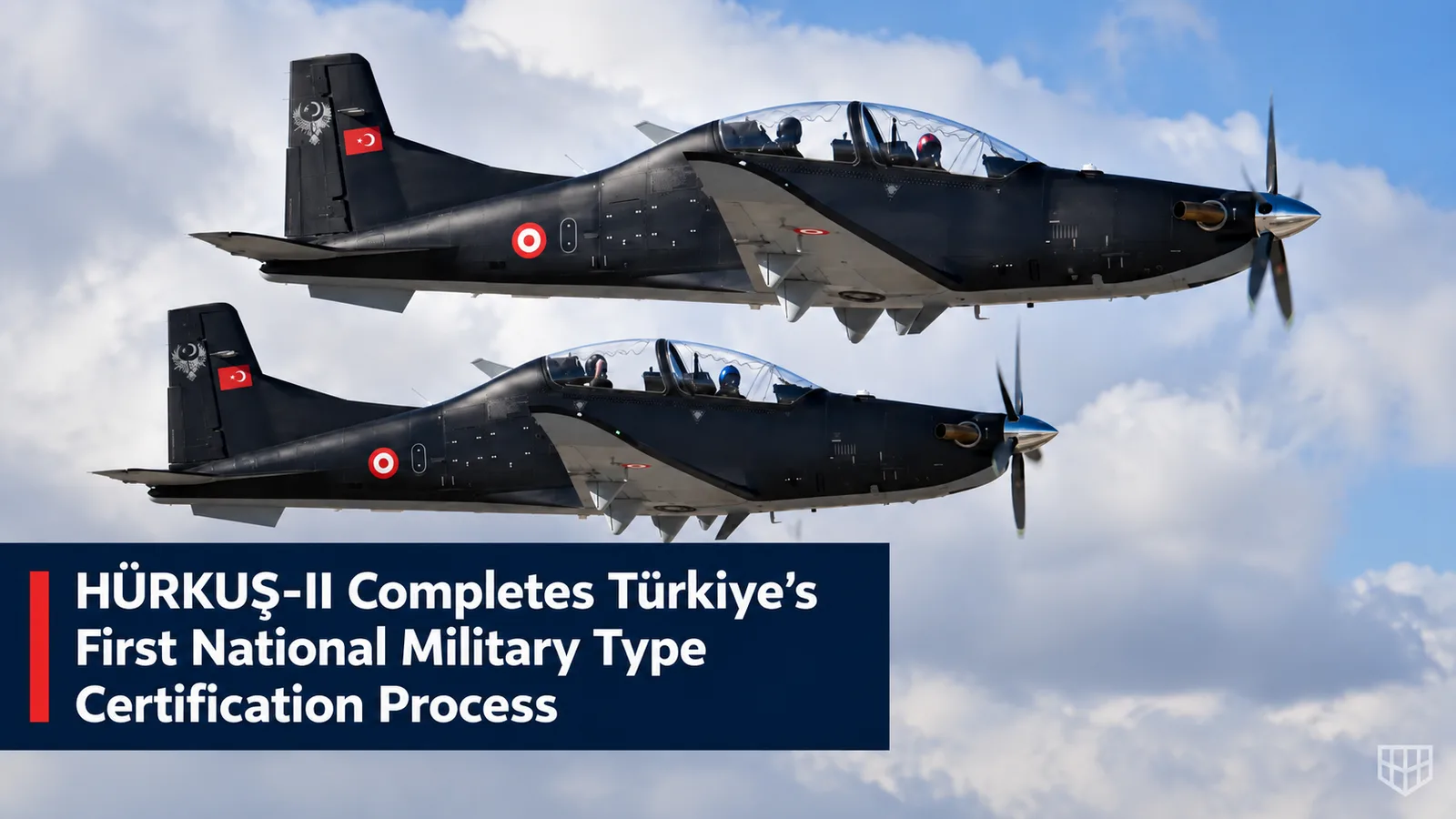
Turkish Aerospace’s HÜRKUŞ-II received its Military Type Certificate on 9 September 2026, completing a certification programme that covered 12 technical disciplines, 1,790 certification requirements, 950 evidence documents and 153 verification tests. The certificate was issued by a Certification Board composed of personnel from Türkiye’s Secretariat of Defence Industries and the Turkish Air Force Command.
The milestone is significant because the authorities describe it as the first time a military type certification process for a domestically developed air platform has been completed in Türkiye in accordance with international standards and using a fully national pool of certification personnel. The achievement therefore concerns not only the HÜRKUŞ-II trainer, but also the institutional capacity to evaluate the airworthiness of future indigenous aircraft.
A 12-Discipline Certification Campaign Covered the Full Aircraft
The HÜRKUŞ-II certification programme was divided across 12 disciplines covering avionics, electronic hardware, electrical systems and electromagnetic-environment effects, propulsion and fuel, human factors, cabin safety, system safety, continuing airworthiness, aircraft systems, flight performance, structures and software. According to Anadolu Agency, the programme included 283 certification panel meetings and workshops as well as 225 audits of subcontractors supporting software and electronic-hardware activities.
Across those disciplines, 1,790 requirements were verified and 950 certification evidence documents were reviewed technically by the relevant panels. This matters because type certification is fundamentally an evidence-based process: the objective is not merely to fly the aircraft successfully, but to demonstrate through traceable technical evidence that the design satisfies the applicable airworthiness requirements.
153 Tests Built the Evidence Base for the Certificate
The verification campaign included 38 laboratory tests, 71 ground tests and 44 flight tests, for a total of 153 certification tests. These activities were used to determine whether HÜRKUŞ-II complied with the certification requirements defined in the programme and to build the evidence package supporting the final certificate.
The scale of the campaign also shows why certification is a separate engineering capability from design and production. A manufacturer may be able to build and fly an aircraft, but type certification requires an organised process for requirements management, independent technical assessment, configuration control, testing and documented compliance across the entire aircraft.
The Programme Brought Together a National Certification Workforce
The certification effort combined personnel from several Turkish institutions. Anadolu Agency reported that seven specialists from the SSB Quality, Test and Certification Department participated alongside 16 certification specialists from TR Airworthiness acting on behalf of SSB, five Turkish Air Force specialists and 12 Ministry of National Defence specialists participating on behalf of the Air Force.
Turkish Aerospace contributed 40 airworthiness specialists and 10 design and production organisation approval specialists. The resulting structure is important because it creates institutional experience that can be reused on other national aircraft programmes rather than leaving certification knowledge concentrated only inside the manufacturer.
The Milestone Is Broader Than a Single Trainer Programme
Turkish Aerospace says HÜRKUŞ-II was developed through domestic and indigenous engineering and describes the certificate as a milestone for Türkiye’s testing, verification and certification capability. SSB President Haluk Görgün similarly framed the achievement as evidence that Türkiye is building not only aircraft, but also the technical authority, methodology and certification culture required to validate their safety and airworthiness.
This distinction is strategically relevant for programmes such as HÜRJET, GÖKBEY, KAAN and future uncrewed or crewed air platforms. Certification frameworks do not remove the need for programme-specific testing, but accumulated national experience can shorten institutional learning curves, improve traceability and reduce dependence on external technical authorities for military airworthiness assessment.
HÜRKUŞ-II Moves Closer to Turkish Air Force Service
Turkish Aerospace’s current HÜRKUŞ programme page states that work on the New Generation Basic Training Aircraft began following a contract amendment with SSB on 3 May 2021 and that delivery to the Turkish Air Force Command is planned during 2026. The new Military Type Certificate removes a major airworthiness milestone from that pathway, although certification should not be treated as equivalent to operational acceptance or fleet entry.
Further milestones to watch include formal delivery, Air Force acceptance, training-system integration, fleet introduction and any subsequent configuration changes that require additional certification activity. The certification baseline also provides a reference point for future modifications to avionics, software, propulsion interfaces or training-system architecture.
Limitations and Next
The public material defines the size and structure of the certification campaign but does not disclose the full certification basis, individual means of compliance, detailed findings from the 153 tests or any residual limitations attached to the certificate. It also does not establish that every future HÜRKUŞ-II configuration or modification will be covered automatically by the same approval.
The next important programme step is therefore not another certification headline by itself, but evidence that the certified baseline progresses into Turkish Air Force delivery and service. Any later export configuration, major avionics change or mission-system modification would need to be assessed against the applicable certification framework rather than assumed to inherit approval unchanged.