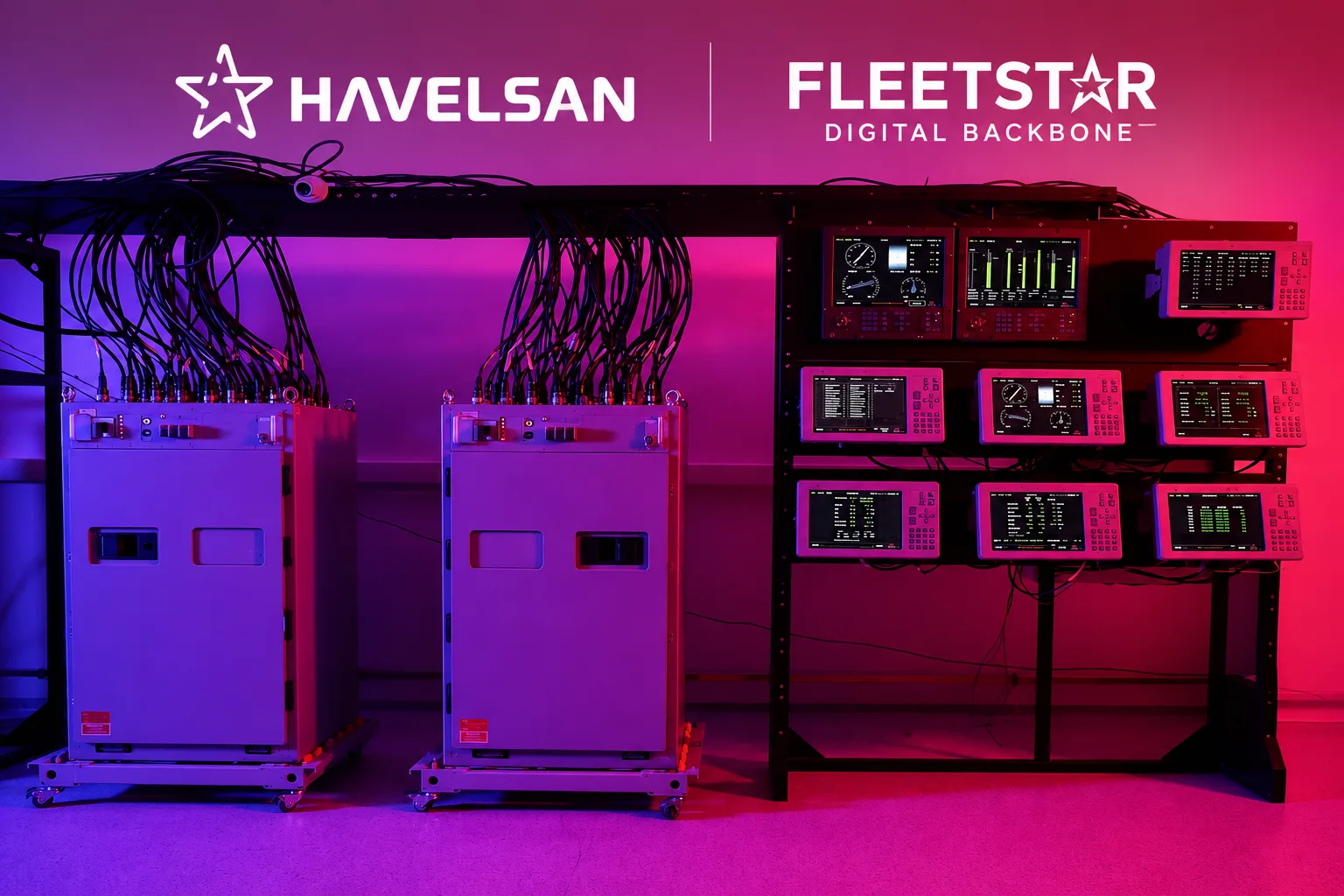
HAVELSAN has completed factory acceptance and delivery of FLEETSTAR Ship Data Distribution Systems for the 10th and 11th ships in Türkiye’s MİLGEM programme, extending the indigenous digital backbone across two more İ-class frigates.
The milestone covers the platform-level data infrastructure that collects, prioritises and distributes information between navigation equipment, communications systems, sensors, weapons, the combat management system and other ship subsystems. HAVELSAN says both systems successfully completed Factory Acceptance Tests, while the company’s own programme statement says the two GVDS sets have been delivered.
The Milestone Is Factory Acceptance and Delivery
The most important programme distinction is that the latest announcement concerns FLEETSTAR equipment rather than completion of the two frigates themselves.
HAVELSAN says the Ship Data Distribution Systems for MİLGEM 10 and 11 passed Factory Acceptance Tests. Factory acceptance is normally conducted before equipment is installed or finally accepted on board the operational platform.
Successful FAT therefore demonstrates that the equipment meets defined pre-installation requirements, but it should not be interpreted as confirmation that shipboard integration, harbour acceptance or sea acceptance of the two frigates is complete.
HAVELSAN’s own 27 August programme statement and subsequent Turkish Armed Forces Foundation reporting describe the two systems as delivered, indicating that the equipment has moved beyond manufacturing and factory verification into the next stage of platform integration.
MİLGEM 10 and 11 Belong to the Expanding İ-Class Fleet
Türkiye’s Presidency of Defence Industries defines MİLGEM’s fifth ship as the first İ-class frigate and confirms that ships 6–12 consist of seven additional İ-class frigates.
Those seven frigates are being constructed simultaneously at three private Turkish shipyards, creating one of the most ambitious parallel surface-combatant production efforts in Türkiye’s naval history.
MİLGEM 10 and 11 therefore form part of the larger İ-class expansion rather than the earlier Ada-class corvette batch.
The public sources reviewed for this package do not provide sufficiently reliable hull-name identification for the 10th and 11th MİLGEM ships. Defence Agenda therefore retains their programme numbers instead of assigning names that are not directly confirmed by the supplied or official source chain.
FLEETSTAR Is the Ship’s Platform-Level Data Backbone
Modern warships depend on continuous movement of information between systems that were historically more isolated.
Navigation sensors, communications equipment, radars, electronic systems, weapons, machinery interfaces and the combat management system all generate or consume platform data. The Ship Data Distribution System provides a common infrastructure through which those systems can exchange information.
HAVELSAN describes FLEETSTAR as the “heart” of the ship because it collects platform data and distributes it safely and efficiently to the required subsystems.
The architecture is designed to remain available even when individual components fail, using redundancy and an expandable system structure to preserve service continuity.
FLEETSTAR and ADVENT Perform Different Functions
FLEETSTAR should not be confused with HAVELSAN’s ADVENT Combat Management System.
ADVENT performs command-and-control, tactical picture generation, sensor fusion, engagement planning and wider combat-system functions. FLEETSTAR provides the underlying platform-data distribution infrastructure that allows multiple onboard systems to exchange information.
The two can therefore operate as complementary layers.
HAVELSAN demonstrated this relationship on TCG Anadolu in early 2026, where ADVENT and FLEETSTAR were integrated with Bayraktar TB3 so imagery and mission information could move from the unmanned aircraft into the ship’s combat-management architecture and onward to other naval assets.
That example shows why platform data distribution is more than a ship-automation function. It becomes an enabling layer for network-centric combat operations when connected to the combat management system.
Low-Latency Data Movement Is Operationally Critical
HAVELSAN lists low data delay among FLEETSTAR’s principal design features.
Latency matters because combat systems depend on the time relationship between sensor measurements, navigation data, weapon status and command decisions.
A radar track, ship position, heading, speed or weapons-status update that arrives too late can reduce the quality of the common tactical picture or degrade engagement performance.
FLEETSTAR is designed to acquire high-speed platform sensor data, prioritise it and distribute it to different clients at different frequencies and in different formats.
Public HAVELSAN documentation does not disclose the exact network bandwidth, deterministic latency figures, protocol stack or hardware topology used on MİLGEM 10 and 11.
Redundancy Supports Combat-System Availability
Warship digital systems must continue operating despite individual equipment failures, battle damage or maintenance events.
HAVELSAN therefore describes FLEETSTAR as redundant, fault tolerant and expandable.
A redundant architecture allows critical platform information to continue moving even if a processing node, interface or communications path becomes unavailable.
This is especially important because a data-distribution failure can affect several otherwise functional ship systems at the same time.
The public product description confirms the architectural principle but does not disclose the exact redundancy topology or damage-control segmentation used on the new frigates.
FLEETSTAR Supports Data Recording and Analysis
The system also performs data recording, playback, transfer and analysis.
These functions can support maintenance, fault investigation, acceptance testing, training and post-mission analysis by allowing operators and engineers to reconstruct system behaviour.
Recorded platform data can be particularly useful during integration because engineers need to identify whether a problem originated in a sensor, interface, software layer or receiving subsystem.
HAVELSAN also lists support for Integrated Logistics Support activities among the FLEETSTAR feature set.
Türkiye Has Built More Than a Decade of Operational Experience
HAVELSAN says FLEETSTAR has been used by the Turkish Naval Forces and foreign navies since 2009.
The company identifies TCG Heybeliada, the first MİLGEM corvette, as the programme’s first GVDS delivery reference and says the technology has subsequently been integrated into numerous classes of naval platforms.
The latest MİLGEM 10 and 11 milestone therefore represents continuity of an established architecture rather than the introduction of an entirely new system family.
That long operational history reduces integration risk because the underlying design has already been exposed to multiple platform classes, different mission systems and long-duration naval operations.
The Product Family Extends Into Submarines
HAVELSAN applies the same data-distribution philosophy below the surface through its submarine product family.
The company’s current surface product is branded FLEETSTAR, while the submarine equivalent is marketed as SUBSTAR / Submarine Data Distribution System.
The original Turkish reporting also refers to the submarine variant as DBDS.
The common principle is the same: collect data from multiple platform systems, control and prioritise it and distribute the information to the subsystems that require it.
This cross-platform product family gives HAVELSAN a reusable digital infrastructure spanning surface combatants and submarines.
Hardware Localisation Matters Alongside Software
The latest HAVELSAN statement emphasises that localisation extends beyond software.
According to the company, a significant portion of the electronic cards used in the GVDS/DBDS product family is developed internally, while software and mechanical design are carried out through indigenous engineering capabilities.
This is strategically relevant because naval digital infrastructure can create long-term dependency if software, interface cards or proprietary hardware must be sourced externally throughout the ship’s service life.
Greater national control over the architecture can simplify modification, obsolescence management and future integration of new Turkish sensors and weapons.
The public announcement does not provide a quantified localisation percentage, so the system should not be described as 100% domestically sourced at component level without further evidence.
Serial Frigate Construction Raises Integration Demands
The FLEETSTAR milestone also reflects the industrial challenge created by Türkiye’s serial İ-class build programme.
Seven MİLGEM 6–12 frigates are being built concurrently across three private shipyards. Parallel construction increases demand for combat systems, radars, weapons, power equipment, cabling, software and platform-integration teams at the same time.
A subsystem supplier therefore has to move from one-off engineering into repeatable production, test and documentation processes.
Completing FLEETSTAR sets for MİLGEM 10 and 11 shows HAVELSAN progressing deeper into that serial-production rhythm.
This matters because programme delays can be driven not only by hull construction but by late arrival of complex electronic systems needed for outfitting and integration.
The Wider Naval Build-Up Makes Digital Commonality More Valuable
Türkiye’s naval construction portfolio now extends far beyond the original MİLGEM corvettes.
Naval Forces Commander Admiral Ercüment Tatlıoğlu said in August 2026 that 37 warships were under construction for the Turkish Naval Forces and another 24 for foreign customers, implying 61 ships in simultaneous construction.
The portfolio includes İ-class frigates, TF-2000 air-defence destroyers, the national submarine, fast attack craft and the MUGEM aircraft carrier.
Common digital architectures become more valuable as the number of ship classes increases. Reusing familiar data-distribution and combat-management technologies can reduce training burden, simplify integration and create common interfaces for new sensors, weapons and uncrewed systems.
FLEETSTAR Is Also an Exportable Naval Building Block
HAVELSAN’s current product page states that FLEETSTAR is used not only by the Turkish Navy but also by foreign naval forces.
This creates an export model in which HAVELSAN can supply either a complete combat-management architecture or selected infrastructure layers depending on customer requirements.
ADVENT’s international footprint has already expanded significantly, including the 2026 delivery of the system to Romania through the CAm.ROMAN corvette programme.
FLEETSTAR provides a complementary infrastructure product for customers seeking national or third-party sensors and weapons connected through a HAVELSAN data backbone.
The current MİLGEM 10 and 11 announcement, however, concerns Turkish programme ships and does not itself constitute a new export award.
Factory Acceptance Does Not Complete Ship Integration
Factory Acceptance Testing is an essential programme gate but only one part of the delivery chain.
After factory acceptance, equipment normally moves into ship installation, cabling and interface integration, followed by platform-level verification and customer acceptance.
Combat-system commissioning can also require testing against real navigation equipment, sensors, weapons and other mission systems that are not present in the factory configuration.
The public HAVELSAN announcement does not state that shipboard acceptance of FLEETSTAR on MİLGEM 10 and 11 has already been completed.
Defence Agenda therefore treats the event as a subsystem production-and-acceptance milestone rather than a ship-delivery milestone.
Limitations and Counterpoint
The public sources do not disclose the contract value for the two FLEETSTAR sets.
No detailed network architecture, bandwidth, latency, node count or cybersecurity configuration is public.
The exact hull names associated with MİLGEM programme numbers 10 and 11 are not identified clearly enough in the reviewed source chain to include without qualification.
The announcement confirms Factory Acceptance Tests and delivery of the systems, but not final shipboard acceptance or operational commissioning of the two frigates.
HAVELSAN describes the system as highly reliable and cites strong availability performance across deployed platforms, but the company does not publish a numerical fleet-wide availability figure in the reviewed material.
Implications / Next
The first milestone to watch is shipboard installation and integration of the two FLEETSTAR systems.
The second is harbour and sea acceptance of the corresponding İ-class frigates, where the data backbone will be tested with the full sensor, weapon and combat-management architecture.
The third is continued serial production for MİLGEM ships 12 and other Turkish naval programmes.
The fourth is greater convergence between FLEETSTAR, ADVENT and uncrewed systems. TCG Anadolu has already demonstrated the operational value of linking the platform-data backbone, CMS and Bayraktar TB3.
The fifth is export growth. Wider adoption of ADVENT and FLEETSTAR together would strengthen HAVELSAN’s position as a supplier of complete naval digital architecture rather than only stand-alone software.
Conclusion
HAVELSAN’s completion of FLEETSTAR factory acceptance and delivery for MİLGEM 10 and 11 is a serial-production milestone for the digital infrastructure underpinning Türkiye’s expanding İ-class frigate fleet.
FLEETSTAR provides the platform-level data backbone that connects navigation equipment, communications, sensors, weapons and the combat management system through a redundant and continuously operating architecture.
The milestone does not mean the two frigates have completed shipboard acceptance, but it removes one critical subsystem from the production pipeline and prepares the vessels for the next integration phase.
As Türkiye expands from MİLGEM frigates into destroyers, submarines, carriers and increasingly networked uncrewed systems, the strategic value of HAVELSAN’s work is becoming broader than one product delivery: FLEETSTAR is evolving into a reusable digital foundation for a growing national naval combat-system ecosystem.