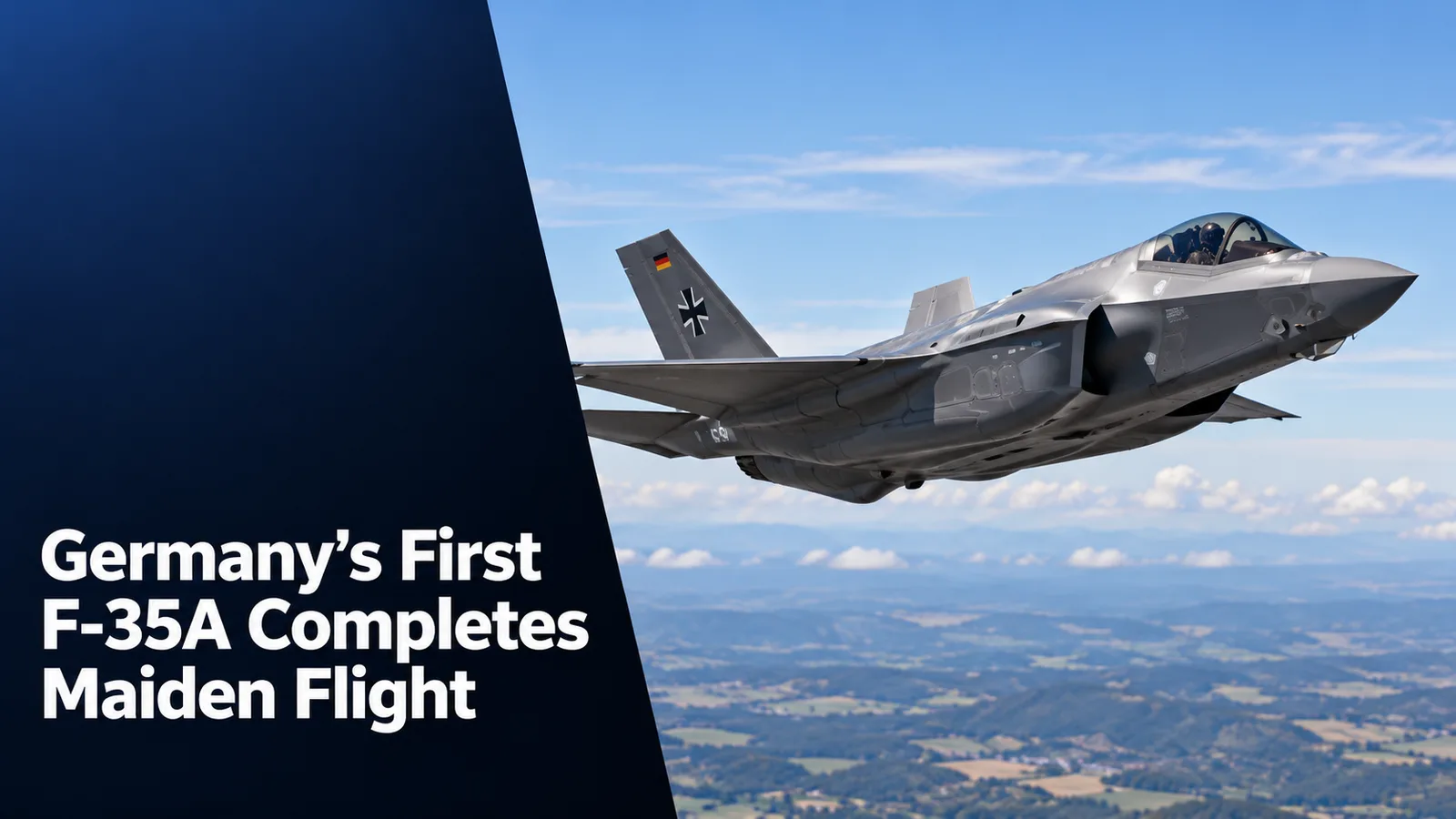
Germany's first F-35A Lightning II completed its maiden flight from Lockheed Martin's Fort Worth facility on 8 September 2026. The aircraft carries the German identity 35+01 and production code MG-01. The flight follows final assembly, engine installation and painting milestones and moves the aircraft toward formal delivery and the start of German pilot training in the United States.
The First German F-35A Has Flown From Fort Worth
The maiden flight is an important production and test milestone, but it is not the same as operational delivery to the Luftwaffe. The aircraft must complete the remaining acceptance process before it can support the training pipeline. Germany's programme of record covers 35 F-35A aircraft, with the initial U.S.-based aircraft intended to build the first cadre of German pilots and maintainers.
Eight Aircraft Are Planned for the Initial U.S. Training Phase
Lockheed Martin and programme reporting indicate that eight German F-35As are planned to support training at Ebbing Air National Guard Base in Arkansas. That arrangement allows Germany to develop crews and technical personnel before the first aircraft arrive at their future German operating base. Training infrastructure and qualified personnel are critical because receiving aircraft without a mature support system would delay useful operational output.
The first aircraft's flight therefore connects the production line to the training schedule. Each subsequent airframe must move through assembly, test and acceptance while Germany prepares maintenance, mission planning and security infrastructure. The programme's pace should be assessed across all of those lines rather than by aircraft production alone.
F-35A Will Replace Tornado in a High-Consequence Mission
Germany selected the F-35A in 2022 to replace part of the Tornado force and support NATO nuclear-sharing requirements. That role gives the programme political and operational weight beyond conventional fighter recapitalisation. The F-35A also adds fifth-generation sensing, networking and survivability that can contribute to wider NATO air and missile defence and strike operations.
However, the aircraft will enter a mixed German combat-air fleet rather than replace every fighter. Eurofighter remains central to Luftwaffe operations, and future combat-air decisions will shape how Germany balances sovereign European programmes with the F-35. The first flight confirms the procurement is physically materialising, but the force structure will continue to depend on readiness, weapons integration and future aircraft orders.
Delivery and German Operational Readiness Are Separate Milestones
The Aviationist reports that the first German aircraft is expected to be delivered after the remaining U.S. test and acceptance activity, with initial aircraft supporting U.S.-based training before the first F-35s reach Büchel. Germany has previously targeted an initial operational capability later in the decade. Those milestones should remain distinct from the 8 September first flight.
The next checkpoints are formal delivery, arrival of the training aircraft at Ebbing, completion of the initial pilot and maintainer pipeline, and eventually the first aircraft arrival in Germany. Only after those steps and national operational evaluation should the programme be described as fielded capability. The maiden flight is therefore a visible production milestone inside a much larger transition from Tornado to F-35A.
Infrastructure at Büchel is another programme dependency because fifth-generation aircraft require secure mission-planning, maintenance and support facilities alongside the aircraft themselves. Germany's transition schedule therefore rests on parallel progress in construction, training, weapons certification and aircraft delivery. A delay in any one of those areas could affect the date at which the Luftwaffe can generate a fully operational F-35A force.
Implications / Next
The next publication-grade milestone will be the first independently verifiable event that changes the programme status described above, such as a delivery, acceptance event, production start, exercised option, operational test or formal fielding decision. Defence Agenda will continue to separate these maturity stages and will not treat an announcement, contract or first test as proof that the full capability has already entered operational service.