Germany Uses OPEX to Test a New Long-Range Naval Strike Option
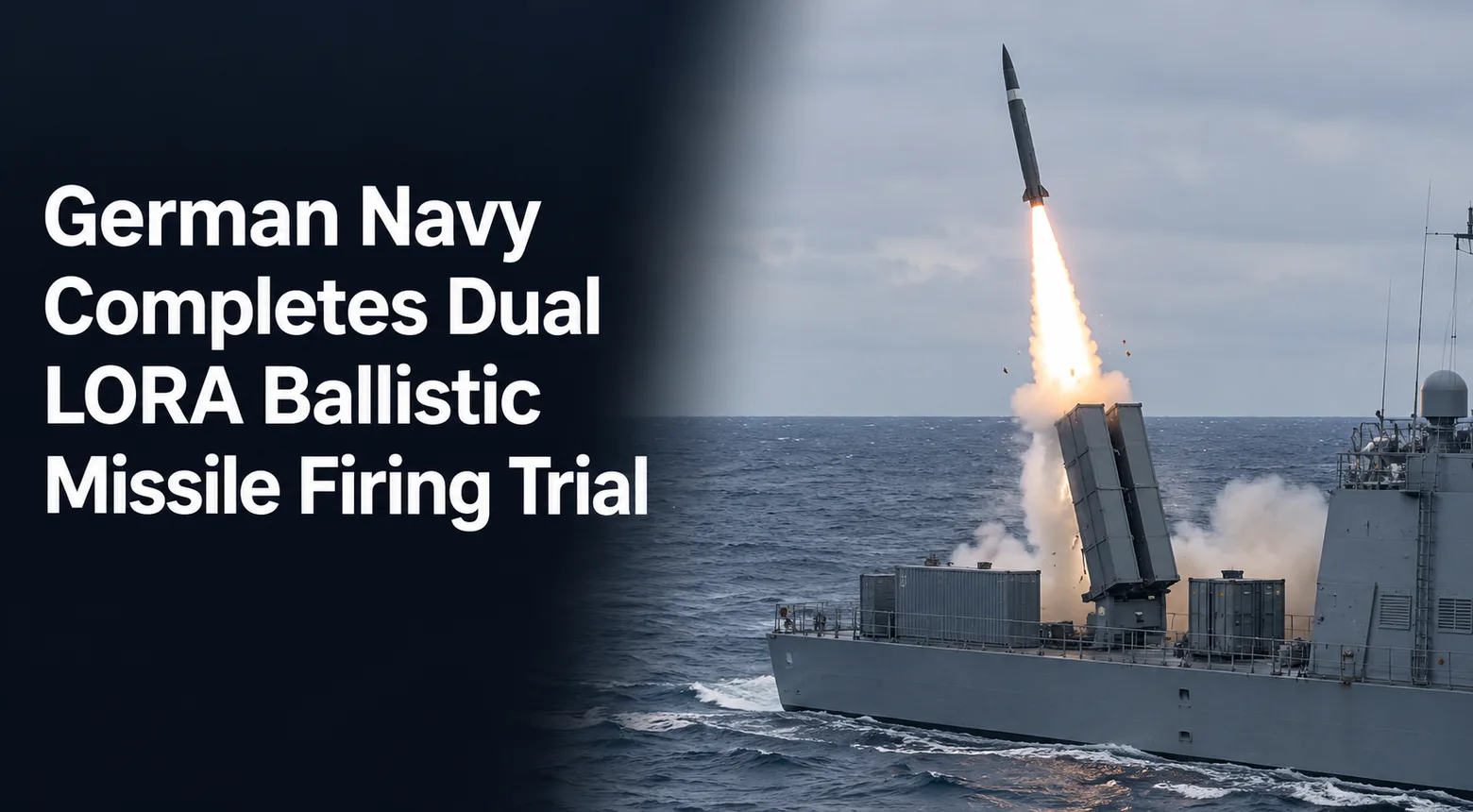
The German Navy has completed two operational firing trials with Israel Aerospace Industries’ LORA ballistic missile as part of its Operational Experimentation framework. IAI announced the activity on 2 September 2026, saying both missiles followed their planned trajectories and struck their targets. Reuters separately reported that the testing took place in the North Atlantic and was viewed by German officials as a significant demonstration of a long-range capability not currently present in the Navy’s regular inventory.
The event is strategically notable because Germany has traditionally relied on cruise missiles, aircraft-delivered weapons and allied capabilities for deep strike rather than fielding a ship-associated ballistic weapon of this class. A successful experiment does not mean Berlin has decided to procure LORA, but it gives the Navy a real data point on launch integration, mission planning, range safety, command processes and precision-strike performance. That makes the trial relevant to the wider Marine 2035 and Beyond debate over how German naval forces should contribute to deterrence at longer distances.
LORA Extends the Strike Envelope but Changes the Mission Set
IAI markets LORA as a precision ballistic weapon with a range of up to 500 km. Compared with many traditional ship-launched anti-ship missiles, that reach supports land-attack missions well beyond the immediate maritime battlespace. It also provides a different flight profile from a low-flying cruise missile, potentially complicating an adversary’s defence planning. The value to Germany would therefore be less about replacing existing missiles and more about adding another geometry and response time to the long-range strike portfolio.
At the same time, a weapon of this type introduces targeting, command-and-control and escalation-management demands that are more significant than those of a short-range defensive missile. Reliable long-range fires require persistent intelligence, validated coordinates, secure mission data and clear political authorities for use. The Navy would also need to decide whether a future ballistic-strike capability should be containerised and deployable from multiple ships, permanently integrated into combatants, or treated as an expeditionary mission module.
A Successful Trial Is Not a Procurement Decision
IAI’s release describes the activity as an operational firing trial under OPEX, the German Navy’s mechanism for testing new concepts and technologies quickly under realistic conditions. That means the correct maturity label is experimentation. No publicly verified German acquisition decision, production quantity or fleet integration contract accompanied the announcement. The test should therefore not be presented as Germany adopting LORA into operational service.
The trial nevertheless reduces uncertainty for any future procurement debate. Germany now has service-generated evidence on launcher handling, mission execution and strike performance rather than relying solely on manufacturer data. That can accelerate requirements work if the Navy decides a ballistic option is useful, but it can equally inform a decision to pursue another European or nationally controlled long-range weapon. Industrial policy and sovereignty will be important because Germany is simultaneously investing in European missile programmes and an upgraded Taurus NEO cruise missile.
Implications / Next
The next meaningful milestone would be a formal German requirement, budget line, request for proposals or follow-on experiment that places LORA against competing solutions. Integration on a front-line German warship would represent a separate and much more consequential step because it would require combat-system, storage, safety and doctrine changes beyond the temporary test configuration.
For IAI, the firing provides a high-profile European naval reference at a time when NATO states are seeking longer-range strike options. For Germany, the more important outcome may be the ability to compare ballistic and cruise-missile pathways using operational evidence. The test therefore expands the choice set without yet resolving the procurement decision.