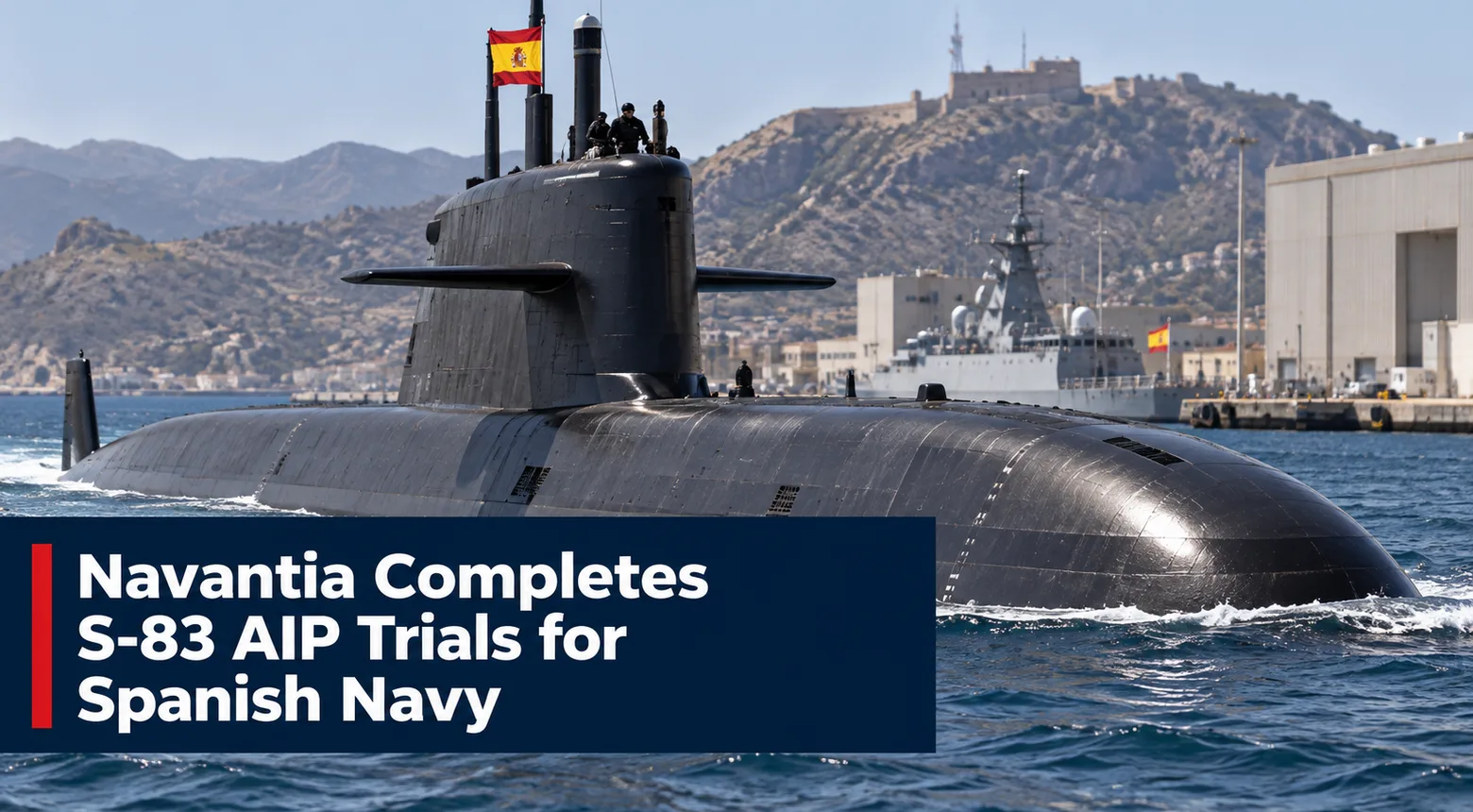
Navantia said on 23 September 2026 that it had completed testing of the air-independent propulsion system for S-83 Cosme García, the third submarine in Spain’s S-80 programme. The tests were conducted with the AIP equipment installed in the specialised hull section at the Cartagena shipyard, moving the system from equipment commissioning toward physical integration with the submarine’s pressure hull.
Testing moved the AIP system into its intended onboard configuration
Navantia began the S-83 AIP test campaign in June 2026 after completing installation and verification work in the dedicated approximately 12-metre, roughly 400-tonne section. The test arrangement was significant because it placed the propulsion equipment in the configuration intended for the submarine rather than testing only isolated components on a separate laboratory rig.
The system uses liquid oxygen and bioethanol to generate hydrogen for a fuel cell, supporting submerged propulsion without the need to run conventional diesel engines at periscope depth. Navantia says the completed campaign demonstrated integration, performance and operational capabilities before the section is transferred for joining to the rest of the pressure hull.
The milestone is important, but it is not submarine acceptance
The successful campaign should be read as an industrial-integration milestone. It does not mean S-83 has completed harbour trials, sea trials or Spanish Navy acceptance. Those steps require the AIP section to be joined to the submarine, followed by continued construction, integration of ship systems and later platform-level testing.
This distinction is especially important for the S-80 programme because the AIP system is one of the design features intended to separate the class from conventional diesel-electric boats that rely more frequently on snorkelling to recharge batteries. The technology is intended to extend submerged endurance, but the exact endurance achieved in operational conditions will depend on mission profile and platform configuration rather than laboratory claims alone.
Spain is building an indigenous submarine technology base
Navantia describes the S-80 programme as a sovereign industrial capability spanning submarine design, construction and advanced propulsion integration. Completion of the S-83 AIP campaign strengthens that industrial claim because the system has progressed into the actual ship section rather than remaining a parallel technology demonstrator.
For export positioning, the milestone also matters because propulsion architecture is a central discriminator in the conventional-submarine market. Even so, the commercial case will depend on programme execution, cost, schedule and sea-trial evidence. The next decisive step is successful incorporation of the tested section into S-83 and subsequent validation at full-platform level.
AIP integration is tied to the S-80 programme’s wider maturity path
The S-80 programme has long placed significant weight on indigenous design authority and the ability to integrate propulsion, combat-system and platform technologies within Spain. Completing AIP testing in the actual S-83 section gives Navantia a stronger engineering baseline for that objective because it validates interfaces in a ship-representative environment. Even so, section-level success must still be carried through welding, hull integration, commissioning and submarine-level acceptance activity.
The industrial challenge is particularly demanding for an AIP system because propulsion performance depends on multiple interacting subsystems, including storage, fuel processing, fuel-cell operation, thermal management, controls and safety architecture. A successful campaign therefore reduces one category of risk without eliminating construction or operational risk elsewhere in the boat. The distinction between technology validation and fleet acceptance is central to accurate reporting on submarine programmes.
For the Spanish Navy, S-83 will also provide evidence about how the AIP architecture performs when integrated with the submarine’s full hotel loads, propulsion demands and mission systems. Public descriptions emphasise the potential for extended submerged endurance, but operational endurance varies with speed, electrical load and mission profile. Defence Agenda therefore avoids converting the industrial milestone into an assumed number of submerged days beyond what Navantia itself has formally validated.
Implications / Next
The next milestones are transfer and joining of the tested AIP section, continued S-83 construction, harbour testing and eventual sea trials. Completion of section-level testing should not be described as operational fielding.