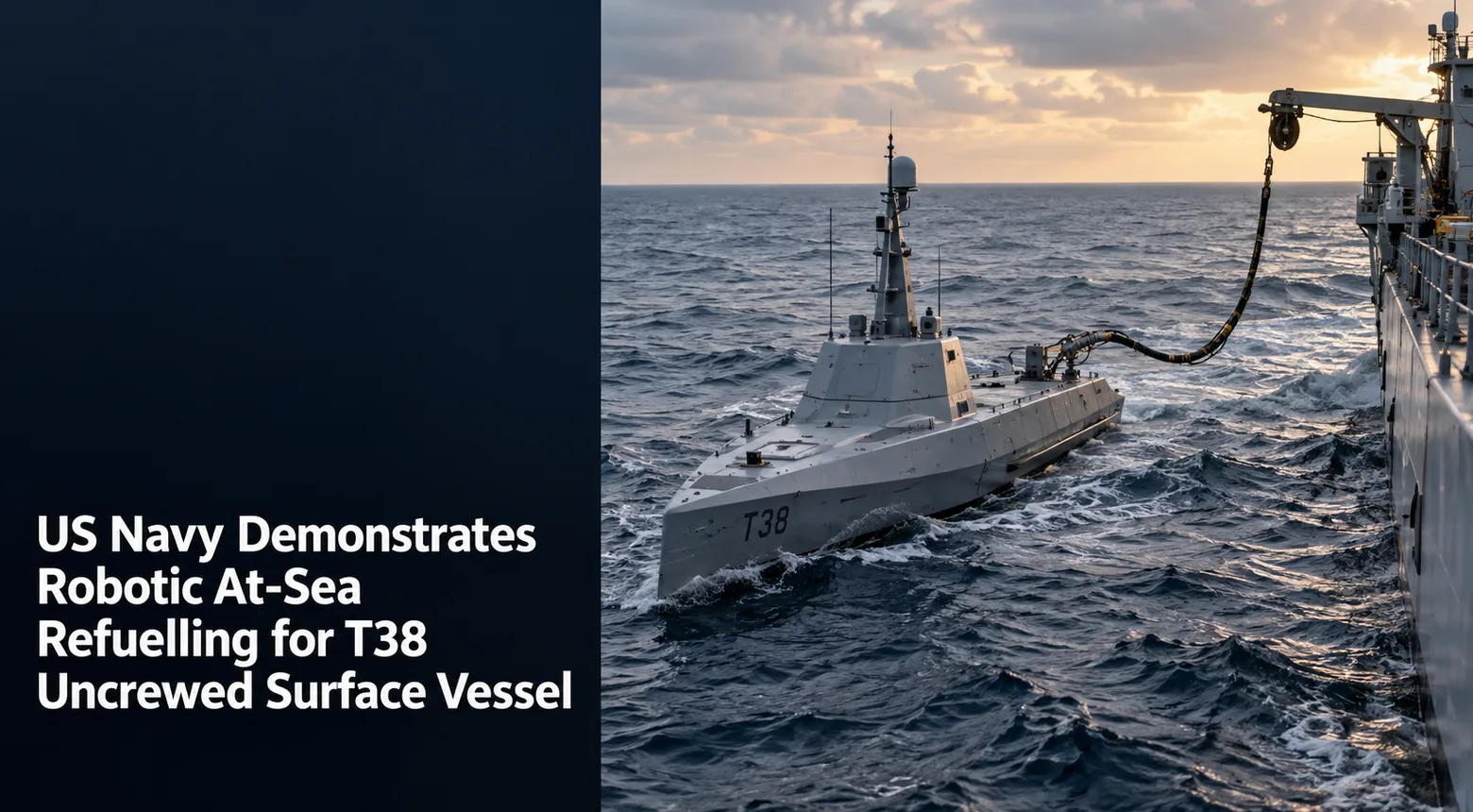
The U.S. Navy has demonstrated a robotic towed connector that repeatedly captured, refuelled and released a T38 uncrewed surface vessel while underway, addressing one of the practical endurance constraints facing persistent maritime autonomy. The 11 August 2026 event took place off Joint Expeditionary Base Little Creek–Fort Story in Virginia and brought together Naval Air Warfare Center Weapons Division’s Blue Water Instrumentation team, its Future Capabilities Office, MARTAC and Israeli maritime-autonomy company Sealartec.
According to the U.S. Department of Defense account published through DVIDS, the team moved from concept to the at-sea demonstration in roughly seven months. The Navy says the test campaign included dozens of complete capture-refuel-release cycles and about 100 connection events over several days, with approximately 400 gallons of fuel transferred to the T38. Those figures matter because the demonstration was not limited to a single carefully scripted contact; it was structured to show repeatability in an operationally relevant maritime environment.
Key Facts
- Trial date: 11 August 2026, off Joint Expeditionary Base Little Creek–Fort Story, Virginia.
- Platform: Navy-owned T38 remotely controlled uncrewed surface vessel supplied by MARTAC.
- Test system: Sealartec towable capture and connection device (TCCD).
- Official reporting says roughly 100 connection cycles were completed over several days.
- About 400 gallons of fuel were transferred during the demonstration.
- Next stated milestone: an end-to-end autonomous rendezvous, capture, refuelling, disconnect and return-to-mission sequence.
Robotic refuelling moves from concept to repeated sea cycles
The development is best assessed as a programme milestone rather than a complete operational endpoint. The verified evidence establishes the event described above, while subsequent procurement, integration, readiness or fielding claims require their own confirmation as the programme advances. That distinction is important for comparing announcements across defence programmes, where testing, production, delivery and operational acceptance are separate maturity stages with different evidentiary thresholds.
Technical and operational significance
The architecture separates the refuelling interface from a permanently crewed mother ship. USNS Vindicator towed Sealartec’s capture and connection device, while the T38 manoeuvred into the system and was mechanically secured for fuel transfer before release. In principle, that approach could allow a compatible support vessel to service multiple uncrewed craft without requiring personnel to board the USV or manually connect hoses in a close-quarters evolution.
For the Navy, refuelling is only one element of persistence, but it is a consequential one. Medium and large USVs are increasingly expected to spend longer periods conducting surveillance, communications relay, experimentation and potentially payload-carrying missions, and endurance becomes constrained by fuel, maintenance and payload servicing rather than autonomy software alone. A reliable automated refuelling interface therefore supports the broader objective of reducing the number of crewed interventions required to keep distributed uncrewed forces operating at sea.
Programme status, limits and next step
The demonstration should not be read as fielding of an operational fleet-wide refuelling standard. The T38 was remotely controlled during the event, and the official Navy description identifies the next milestone as end-to-end autonomous refuelling: the USV must autonomously rendezvous with the support vessel, approach the connector, complete capture and fuel transfer, disconnect and return to its mission. That sequence introduces navigation, collision-avoidance, communications and fault-management requirements beyond the mechanical connection itself.
The test nevertheless narrows an important logistics gap in the Navy’s unmanned-maritime roadmap. If the next autonomous milestone is completed successfully, attention will shift to compatibility across different USV classes, fuel-flow rates, sea-state limits, connector survivability and integration with fleet logistics procedures. Those factors will determine whether robotic at-sea refuelling remains a specialised demonstrator or becomes a repeatable support function for deployed uncrewed surface forces.
Implications / Next
The next publication-grade milestone will be the first independently verifiable step that moves the programme beyond the status described here—such as a follow-on test, formal contract action, delivery, operational deployment or completed transaction, depending on the story. Defence Agenda will treat each maturity stage separately and will not infer production, operational capability or procurement completion from an earlier demonstration or announcement. The most useful follow-up evidence will therefore be dated official documentation, customer acceptance, serial-production data or operational activity that can be cross-checked against the current record.