ITAR-free defence products are becoming increasingly important in Europe as defence buyers seek systems that reduce exposure to U.S. export-control restrictions and improve operational flexibility.
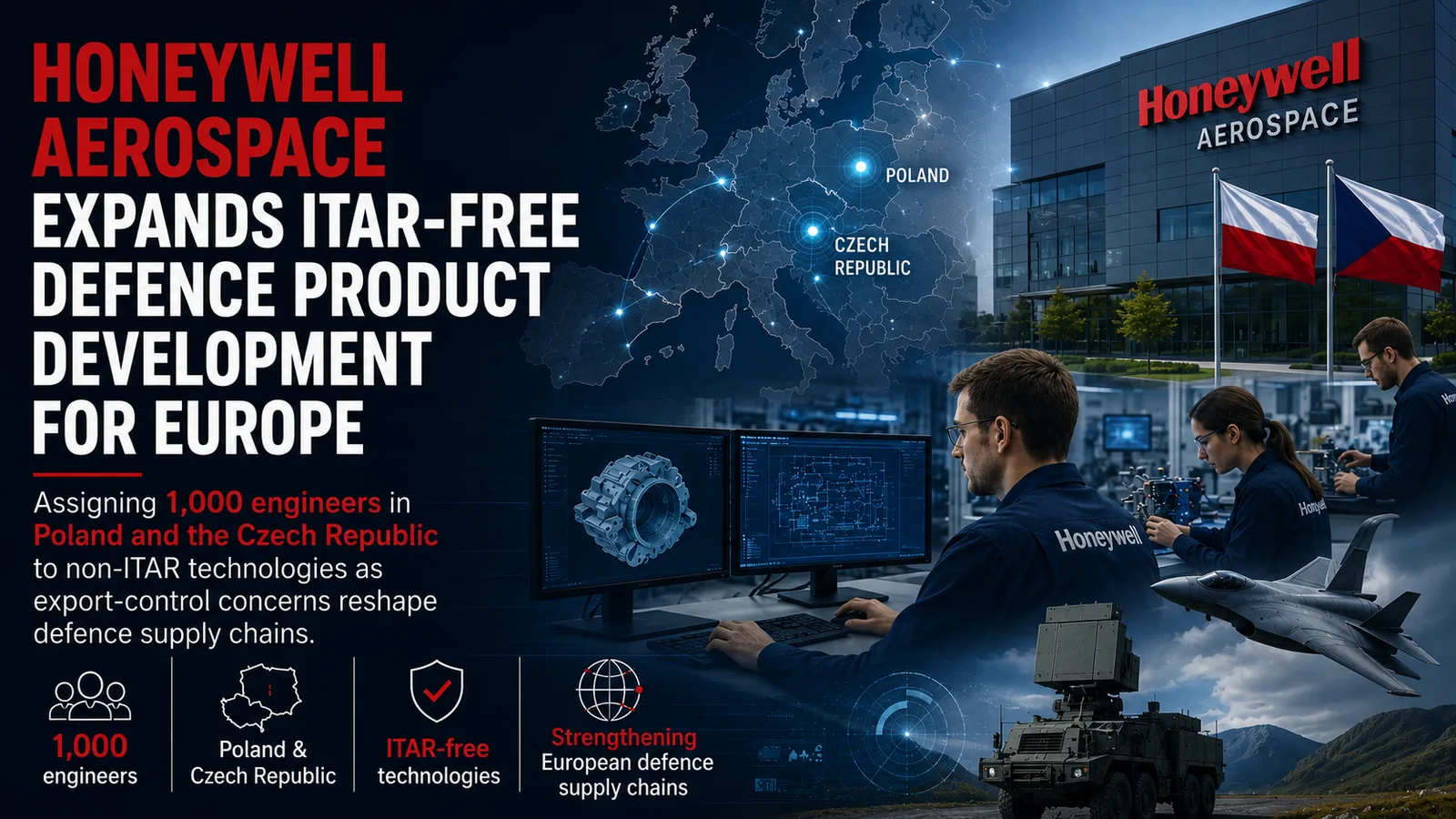
Honeywell Aerospace is expanding development of products designed without restricted U.S. technologies. According to Reuters, the company has assigned around 1,000 engineers in Poland and the Czech Republic to design non-ITAR technologies for European and international defence markets.
This move reflects a broader shift in European defence procurement. Governments are increasing spending while also prioritising supply-chain autonomy and export flexibility. ITAR, or International Traffic in Arms Regulations, governs U.S. defence articles and technical data, and can create approval risks when systems are exported or transferred.
As a result, ITAR-free defence products are moving from a niche requirement to a central consideration in procurement strategies across Europe.
ITAR-Free Defence Products and Europe’s Autonomy Strategy
The growing demand for ITAR-free defence products reflects Europe’s push for greater strategic autonomy. Governments want to strengthen defence capabilities while maintaining control over how systems are exported and deployed.
This is particularly relevant for missile systems, drones, aircraft and electronic warfare platforms. Even a single ITAR-controlled component can limit how a complete system is sold or transferred internationally.
For defence suppliers, this creates a competitive opportunity. Companies that can deliver high-performance systems without U.S. export restrictions may gain an advantage in European procurement programmes.
Honeywell Expands European Engineering Capabilities
Honeywell Aerospace’s investment in European engineering is central to its strategy. By assigning engineers in Poland and the Czech Republic to non-ITAR development, the company is strengthening its position within European defence supply chains.
This approach allows Honeywell to operate not only as a U.S.-based supplier but also as a partner capable of localising technology for European customers. It aligns with increasing demand for regional production, certification and integration capabilities.
As European defence programmes expand, local engineering capacity is becoming a key factor in supplier selection.
Navigation Systems and Missile Components in Focus
Honeywell’s defence portfolio includes navigation systems and missile actuators, both of which are critical for modern military platforms. These components must deliver high precision and reliability in contested environments.
Navigation technologies are especially important as GPS disruption becomes more common. Inertial navigation systems and resilient positioning solutions are essential for drones, missiles and aircraft operating in electronic warfare conditions.
The acquisition of Italy-based Civitanavi Systems strengthens Honeywell’s capabilities in this area, providing a European foundation for advanced navigation technologies that can be developed outside ITAR constraints.
Export-Control Risk and Programme Flexibility
Export-control risk can significantly affect defence programmes. If a system includes ITAR-controlled components, exporting it to third countries may require U.S. approval, potentially delaying or limiting sales.
This creates uncertainty for governments and defence contractors. It can also reduce the attractiveness of platforms in competitive international markets.
ITAR-free designs do not eliminate all regulatory requirements, but they reduce dependence on U.S. approval processes and provide greater flexibility for European suppliers.
European Rearmament Drives Demand
Europe’s ongoing rearmament is increasing demand for advanced defence systems, including missiles, drones, air defence platforms and command-and-control networks. This growth is placing pressure on supply chains to scale production efficiently.
Non-ITAR technologies support this effort by simplifying export processes and enabling multinational cooperation. They also help governments build shared capabilities and interoperable systems.
The trend extends beyond Honeywell, with European and Canadian suppliers also developing ITAR-free components to meet market demand.
Strategic Implications for Defence Suppliers
Honeywell’s strategy highlights a broader shift in the defence industry. Exportability is becoming a key feature alongside performance and cost. Suppliers must consider regulatory constraints during the design phase to remain competitive.
This shift is likely to reshape competition in areas such as navigation systems, missile components, electronic warfare and unmanned platforms. Companies that integrate export-control considerations into product development will be better positioned in global markets.
While Europe continues to rely on U.S. technology, it is also seeking greater independence in critical areas. ITAR-free defence products represent a balance between maintaining transatlantic cooperation and achieving strategic autonomy.
Conclusion
Honeywell Aerospace’s expansion into ITAR-free defence products demonstrates how export-control considerations are reshaping the defence industry. As Europe increases defence spending and prioritises supply-chain resilience, demand for non-ITAR technologies is expected to grow.
This trend is likely to influence procurement strategies, supplier competition and industrial policy across the region, making ITAR-free solutions a defining feature of future defence systems.