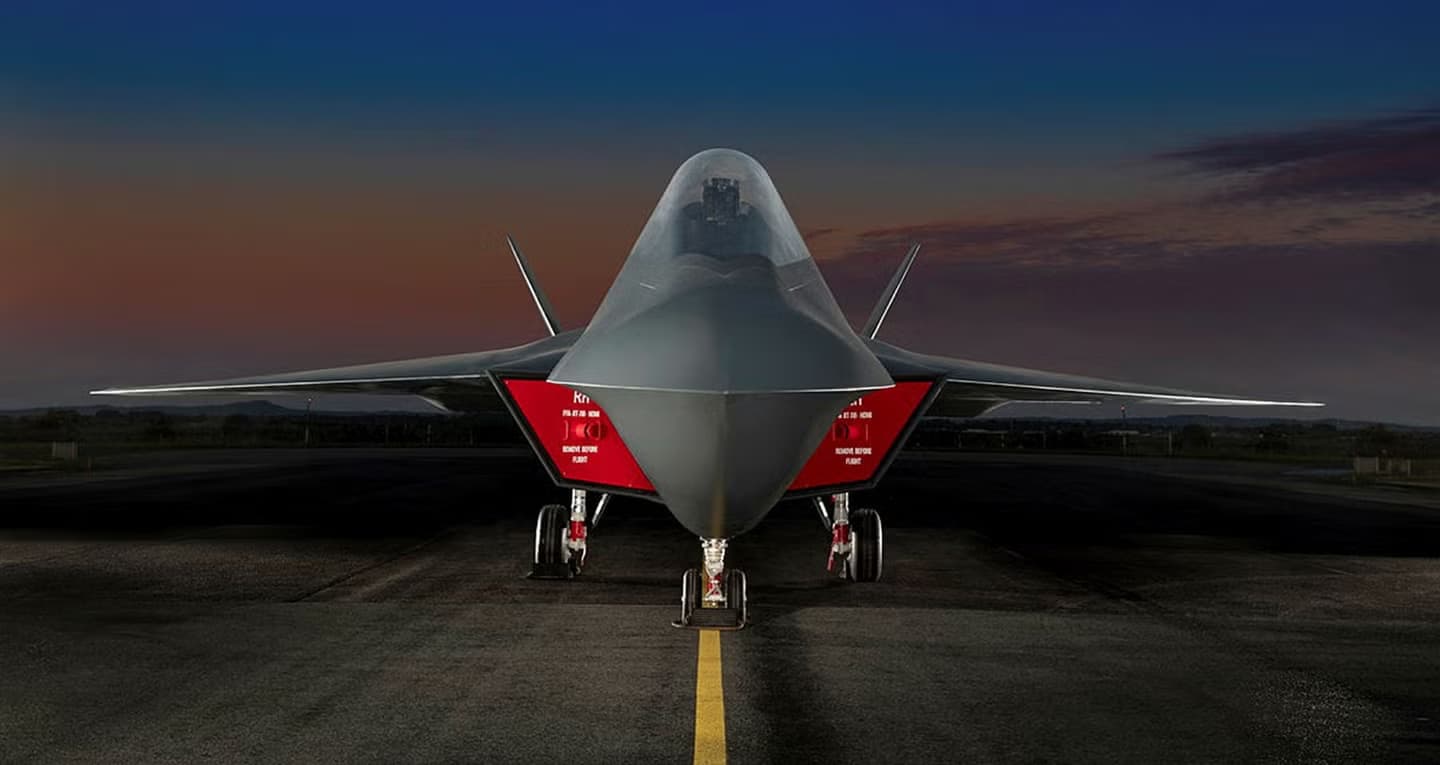
Sixth-generation fighters are entering a new phase of the global air-superiority contest. The US Navy awarded Boeing a development contract for its F/A-XX carrier-based fighter on 29 September 2026, adding to the company's F-47 work for the US Air Force. Meanwhile, the UK, Italy and Japan have funded the next design stage of GCAP, and the joint French-German-Spanish fighter project has broken down. The significance is not that a new generation is already operational: it is that governments are making consequential choices about aircraft, software, suppliers and control of future combat-air systems.
The US acquisition authority's 29 September announcement described an F/A-XX full-scale development award to Boeing worth more than USD 20 billion, including multiple test aircraft for ground, airworthiness, systems and weapons integration trials. That is a development-stage contract, not a delivered fleet or a verified flyaway price. The US Air Force said in July that its separate F-47 family of systems had entered engineering and manufacturing development, with programme leaders continuing to target a first flight before the end of the current US presidential administration.
On 3 July, the UK Ministry of Defence announced a £4.6 billion GCAP contract with Edgewing on behalf of the UK, Italy and Japan. On 21 July, Canada joined as GCAP's first observer nation. At the same time, the demise of the common New Generation Fighter within the Franco-German-Spanish FCAS effort has forced European governments to reconsider their industrial pathways. The race is becoming as much about sustainable system integration and programme governance as about aircraft performance.
What Makes a Fighter Sixth Generation?
There is no universally binding technical specification that makes an aircraft 'sixth generation'. The term generally refers to future combat-air systems combining low observability, advanced sensing, resilient connectivity, adaptable software, extended operational reach and closer integration with uncrewed collaborators. These are aspirations and design priorities, not an internationally certified checklist. A platform may excel in one area while remaining immature in another.
One distinguishing shift is the idea of a family of systems. Instead of evaluating only the speed, radar signature and weapons carriage of a crewed aircraft, planners assess how it exchanges information with satellites, airborne sensors, other fighters, command networks and collaborative combat aircraft (CCAs). The quality of the overall operational system can matter more than an isolated platform characteristic. A sophisticated airframe may still be constrained by inadequate data links, unavailable weapons or maintenance bottlenecks.
Autonomy is also often overstated. An AI-assisted mission system can help a pilot process sensor information or coordinate tasks without independently authorising lethal force. A semi-autonomous wingman can demonstrate flight and stores-integration functions while remaining far from a validated combat deployment. The US Air Force's February 2026 CCA trials used inert munitions to assess airworthiness, structural loads and compatibility. Such tests are important, but should not be described as operational air-to-air victories.
F-47: The US Air Force's High-End Air Superiority Investment
The US Air Force selected Boeing on 21 March 2025 for the F-47 engineering and manufacturing development phase. The contract covers the development, integration and testing of the future fighter, including a limited number of test aircraft; it also contains options related to later low-rate production. Options are not the same as placed production orders. The aircraft is intended to succeed the F-22 as the Air Force's most demanding air-superiority missions evolve.
The strategic rationale is reach and survivability in contested airspace, especially where distances, advanced sensors and integrated air defences increase operating difficulty. The Air Force has said its F-47 design places emphasis on adaptability and a government-owned digital architecture. Yet the programme's exact configuration, operational effectiveness, cost per delivered aircraft and future readiness rates cannot be independently established from publicly released concept art or selected performance claims.
On 29 July 2026, US Air Force officials reported that F-47 development had entered a mature engineering-and-manufacturing phase and maintained an aggressive flight schedule. This is a meaningful management milestone, but first flight, certification, operational testing, initial operating capability and force-wide deployment are different achievements. The 2028 first-flight goal does not imply an operational squadron will be ready in that year.
F/A-XX: A Separate Carrier Fighter With a Major New Award
The US Navy's F/A-XX addresses a different operational requirement. Carrier aircraft face demanding launch, recovery, maritime sustainment and expeditionary support conditions. Their design priorities therefore cannot simply be copied from a land-based air-superiority aircraft. The Navy seeks a future fighter to replace the F/A-18E/F Super Hornet within a larger carrier air wing and networked force.
The 29 September 2026 government award notice placed more than USD 20 billion on the F/A-XX full-scale development phase, including multiple test aircraft. Boeing's accompanying announcement said the aircraft would use an open mission-systems architecture and advanced operational reach. The award is a substantial industrial milestone: Boeing is now responsible for leading development work on both headline US sixth-generation fighter programmes. It is not evidence that the two programmes share a common airframe or that the Navy's aircraft is production-ready.
A dual-programme position offers opportunities for technology, tooling and workforce learning, but creates execution risk as well. Engineering capacity, classified integration, propulsion development, software verification and supply-chain assurance will all compete for resources. Programme offices will need to show that digital design and modular architectures yield repeatable manufacturing and sustainment gains rather than merely optimistic development schedules.
GCAP: UK, Italy and Japan Convert Cooperation Into Contracts
The Global Combat Air Programme is the most clearly institutionalised multinational counterpart to the US projects in this comparison. The UK, Italy and Japan have established a government organisation and a joint industrial venture, Edgewing, to advance their planned next-generation aircraft. The consortium brings together BAE Systems, Leonardo and the Japan Aircraft Industrial Enhancement Company through a shared design organisation.
The 3 July 2026 UK announcement said the three governments would collectively fund a £4.6 billion contract for Edgewing to advance aircraft requirements, design and rigorous evaluation. The announcement also described a UK commitment of £8.6 billion over four years. These are distinct financial figures: the contract is a tri-national industrial commitment, while the four-year amount describes planned UK programme investment. Adding them together as if they were separate purchases of aircraft would be misleading.
The Japanese Ministry of Defense confirmed on 6 July that GIGO and Edgewing had signed an agreement running through the end of 2027. The UK Parliament said on 17 July that the ambition remained an aircraft entering service from 2035, while detailed milestones would be determined after concept and assessment work. This is a programme goal rather than a delivery guarantee.
Canada's 21 July 2026 observer arrangement broadened the political conversation without immediately changing the three-country ownership and delivery model. Observer access permits closer evaluation of governance, capabilities and industrial opportunities; it does not equal funded membership, a final purchase commitment or guaranteed production workshare. Defence Agenda has examined the deadline pressures facing prospective GCAP partners and the programme's electronics-contract architecture.
FCAS After the Common Fighter Collapse: A Different European Race
The former Franco-German-Spanish Future Combat Air System (FCAS) proposal was frequently presented as a direct rival to GCAP. That description now requires a major qualification. In June 2026, France and Germany ended the effort to build a common New Generation Fighter after Dassault and Airbus failed to resolve industrial and leadership disputes. The decision was a setback for the shared fighter; it did not automatically erase every strand of combat-cloud, uncrewed systems or technology work previously associated with FCAS.
A 15 September 2026 German Bundestag account said existing NGWS arrangements were being run down contractually, with negotiations regarding an early conclusion to the New Generation Fighter portion. Germany described continued work on wider FCAS capabilities, including national research. These details matter because programme labels may survive after their original aircraft partnership has ceased to be viable.
The national alternatives are starting to emerge. On 15 October 2026, Defense News reported that France's Air and Space Force chief described a future domestic combat aircraft, or Avion de Combat du Futur, with conventional operations targeted around 2040. Germany, meanwhile, has considered alternatives including cooperation with other partners, a new industrial coalition or additional existing aircraft as an interim measure. These possibilities are not concluded production contracts.
For readers tracking the industrial landscape, Defence Agenda's earlier GCAP-versus-FCAS comparison now serves as historical context. The situation in October 2026 is not a race between two unchanged European joint fighter teams. It is a funded GCAP pathway alongside a fragmented post-NGF search for sovereign or revised multinational alternatives.
Programme Comparison: Commitments, Timelines and Risks
| Programme | Participants / industrial lead | Verified 2026 status | Public timing / financial reference | Principal risk |
|---|---|---|---|---|
| F-47 (USAF) | United States / Boeing | Engineering and manufacturing development; testing preparations | First flight targeted around 2028; operational entry not confirmed | Technical integration, classified cost, maturation and sustainment |
| F/A-XX (US Navy) | United States / Boeing | Full-scale development award on 29 September 2026 | Contract above USD 20bn for development and test aircraft; no operational delivery date established here | Carrier suitability, budget, dual-programme execution |
| GCAP | UK–Italy–Japan / Edgewing | £4.6bn tri-national design-stage agreement; Canada observer | Service-entry ambition from 2035, not a guaranteed IOC | Workshare, three-nation governance, affordability and schedule |
| FCAS common NGF | Former France–Germany–Spain fighter effort | Joint aircraft effort discontinued in June 2026 | Previous around-2040 ambitions no longer apply to a common NGF | Fragmentation and new programme definition |
| French ACF concept | France / national route under development | Publicly described national successor pathway in October 2026 | Conventional missions targeted around 2040, subject to future decisions | Funding, development scope and export economics |
Editorial comparison based on announcements available by 20 October 2026. Values represent different contract scopes and currencies and must not be compared as unit prices. No programme is rated combat-ready by this table.
Why Software, Autonomy and Industry Matter More Than Labels
Low observability remains relevant, but future aircraft will increasingly compete on how easily sensors and mission applications can be upgraded, how information moves across platforms and how quickly forces can recover from degraded communications. The architecture has to support not just impressive demonstrations but dependable operational performance after years of software changes and equipment maintenance.
The US Air Force's 17 June 2026 CCA awards covered both air vehicles and mission-autonomy software. The subsequent Creech Air Force Base exercise in July helped develop operational procedures for semi-autonomous aircraft. This progression illustrates how software rights, experimentation, certification and tactics must develop alongside a crewed fighter. A future fighter programme that cannot integrate affordable adjunct aircraft risks paying for advanced individual platforms without extracting the benefits of distributed force design.
European suppliers face a related problem. Shared fighter procurement does not automatically produce shared electronics standards or a resilient supply chain. Governments need agreement on intellectual property, export authorisations, secure software updates, sovereign mission-data control and who pays for modifications. Defence Agenda's analysis of wingman aircraft in European rearmament highlights the operational and industrial importance of those uncrewed complements. Sweden's future-fighter technology studies show that some countries are keeping alternative design expertise alive rather than committing prematurely to one sixth-generation industrial coalition.
The strongest counterargument to a costly clean-sheet aircraft is that upgraded fifth-generation fighters, stand-off weapons, improved electronic warfare, networking and larger fleets of less expensive uncrewed systems might deliver some of the required effects sooner. These are not universal substitutes: a fighter's persistence, survivability, sensing and ability to coordinate multiple assets may justify high-end investment in some missions. But the balance should be decided through operational analysis and lifecycle affordability rather than branding a programme 'sixth generation'.
Implications / Next: The Milestones That Will Decide the Race
For the F-47, the next objective public milestone is whether the programme meets its stated first-flight target in 2028. Observers should then separate flight-test progress from production approval, cost baselines, certification and declared operational capability. For the F/A-XX, the award now makes development planning, test-aircraft construction, affordability oversight and carrier-specific validation the relevant milestones; it is premature to assume a service-entry year.
For GCAP, the key checkpoints are the delivery of requirements and design milestones under the 2026 contract, the operational role of the Edgewing organisation and decisions about whether observers become funded programme partners. A clearer aircraft development calendar and demonstration evidence will matter more than claims about abstract generational superiority. For the post-FCAS European programmes, the questions are whether France can fund a national path, what industrial model Germany pursues and which elements of collaborative sensors, combat-cloud and uncrewed technology actually continue.
For OEMs and suppliers, the industry signal is to invest in certifiable mission software, sensors, propulsion, advanced manufacturing, secure communications, qualified components and maintainable design. Political announcements may attract headlines, but contractual milestones, tested subsystems, manufacturing throughput and fleet support will decide whether these investments deliver operational value.
Conclusion
The sixth-generation fighter race in 2026 is no longer a contest of futuristic artist impressions. Boeing's F/A-XX selection and F-47 development role, GCAP's funded multinational design work and the collapse of the shared FCAS fighter have created visibly different procurement paths. No one has yet demonstrated that these future operational systems will be affordable, interoperable and fielded on schedule. The likely competitive advantage will go to the programme that turns advanced aircraft, uncrewed collaborators and industrial capacity into a sustainable air-superiority system — rather than simply claiming the next generation first.
Further Reading
- US Air Force — F-47 engineering and manufacturing development award (21 March 2025)
- US Department of War — F/A-XX development contract (29 September 2026)
- UK Ministry of Defence — £4.6bn GCAP contract (3 July 2026)
- UK Ministry of Defence — Canada joins GCAP as observer (21 July 2026)
- German Bundestag — NGWS and FCAS status (15 September 2026)
- Defense News — French ACF pathway (15 October 2026)
- Defence Agenda — GCAP vs FCAS: Europe's Airpower Race
- Defence Agenda — GCAP Electronics Evolution Contract