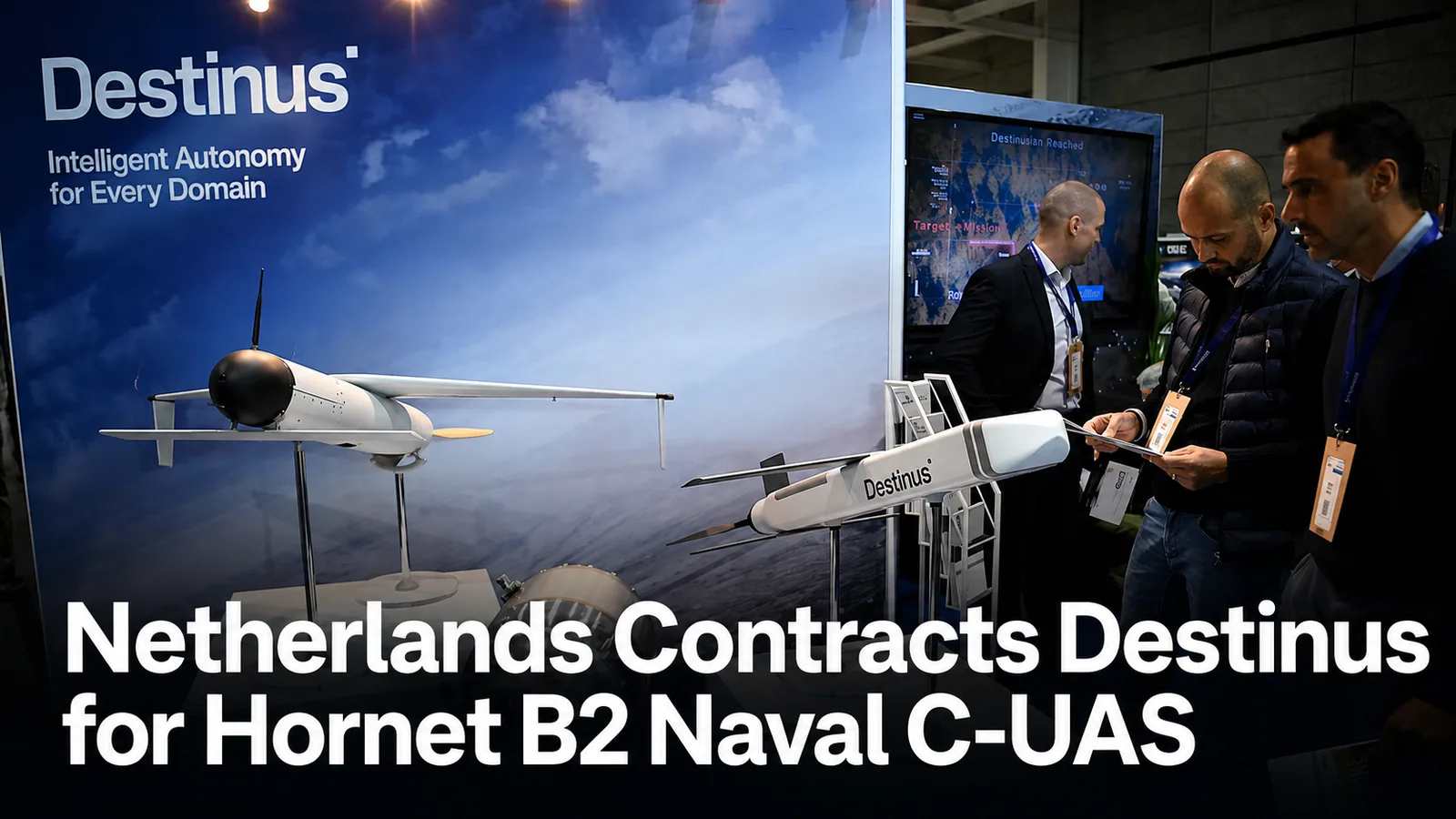
The Netherlands Ministry of Defence has contracted Destinus to develop a Hornet B2 naval counter-UAS capability for the Royal Netherlands Navy, launching a Concept Development & Evaluation programme that will deliver interceptor systems, integrate them with several warships and support work towards a possible initial operating capability.
The contract, announced on 24 August 2026, is intended to address a growing medium-range drone threat to naval forces. The programme is scheduled to run through the second quarter of 2027. The key procurement point is that this is not yet a fleet-wide operational deployment: Hornet B2 is entering a development, integration and evaluation phase in which the land-origin C-UAS architecture will be adapted for use at sea.
Key Facts
- Contract date: 24 August 2026
- Customer: Netherlands Ministry of Defence / Materiel and IT Command (COMMIT)
- Service: Royal Netherlands Navy
- System: Destinus Hornet B2 kinetic counter-UAS interceptor
- Programme: Concept Development & Evaluation (CD&E)
- Scope: Interceptor delivery, integration with several warships and Integrated Logistics Support
- Programme completion: Q2 2027
- Contract value / interceptor quantity: Not publicly disclosed
Context and New Development
The Dutch Ministry of Defence says the existing fleet will receive an additional counter-UAS layer because the threat from medium-range drones is increasing, based on operational analysis and the current maritime threat picture. The requirement is for a kinetic capability able to destroy incoming aerial objects rather than relying only on electronic disruption or soft-kill effects.
The ministry describes the new architecture as consisting of a base station and a launch platform from which an interceptor drone can be fired. It also states that the system will continue to be developed through test campaigns as an existing land-oriented C-UAS concept is converted into a variant suitable for operational use at sea.
Destinus identifies Hornet B2 as the interceptor at the centre of the programme. According to the company, COMMIT has signed a Concept Development & Evaluation contract covering delivery of Hornet B2 systems, integration with several Royal Netherlands Navy warships and Integrated Logistics Support activities towards a possible initial operating capability.
This distinction matters. The programme establishes a contractual route to naval integration, but the public record does not yet confirm a fleet-wide production quantity, full operational acceptance or a fixed IOC date. The stated Q2 2027 milestone is the scheduled completion of the CD&E programme.
Hornet B2 Architecture
Destinus describes Hornet B2 as a canister-launched interceptor with an architecture that differs from a conventional surface-to-air missile. The vehicle is stored in a sealed canister and launched by a rocket booster. After launch, it deploys folding wings and transitions to electric-powered cruise flight.
The company says the interceptor is designed to engage one-way attack systems and other subsonic aerial threats using electro-optical and infrared sensing, with AI-based processing supporting the terminal phase. Destinus also states that engagement decisions remain under human command in accordance with applicable rules of engagement.
On its current Hornet Block 2 product page, Destinus publishes a range of more than 150 km and a 3 kg payload, while also describing EO/IR and radar guidance, all-weather operation and AI-coordinated multi-vehicle functions. These figures are manufacturer-published specifications for the Block 2 product family. The Netherlands Ministry of Defence has not publicly confirmed that the eventual naval configuration will field the same range, payload, seeker set or software functions without modification.
That qualification is important because ship integration can alter launcher arrangement, datalinks, sensor interfaces, engagement doctrine, electromagnetic compatibility requirements and safety envelopes. Public sources have not disclosed the exact Dutch shipboard configuration.
Technical and Operational Impact
The operational logic is centred on the cost-exchange problem in modern naval air defence. Warships must preserve high-end surface-to-air missiles for complex aircraft, missiles and other demanding targets, while still having sufficient magazine depth to defeat lower-cost one-way attack drones and similar threats arriving in numbers.
A drone interceptor creates a potential additional layer between electronic warfare, guns and premium naval missiles. If it can be stored densely, launched quickly and integrated with existing ship sensors and command systems, it may allow commanders to assign a lower-cost kinetic effector to target classes that do not justify expenditure of scarce high-performance missiles.
The interceptor itself, however, is only one component of the capability. Effective naval employment will require target detection, classification, fire-control cueing, deconfliction, command-and-control integration, safe launch geometry, ship motion compensation, communications resilience and clear engagement authority.
The Dutch programme explicitly includes operator participation. Royal Netherlands Navy personnel are expected to contribute operational expertise during development and evaluation, helping shape requirements and system specifications before the naval configuration is frozen. This can reduce the risk of developing a technically capable interceptor that later requires extensive redesign for shipboard use.
Naval Integration Dimension
The Netherlands has not publicly identified which warship classes will receive Hornet B2 during the programme. Public statements refer only to integration with “several” Royal Netherlands Navy warships. Any attribution to specific frigate, patrol or support-ship classes would therefore be premature.
The broader naval integration challenge will involve more than mounting a launcher. The system will need to coexist with existing radars, electro-optical sensors, combat-management systems, datalinks, decoys, guns and missile systems without creating electromagnetic, physical or tactical interference.
Destinus has already demonstrated a Hornet Block 1 launch from the Spanish Navy frigate Santa María in June 2026. That test explored a containerised naval deployment concept and provides a relevant technical precedent, but it does not constitute qualification of Hornet B2 for the Dutch fleet.
The Royal Netherlands Navy is also experimenting with wider uncrewed command-and-control architectures. Defence Agenda previously reported on the Navy’s IDUS system, tested during Maritime Uncrewed Sea Trials 2026 to coordinate air, surface and underwater uncrewed systems and pass sensor information into the naval combat-management environment. Hornet B2 is a separate C-UAS programme, but the two efforts reflect the same broader requirement: uncrewed systems must become integrated nodes inside the fleet architecture rather than stand-alone platforms.
Programme and Procurement Dimension
The acquisition model is a Concept Development & Evaluation contract rather than a conventional large-scale production award. It combines system delivery, ship integration, test activity and Integrated Logistics Support while the capability is still being shaped.
This approach allows the Navy to bring operational users into the engineering cycle and evaluate the system in the maritime environment before committing to a larger fleet-wide configuration. It also gives the customer an opportunity to determine whether claimed advantages in cost, magazine depth, endurance and sensor performance translate into operational value at sea.
No contract value, number of interceptors, number of launchers, number of participating ships or follow-on procurement ceiling has been publicly disclosed. These data should not be inferred from Destinus production claims or from the programme schedule.
The earlier Hornet B1 is already in serial production, according to Destinus. That provides an industrial baseline for the family, but the B2 naval programme still has to demonstrate that the next-generation architecture can be manufactured, integrated and supported at the scale required by a naval customer.
Industrial Impact
The Dutch award gives Destinus a domestic naval development reference for its interceptor portfolio and expands the company’s role in European layered air defence. The company is headquartered in the Netherlands and has been building partnerships around both interception and strike systems.
In June 2026, Destinus and Diehl Defence agreed to integrate Hornet B2 into the GARMR counter-UAS architecture, with a pathway to explore Hornet as a potential secondary effector within the IRIS-T ground-based air-defence family subject to validation and approvals. Destinus has also worked with TNO on advanced radar-seeker technology intended for interceptor systems.
Those developments suggest that Hornet is being positioned not as a closed stand-alone product but as an effector that can connect to different sensing, command and launcher architectures. The Dutch naval programme will test whether that modularity extends effectively into the shipboard domain.
Limitations and Counterpoint
The public information base remains incomplete. Neither the Netherlands Ministry of Defence nor Destinus has disclosed the contract value, procurement quantity, target unit cost, ship classes, launcher density, reload concept, probability of kill, engagement envelope, maximum target speed or tested performance at sea.
The 150+ km range and 3 kg payload are current Destinus product specifications for Hornet Block 2, not Dutch government acceptance-test data. Likewise, the company’s claim that the cost per engagement is far below that of traditional interceptor missiles has not been supported publicly with unit-price or lifecycle-cost figures.
There is also a difference between defeating subsonic one-way attack drones and providing broad naval air defence. Hornet B2 is being developed as an additional layer, not as a replacement for high-end shipborne missile systems. Faster, manoeuvring or more sophisticated threats may continue to require premium interceptors and other defensive layers.
Implications / Next
The next milestones are technical rather than purely contractual. The programme will need to demonstrate safe shipboard launch, reliable target cueing, terminal guidance, integration with Navy command-and-control, logistics support and repeatable performance in representative maritime conditions.
The Q2 2027 programme-completion target will be the first major indicator of whether the CD&E effort can transition into an initial operational capability. A follow-on production decision, disclosed quantity or named ship class would signal that Hornet B2 is moving from evaluation into a more durable fleet capability.
The programme will also be relevant beyond the Netherlands. European navies face the same magazine-depth and cost-per-engagement problem, particularly after operational experience in the Red Sea and Ukraine demonstrated the scale at which low-cost uncrewed threats can be employed. A successful Dutch integration could therefore become an export and interoperability reference for Destinus.
Conclusion
The Netherlands has taken a concrete step toward adding a lower-cost kinetic counter-UAS layer to its naval air-defence architecture, but the current contract is best understood as a development and integration programme rather than completed fleet-wide fielding.
Hornet B2 offers a different interception model built around canister launch, booster-assisted departure and electric cruise. Its strategic value will depend less on headline range than on ship integration, sensor and command-system connectivity, magazine depth, reliability and cost per successful engagement. The Q2 2027 CD&E milestone will show whether those attributes can be translated into an operational naval capability.