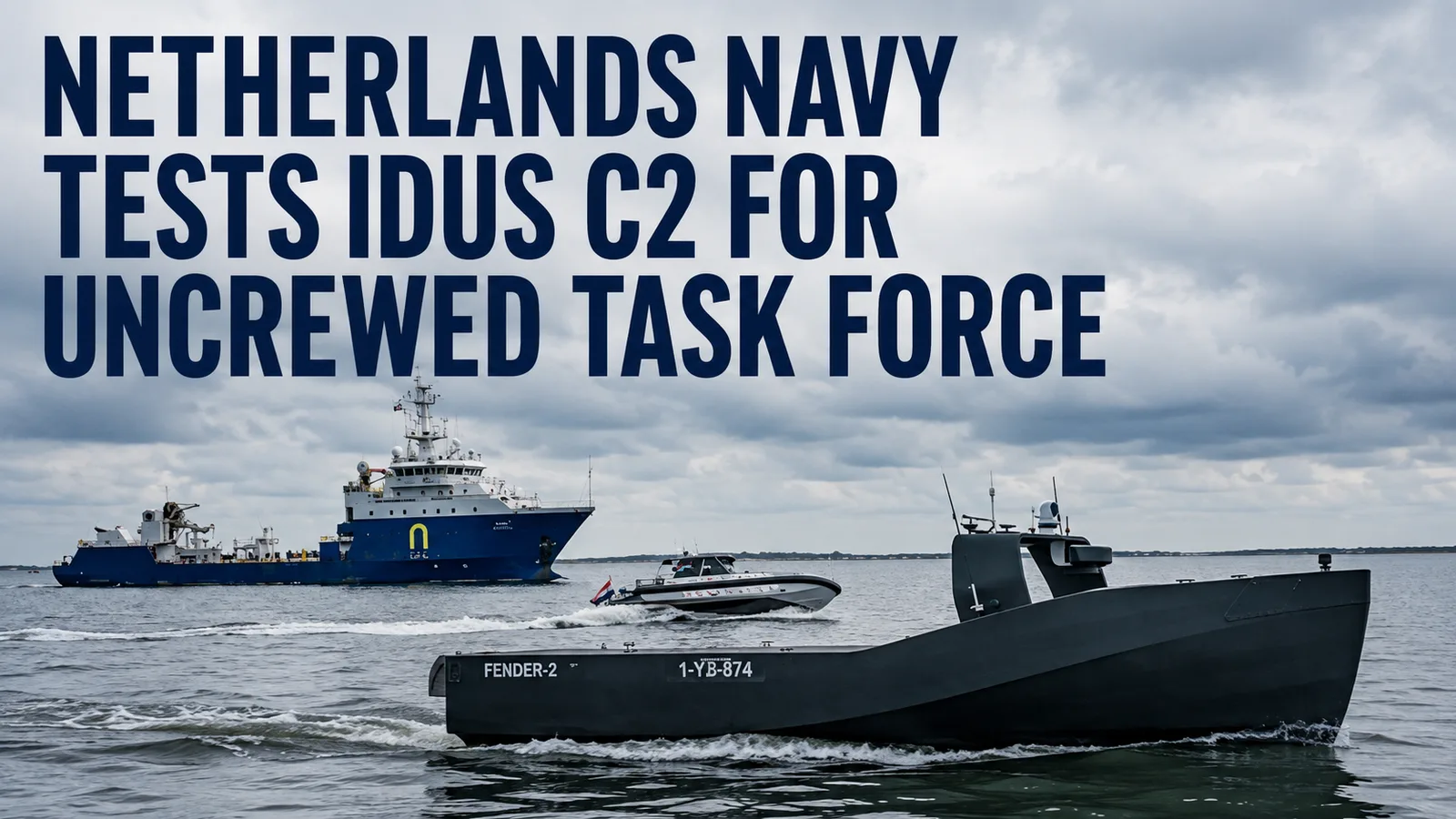
Netherlands Navy IDUS C2 trials have demonstrated how the Royal Netherlands Navy intends to command a future mixed force of crewed ships, uncrewed surface vessels, underwater vehicles and aerial drones through a common maritime command architecture.
The Royal Netherlands Navy tested the concept during its inaugural Maritime Uncrewed Sea Trials, or MUST 2026, conducted from Den Helder in June. Janes reported that the five-week activity focused on command and control of the Navy’s Task Force Maritime Uncrewed, while Dutch Defence described it as the first time the service had exercised air, surface and underwater uncrewed systems together around a crewed command platform.
The significance extends beyond individual drones. The experiment tested whether heterogeneous uncrewed platforms could be tasked through the Navy-developed Intelligent Distributed Uncrewed Systems software and feed their sensor information into the existing naval combat-management environment. That software layer could become one of the central enablers of the Netherlands’ planned 2035 “hybrid navy”.
Key Facts
- Exercise: Maritime Uncrewed Sea Trials 2026, conducted from Den Helder in June 2026.
- Duration: Janes reports that the inaugural MUST activity lasted five weeks.
- C2 system: IDUS — Intelligent Distributed Uncrewed Systems — developed by the Royal Netherlands Navy.
- Domains: UAVs, USVs and UUVs operated as part of one crewed-uncrewed maritime force.
- Command platform: DSS Galatea was operated as a crewed at-sea C2 centre during the trials.
- CMS integration: IDUS combined uncrewed-vehicle sensor information and transferred it into CAMS/Force Vision Guardion.
- Operational scenario: UAVs and USVs located and verified a vessel of interest before UUVs investigated possible activity threatening critical undersea infrastructure.
Netherlands Navy IDUS C2 Moves Beyond Platform Control
The most important result from MUST 2026 was not simply that several unmanned systems operated simultaneously.
The test addressed a more difficult problem: how a naval commander can control increasing numbers of heterogeneous uncrewed vehicles without creating a separate command station, operator team and tactical picture for every platform.
IDUS is intended to provide that orchestration layer.
According to Janes, operational experimentation during MUST showed that IDUS could integrate unmanned maritime vehicles and aggregate their sensor information into the Royal Netherlands Navy’s CAMS/Force Vision Guardion combat management system.
This distinction is strategically important. A navy can purchase large numbers of drones, but those systems create limited additional combat power if their information remains trapped inside separate control consoles.
The operational objective is therefore to make the uncrewed vehicle another distributed node inside the fleet’s existing command architecture.
DSS Galatea Became an At-Sea Uncrewed Force Command Platform
DSS Galatea played a central role in the experiment.
The Netherlands Ministry of Defence said on 6 July 2026 that UAVs, USVs and UUVs operated around Galatea while being controlled through IDUS.
Janes describes Galatea as a dual-mode Damen patrol vessel that was operated in crewed configuration as the at-sea command-and-control centre during MUST.
This effectively turns the ship into a mothership-style command node without requiring every uncrewed platform to carry its own large operator footprint.
Research ship MV Geosea and amphibious ship HNLMS Johan de Witt also took part in the activity, providing additional platforms through which the Navy could examine how uncrewed systems fit around existing fleet units.
The Trial Used Air, Surface and Underwater Drones Together
MUST was deliberately multi-domain within the maritime environment.
Shield AI V-BAT aircraft and UAVs from the Navy’s Maritime Drone Team provided the airborne layer.
Experimental uncrewed surface vessels operated on the North Sea, while a Lobster Robotics underwater vehicle provided the subsurface layer.
The architecture therefore connected systems operating above, on and below the water rather than demonstrating a homogeneous USV swarm.
This matters because the military value of maritime autonomy increasingly depends on combining complementary sensors and vehicle types rather than asking one platform to perform every mission.
A FIND Mission Tested the Full Sensor Chain
One of the central scenarios was a FIND operation.
Dutch Defence says UAVs, surface vessels and underwater vehicles worked together to locate and track a target.
Janes provides additional operational detail: UAVs and USVs were tasked to find, identify and verify a vessel of interest at sea, after which UUVs examined whether the vessel was conducting subsurface activity that could threaten critical undersea infrastructure.
The sequence illustrates the system-of-systems model clearly.
An airborne sensor can search a large area rapidly. A surface vessel can provide closer persistence and communications. An underwater platform can then investigate activity below the surface.
IDUS and the combat-management system are intended to make those individual steps appear to the commander as one connected mission rather than three separate drone operations.
Critical Undersea Infrastructure Is Driving the Requirement
The choice of mission reflects a growing European naval priority.
Subsea telecommunications cables, energy infrastructure and other seabed installations have become critical security concerns across the North Sea and Baltic region.
Monitoring large underwater areas exclusively with crewed ships is expensive and manpower-intensive.
A network containing aerial drones, USVs and UUVs can distribute surveillance across a wider area and send specialist vehicles toward suspicious activity only when required.
This makes infrastructure protection a particularly suitable early mission for maritime autonomy because persistent surveillance and identification can deliver operational value before navies move into more complex autonomous weapon employment.
Two 12-Metre USVs Were Built in About Three Months
MUST also tested a different model for producing the surface vehicles themselves.
Dutch Defence says two specially designed, approximately 12-metre USVs used during the exercise were produced with large-scale 3D-printing techniques and built in roughly three months in cooperation with the Maritime Research Institute Netherlands, or MARIN.
The vehicles form part of the wider SeaRush effort to develop scalable and rapidly producible experimental USVs.
MARIN said in January 2026 that SeaRush was designed around rapid development, deployment and iterative improvement, using Dutch production infrastructure and flexible manufacturing methods including 3D printing.
The industrial concept mirrors lessons from current warfare: uncrewed fleets may need to be produced, modified and replaced much faster than conventional naval ships.
MARIN Wants More USVs Without More Operators
Scaling the number of vehicles creates a second problem: manpower.
If ten USVs require ten dedicated control teams, a nominally uncrewed fleet can still create a substantial personnel burden.
MARIN’s KNOWONE research programme is examining how several small and large USVs can operate with crewed vessels without requiring a proportional increase in operators.
The organisation has developed software enabling USVs to sail automatically in formation with a crewed vessel.
During MUST, Dutch Defence says USVs practised automatic formation sailing around Galatea.
This is a relatively simple operational behaviour compared with combat autonomy, but it is a necessary building block if future task groups are expected to manage dozens of robotic platforms.
Simulation Is Feeding Directly Into Sea Trials
The Dutch programme is also linking simulation directly to operational experimentation.
Within KNOWONE, MARIN has evaluated operational concepts with Defence personnel in its Dolphin simulation environment before transferring the software onto experimental vessels.
MARIN and TNO are also working with the Navy through the Military-Maritime Operational Management in Transition, or MOMiT, programme.
In one experiment, 12 naval professionals operated a simulated future frigate accompanied by four autonomous USVs while responding to tactical events and a USV propulsion failure.
The objective is broader than vehicle control: it is to determine which tasks should remain with human operators, which can be assigned to machines and where those functions should physically sit within a future ship or task group.
The Netherlands Is Designing a 2035 Hybrid Navy
MUST sits inside an explicit long-term fleet strategy.
The Royal Netherlands Navy published its Future Vision Maritime Uncrewed on 30 April 2026.
The service expects its 2035 force structure to combine larger crewed platforms with uncrewed systems operating on the surface, in the air, underwater and in the littoral domain.
Vice Admiral Harold Liebregs framed the objective as a system-of-systems approach rather than a collection of individual unmanned platforms.
The Navy has established Taskforce Maritime Uncrewed to bring operational and technical specialists together with research organisations and industry around this transition.
The vision covers seven maritime warfare areas, including North Sea and Caribbean security as well as amphibious operations.
V-BAT Brings a More Mature UAV Into the Architecture
Not every platform used in the Dutch hybrid-fleet concept is experimental.
The Navy has purchased 12 Shield AI V-BAT vertical-take-off UAVs following earlier testing.
Dutch Defence said in March 2026 that control equipment for the aircraft would be installed across eight ships.
The aircraft provides persistent reconnaissance with radar and electro-optical sensors while requiring only a small deck area for vertical take-off and landing.
Its participation in MUST is therefore strategically relevant because the exercise combined rapidly produced experimental USVs and emerging UUVs with an unmanned aircraft already moving into fleet use.
Lobster Robotics Adds a NATO-Linked Underwater Layer
Delft-based Lobster Robotics also participated with an underwater vehicle.
The company has been working with Defence on a military version of its Scout underwater drone, designed to image, identify and classify seabed objects.
The programme has also been associated with NATO’s Rapid Adoption Action Plan and builds on Lobster Robotics’ participation in the NATO DIANA accelerator.
This provides another example of how the Dutch model combines large defence institutions with relatively small dual-use technology companies rather than relying entirely on traditional prime contractors.
IDUS Has Already Been Tested at REPMUS
IDUS itself predates MUST 2026.
Janes reports that the software has been developed over several years and was previously tested during REPMUS 2025 in Portugal.
During that exercise, two Dutch UAVs used IDUS for collaborative tasking.
The progression from two airborne systems at REPMUS toward integrated UAV, USV and UUV operations during MUST indicates that the programme is broadening the number of domains and platform types controlled by the architecture.
This also gives the Netherlands a direct route into wider NATO maritime-autonomy experimentation.
Defence Agenda previously examined REPMUS/Dynamic Messenger, where NATO uses large multinational experimentation campaigns to develop common procedures and interfaces for maritime unmanned systems.
C2 Is Becoming More Important Than the Individual USV
The Dutch programme illustrates a broader shift in naval autonomy.
Early unmanned programmes were frequently assessed according to individual vehicle specifications: speed, range, endurance or payload.
Those metrics remain important, but navies are increasingly focusing on the command architecture connecting the platforms.
A relatively inexpensive USV can be operationally valuable if it contributes useful information to the fleet combat system. Conversely, a highly capable autonomous craft can remain tactically isolated if its data cannot be integrated into the commander’s common operating picture.
Defence Agenda’s analysis of USV technology and hybrid fleets identified open interfaces, resilient communications and common control architectures as key factors determining whether uncrewed vessels can move from experimentation into routine fleet operations.
The Dutch Model Resembles Software-Defined Naval Warfare
In practical terms, IDUS allows the Navy to separate the vehicle from the higher-level mission architecture.
That can make the fleet more adaptable.
A new USV, UUV or UAV does not necessarily need to create an entirely new operational workflow if it can connect through a common tasking and data interface.
The platform then becomes one interchangeable node within a wider network.
This approach is particularly useful in an environment where commercial robotics and autonomous technologies can evolve much faster than traditional naval shipbuilding programmes.
Operator Workload Is the Hidden Scaling Constraint
The main operational risk is human workload.
A commander controlling one unmanned aircraft can follow the platform closely. A task group controlling dozens of UAVs, USVs and UUVs cannot realistically maintain the same operator-to-vehicle ratio.
Autonomy therefore has to expand from basic navigation into mission management, formation control, fault handling and intelligent task allocation.
Humans can then supervise objectives and exceptions rather than manually steering every vehicle.
The Netherlands’ simulation work and automatic formation trials suggest that reducing this operator burden is already being treated as a central design requirement rather than an afterthought.
Communications Remain a Major Vulnerability
A distributed uncrewed force also depends heavily on communications.
Surface and airborne systems can use radio, tactical data links and satellite connectivity, while underwater systems face much more restrictive acoustic communications.
In a contested electromagnetic environment, links may also be jammed, degraded or deliberately denied.
A scalable IDUS architecture therefore needs vehicles capable of continuing useful mission behaviour when connection to the command platform is intermittent.
This is one reason naval autonomy cannot be reduced to remote control. A hybrid fleet needs enough onboard autonomy to tolerate communications disruption while preserving human command authority at the mission level.
Rapid Manufacturing Could Change Naval Force Generation
The SeaRush element introduces an industrial dimension to the Dutch concept.
Traditional warships take years to design and build. Experimental USVs produced in approximately three months support a very different development cycle.
They can be built, tested, modified and replaced while software and operational concepts evolve in parallel.
This does not mean 3D-printed experimental vessels can substitute directly for fully qualified combatants.
Military survivability, seaworthiness, communications security, payload integration and lifecycle support remain much harder requirements.
But rapid-production test assets can substantially shorten the learning cycle before the Navy commits to larger procurement programmes.
NATO Interoperability Is the Next Test
Dutch Defence says MUST will become an annual exercise and that lessons from the programme will feed international NATO experimentation.
This is likely to be critical for IDUS.
A national command system becomes considerably more valuable if it can exchange tasking and sensor information with allied unmanned platforms and combat-management systems.
REPMUS provides one pathway for demonstrating that interoperability.
Future trials will therefore need to move beyond Dutch-owned vehicles and show how the software performs in a multinational task group containing different autonomy stacks, data standards and communications systems.
Implications / Next
The first milestone will be the next MUST exercise. The Netherlands intends to make the sea trials an annual experimentation cycle rather than a one-off demonstration.
The second is deeper IDUS integration with operational combat-management systems. MUST demonstrated sensor-data integration into the Guardion environment, but routine fleet employment will require robust cybersecurity, communications resilience and operator workflows across multiple ship classes.
The third is scale. Automatic formation sailing and multi-domain FIND missions are important foundations, but the real test will be whether one command team can supervise substantially larger numbers of vehicles without operator workload increasing proportionally.
The fourth is NATO interoperability. REPMUS and subsequent Alliance exercises should show whether IDUS can work beyond Dutch platforms and participate in multinational unmanned task groups.
Finally, procurement will determine which experimental technologies become permanent fleet capability. The Netherlands has already committed to V-BAT, while programmes such as Scout, SeaRush and the wider Taskforce Maritime Uncrewed architecture remain part of a faster experimentation and adoption cycle.
Conclusion
MUST 2026 shows that the Royal Netherlands Navy is approaching maritime autonomy primarily as a command-and-control problem rather than a competition to acquire the largest number of unmanned vehicles.
IDUS is central to that strategy.
The software allowed UAVs, USVs and UUVs to contribute to a common mission while their information was brought into the Navy’s existing combat-management environment.
DSS Galatea demonstrated how a conventional vessel can become the command node for a distributed uncrewed force. SeaRush showed how experimental USVs can be produced rapidly. V-BAT and Lobster Robotics provided increasingly mature air and underwater components.
The larger objective is a 2035 fleet in which crewed and uncrewed systems are no longer managed as separate categories but operate as one system of systems.
The decisive metric will not be how many drones the Netherlands Navy owns. It will be how many heterogeneous vehicles a task-group commander can reliably employ through one operational picture, with limited additional manpower and resilient control under contested conditions.
For further Defence Agenda coverage, read USV Technology Drives the Navy’s Hybrid Fleet, REPMUS/Dynamic Messenger 2025 Begins, Naval USV Autonomous Launch & Recovery Advances and Autonomous Underwater Systems and Swarming Drones.
Further Reading
- Janes: Netherlands Navy Trials Unmanned Task Force C2
- Netherlands Ministry of Defence: Navy Takes Next Step with Uncrewed Systems
- Netherlands Ministry of Defence: Future Vision for Maritime Uncrewed Systems
- MARIN: SeaRush Moves Toward Scalable 3D-Printed USVs
- Defence Agenda: USV Technology Drives the Navy’s Hybrid Fleet
- Defence Agenda: REPMUS/Dynamic Messenger 2025 Begins
- Defence Agenda: Naval USV Autonomous Launch & Recovery Advances
- Defence Agenda: Autonomous Underwater Systems and Swarming Drones