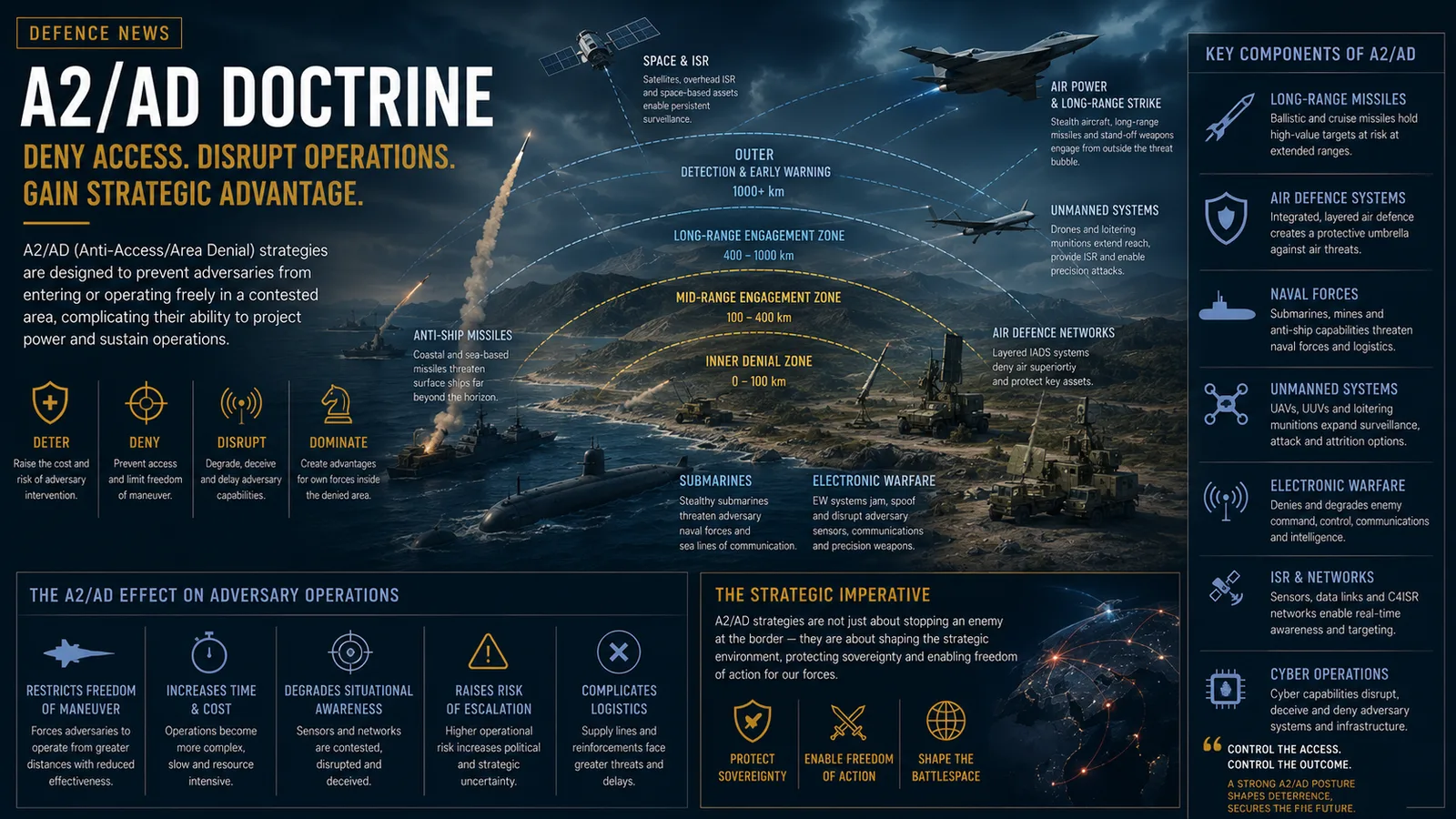
A2/AD doctrine is becoming one of the most important concepts in modern defence strategy as states use layered systems to prevent adversaries from entering, operating in or projecting power across contested regions.
A SAHA Blog analysis defines Anti-Access/Area Denial as a strategy that creates an exclusion zone and makes it difficult or impossible for an adversary to enter or operate inside that zone. The objective is to delay, limit or prevent hostile power projection while giving the defender a tactical and operational advantage.
The concept matters because modern warfare is increasingly shaped by precision weapons, long-range sensors, air defence, electronic warfare, unmanned systems and command networks. A2/AD is not one weapon or one platform. It is a system of systems designed to make access costly, risky and uncertain.
A2/AD Doctrine Turns Geography Into Defence Power
A2/AD doctrine starts from a geographic logic. A state identifies a critical area, then builds layered military capability to prevent an adversary from moving freely inside it. That area may be a coastline, island chain, strait, air corridor, maritime chokepoint, border region or strategic sea basin.
The anti-access part aims to stop the adversary from entering the theatre. The area-denial part aims to restrict freedom of operation once the adversary is already inside. Together, they create a defensive architecture that limits the adversary’s options before a major battle even begins.
This is why A2/AD is attractive for states that face stronger expeditionary forces. It allows a defender to exploit geography, depth, concealment, sensors and precision weapons to raise the cost of intervention.
The Core of A2/AD Is Layered Defence
The SAHA Blog article highlights the layered nature of A2/AD systems. Long-range missiles, anti-ship missiles, submarines, mines, surface-to-air missiles, cruise missiles, radar networks and electronic warfare systems can all support area denial.
Each layer serves a different function. Radars and sensors detect the adversary. Air defence systems protect the defended area. Anti-ship missiles threaten naval forces. Submarines complicate maritime movement. Mines restrict chokepoints. Electronic warfare disrupts command, navigation and targeting.
The strength of the doctrine comes from integration. A missile battery is dangerous on its own. It becomes much more powerful when connected to ISR assets, unmanned systems, coastal radars, electronic warfare units and command-and-control networks.
Integrated Air and Missile Defence Is Central
Air and missile defence sits at the centre of most A2/AD networks. A defender must protect its own sensors, command centres, missile batteries, naval bases and logistics infrastructure from air attack.
NATO’s 2025 Integrated Air and Missile Defence policy reflects this reality. The policy states that the air domain is increasingly contested and that NATO must integrate capabilities across land, air, sea, space and cyber through interoperable command-and-control structures.
This is directly relevant to A2/AD. A modern denial zone cannot be built only with missiles. It needs radar, space support, cyber defence, electronic warfare, air defence, ground forces, naval forces and resilient communications working together.
China Shows the Maritime A2/AD Model
China is the most discussed example of maritime A2/AD. The SAHA Blog article notes that China has invested in shipbuilding, anti-ship missiles, submarines, air defence systems and artificial island infrastructure to restrict U.S. and allied freedom of action in the Western Pacific.
The strategic purpose is clear. By threatening ships, aircraft and bases at long range, China can complicate outside intervention near its maritime approaches. This is especially relevant around Taiwan, the First Island Chain and the wider Western Pacific.
China’s A2/AD posture also shows why missiles are central to the concept. Anti-ship ballistic missiles, cruise missiles and integrated air defence systems can force adversaries to operate farther away, disperse their forces or invest in costly countermeasures.
Russia Uses A2/AD Around Strategic Regions
Russia has also been widely associated with A2/AD thinking, especially around Kaliningrad, the Baltic region, the Black Sea and parts of the Arctic. The model combines air defence, coastal defence, long-range fires, electronic warfare and naval assets to complicate NATO movement and reinforcement.
The Ukraine war has shown that A2/AD is not a perfect shield. Integrated air defence systems can be attacked. Radars can be located. Electronic warfare can be countered. Missile stocks can be depleted. However, the war has also confirmed that layered denial systems can slow operations, raise costs and force adaptation.
The lesson is that A2/AD is not invulnerability. It is friction. A successful denial network does not need to stop every adversary action. It must make the adversary’s plan slower, more expensive, more visible and more dangerous.
Unmanned Systems Add a New Layer
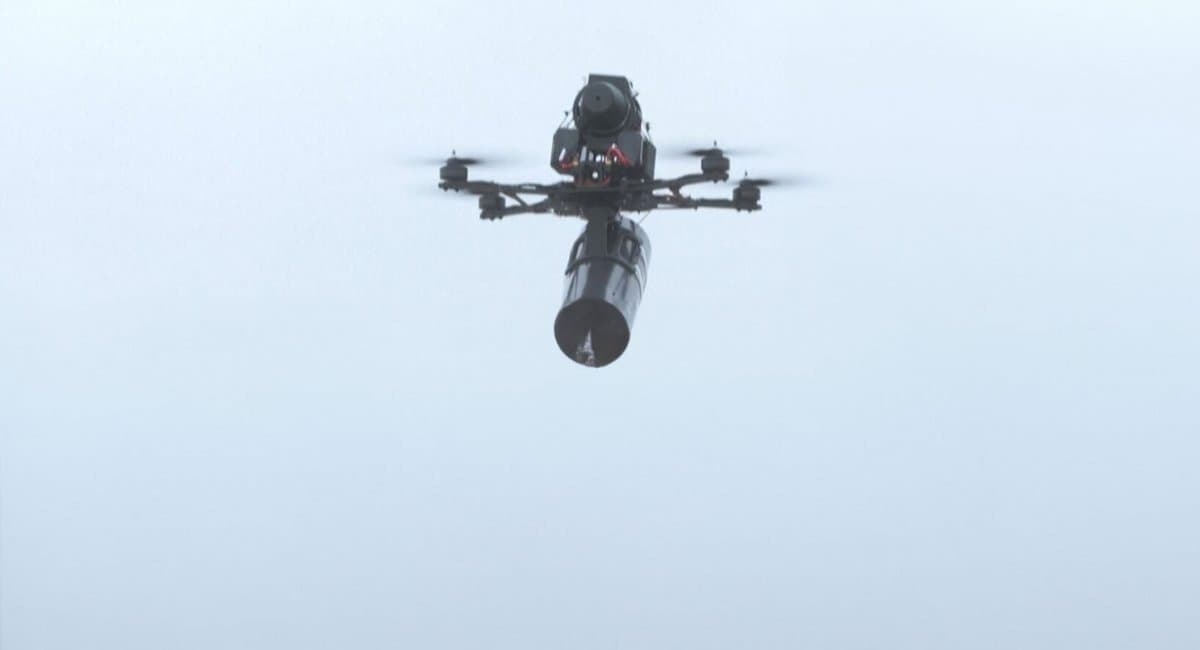
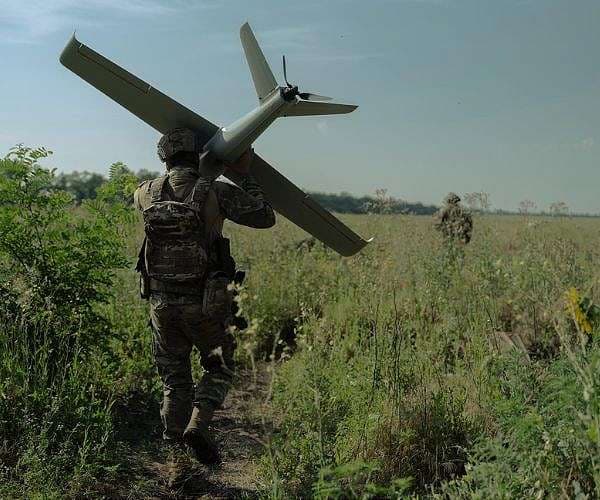
The most important change since earlier A2/AD debates is the rise of unmanned systems. The SAHA Blog article argues that unmanned platforms can support layered defence across air, surface and undersea domains.
UAVs can provide ISR, target acquisition, electronic support and strike. Unmanned surface vessels can patrol maritime zones, carry sensors, act as decoys or support electronic warfare. Unmanned underwater vehicles can map seabeds, detect mines, monitor chokepoints and support undersea surveillance.
This changes the economics of denial. Instead of relying only on expensive crewed platforms, a state can create persistent surveillance and distributed pressure through lower-cost unmanned systems.
Türkiye’s Unmanned Ecosystem Fits A2/AD Logic
Türkiye has a strong entry point into A2/AD doctrine because it has developed capabilities across UAVs, unmanned surface vessels, naval platforms, electronic warfare, C4ISR, satellites and precision strike.
The SAHA Blog article points to systems such as MARLIN, SANCAR and ULAQ as examples of national unmanned surface vessel capability. It also refers to Bayraktar TB2, ANKA, GÖKTÜRK-2 and RASAT as part of a broader layered defence approach.
The strategic opportunity is not only to field individual platforms. It is to connect them. Türkiye’s future A2/AD value will depend on how well UAVs, USVs, satellites, radars, coastal missile systems, naval platforms and command networks operate together.
Mavi Vatan Requires Layered Maritime Denial
For Türkiye, A2/AD is especially relevant in the maritime domain. The Black Sea, Aegean Sea and Eastern Mediterranean all require surveillance, deterrence, rapid reaction and maritime situational awareness.
A layered approach can support the protection of coastlines, naval bases, ports, energy infrastructure, chokepoints and offshore areas. In this context, unmanned systems can act as forward sensors, patrol assets, decoys, electronic warfare nodes and mission-specific effectors.
This is why the concept aligns with the Mavi Vatan, or Blue Homeland, framework. Maritime defence is no longer only about ships. It is about networks that connect ships, aircraft, drones, sensors, satellites, coastal systems and command centres.
TCG Anadolu Can Support Distributed Maritime Defence
The SAHA Blog article also notes that large ships such as TCG Anadolu can support layered defence as mother ships or forward operating platforms. This is important because distributed unmanned operations need logistics, maintenance, communications and command support.
A platform like TCG Anadolu can contribute to drone operations, maritime surveillance, command-and-control, logistics and amphibious support. It can also help extend the reach of unmanned systems across contested maritime areas.
In an A2/AD context, the ship’s value depends on integration with the wider force. It should not be treated only as a large platform. It should be treated as a node inside a layered maritime command network.
Electronic Warfare Is the Hidden Layer
Electronic warfare is one of the hidden but decisive layers of A2/AD doctrine. Modern operations depend on radar, satellite navigation, datalinks, communications and sensor fusion. If those systems are disrupted, the adversary’s access problem becomes much harder.
Electronic attack can jam radars, disrupt communications, degrade GPS, confuse drones and interfere with targeting networks. Electronic support can locate enemy emitters and help build a targeting picture. Electronic protection helps friendly systems survive in contested spectrum.
This makes spectrum control essential. An A2/AD network that cannot protect its own electromagnetic environment may fail under cyber and electronic attack.
C4ISR Decides Whether A2/AD Works
A2/AD doctrine depends on C4ISR. Sensors must detect threats. Command systems must classify them. Decision-makers must assign responses. Shooters must receive targeting data. Defence systems must coordinate without fratricide or delay.
The biggest challenge is not owning many systems. The challenge is making those systems work together under pressure. A radar, UAV, missile launcher, submarine and command centre must share data in a secure and usable format.
This is why digital backbone, tactical data links, edge processing, cyber security and AI-enabled decision support will increasingly shape the effectiveness of A2/AD networks.
A2/AD Creates Deterrence by Denial
A2/AD doctrine is closely linked to deterrence by denial. Instead of threatening punishment after aggression, denial tries to convince the adversary that aggression will fail or become too costly from the start.
This is why A2/AD is not only a wartime concept. It is also a peacetime signalling tool. A credible denial network can shape adversary planning, influence crisis behaviour and reduce confidence in rapid military success.
However, deterrence only works if the network is credible. Systems must be survivable, trained, supplied, integrated and backed by clear doctrine. A paper architecture does not deter. A tested and resilient force does.
The Cost Problem Is Real
The SAHA Blog article correctly notes that A2/AD can be expensive. Advanced radars, missiles, submarines, air defence systems, electronic warfare tools and hardened infrastructure require large investment.
This creates a procurement dilemma. A state must decide which layers are essential, which can be lower-cost, and which can be covered through unmanned systems, mobility or deception.
The best A2/AD posture will not simply buy the most expensive systems. It will create a balanced architecture: high-end systems for critical threats, attritable systems for mass, deception for survivability and mobile platforms for uncertainty.
The Escalation Risk Must Be Managed
A2/AD doctrine can strengthen defence, but it can also create regional tension. Neighbours may interpret new missiles, air defence systems, mines or unmanned platforms as offensive signals. This can feed arms racing and crisis instability.
Therefore, A2/AD must be paired with strategic communication, alliance coordination, rules of engagement and crisis-management channels. A denial posture should reduce the chance of aggression, not increase the risk of miscalculation.
This is especially important in crowded maritime areas where military aircraft, naval vessels, drones and civilian traffic operate close to each other.
Counter-A2/AD Is Also Evolving
No A2/AD system is permanent. Adversaries develop countermeasures. These may include stealth aircraft, long-range fires, cyber operations, electronic attack, special operations, decoys, hypersonic weapons, distributed basing and unmanned systems.
This means denial networks must adapt continuously. Fixed systems can be targeted. Predictable radar patterns can be studied. Static launchers can be destroyed. Communications can be attacked.
The future of A2/AD therefore belongs to systems that are mobile, networked, redundant and updateable. Open architectures, software upgrades and modular payloads will matter as much as individual platforms.
Precise Mass Changes the Future of Denial
Recent defence analysis increasingly points to the importance of precise mass. States need enough precision systems to create persistent pressure, not only a small number of exquisite platforms.
This trend fits A2/AD doctrine. A denial network must be able to absorb losses, replace sensors, continue firing, regenerate situational awareness and operate under attrition.
In practical terms, this favours scalable production, munitions depth, unmanned systems, mobile launchers, distributed sensors and resilient logistics. The denial zone must be sustainable, not only impressive on day one.
A Practical A2/AD Roadmap for Türkiye
A practical roadmap for Türkiye should begin with mission clarity. The country should define which areas require denial, which threats are most likely and which systems must be integrated first.
The second step is sensor depth. A2/AD requires persistent detection through radars, UAVs, satellites, acoustic sensors, maritime patrol assets and electronic support systems.
The third step is network integration. Data from these sensors must flow into secure command-and-control systems that can assign targets and coordinate responses across services.
The fourth step is layered effectors. These may include air defence, coastal defence, anti-ship missiles, naval systems, unmanned surface vessels, UAVs, electronic warfare and cyber defence.
The fifth step is resilience. The network must survive jamming, cyberattack, missile strikes, deception and logistics pressure. This requires mobility, redundancy, hardened infrastructure, operator training and realistic exercises.
Conclusion
A2/AD doctrine is one of the defining defence concepts of modern military strategy. It allows states to convert geography, sensors, missiles, air defence, submarines, mines, electronic warfare and unmanned systems into a layered denial network.
The concept is powerful because it targets the adversary’s access, tempo and confidence. It does not need to defeat every platform directly. It needs to make intervention slower, riskier and more costly.
For Türkiye, the most important opportunity lies in integration. UAVs, USVs, satellites, radars, naval platforms, electronic warfare systems and command networks can create a stronger maritime and air denial posture when they operate as one system.
The future of A2/AD will be shaped by resilient C4ISR, unmanned systems, precision mass, electronic warfare and adaptive doctrine. The countries that master this architecture will not only defend territory. They will shape the operational choices of every adversary before the first shot is fired.
For further Defence Agenda coverage, read our defence strategy, C4ISR and naval warfare sections. Related analysis includes unmanned underwater vehicles and naval warfare, drone swarm warfare and unmanned combat and future warfare technologies and military strategy.