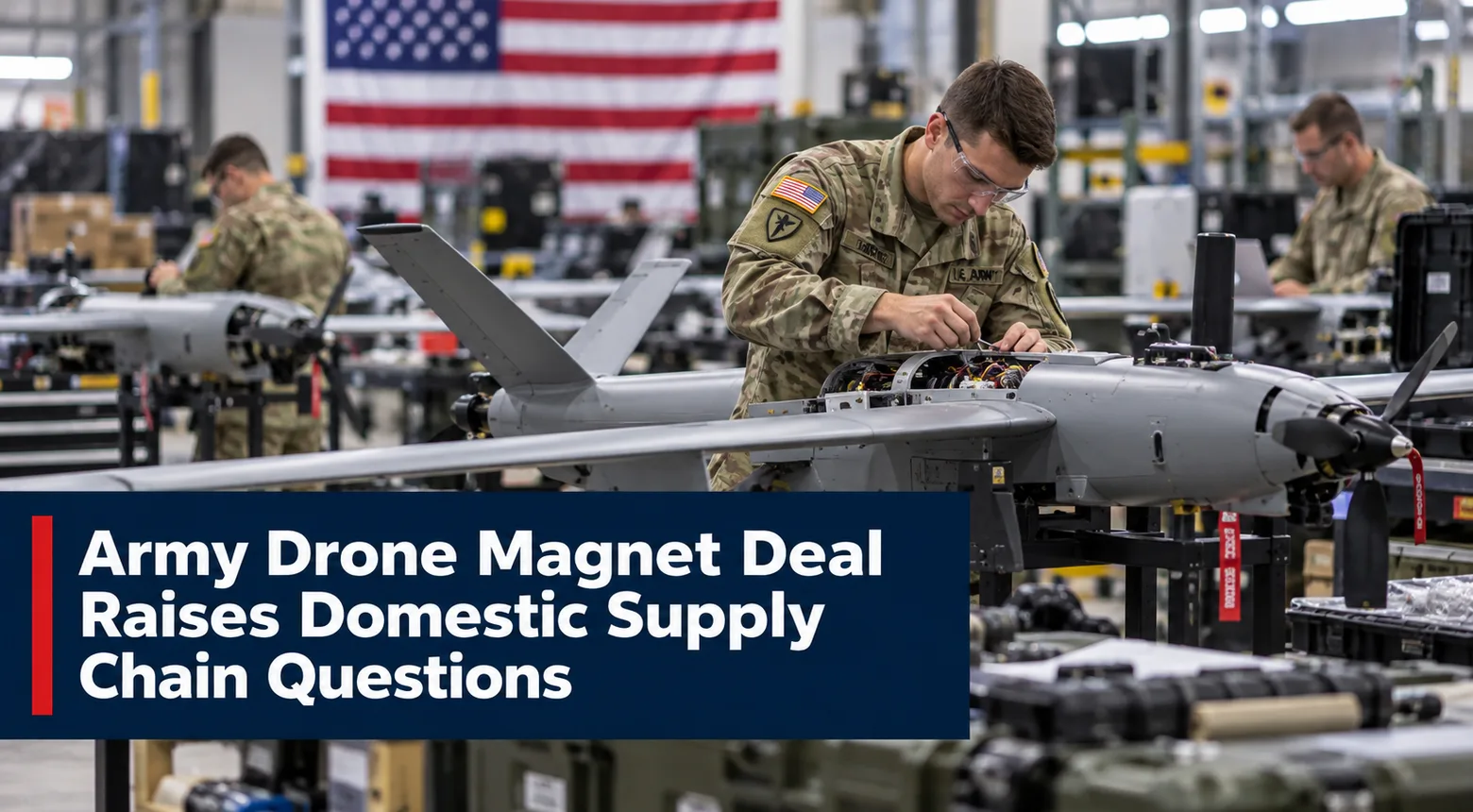
US drone tariffs will reach as high as 100% under a new White House trade measure designed to reduce American dependence on foreign unmanned aircraft systems and critical drone components while accelerating domestic production.
The White House announced on 13 August 2026 that President Donald Trump had signed a proclamation imposing differentiated tariffs on imported drones, docking stations and components following a national-security review of the U.S. unmanned aircraft supply chain.
The measure is significant because it combines trade protection, national-security policy and defence-industrial strategy. Washington is effectively attempting to reshape the economics of the U.S. drone market so that domestic production and trusted allied sourcing become more competitive relative to imported systems and components.
Key Facts
- 100% tariff: Applies to certain drones considered particularly sensitive for national security, including qualifying systems above 25 kg maximum takeoff weight and drones with thermal imaging capabilities, as well as specified critical components and docking stations.
- 25% tariff: Applies to certain smaller drones with less sensitive capability and additional drone components.
- Trusted-partner rates: Eligible products from the European Union, Japan, Liechtenstein, Republic of Korea, Switzerland and Taiwan can face a 15% rate; qualifying UK drones can face a 10% rate.
- Origin requirement: The lower partner rates depend on substantially all hardware, software and technology originating within those countries and the United States.
- Effective date: The principal tariffs take effect on 3 September 2026, 21 days after signing.
- Delayed components: Less-sensitive drone components generally move to the new tariff regime on 9 February 2027.
- Onshoring: The Commerce Secretary is authorised to establish a programme supporting companies making new U.S. investments in drone and component manufacturing.
US Drone Tariffs Create a Two-Tier Industrial Barrier
The tariff structure is designed around national-security sensitivity rather than applying a single rate to every unmanned aircraft.
The highest rate — 100% ad valorem — applies to specified categories of drones considered particularly important from a security perspective. The White House specifically identifies systems with a maximum takeoff weight above 25 kg and drones with thermal imaging capability among the affected categories.
Specified docking stations and critical components associated with those systems are also included.
Smaller systems that lack the capabilities identified as particularly sensitive face a lower 25% tariff, along with other covered drone components.
The structure therefore attempts to impose the strongest economic barrier around systems and technologies that Washington considers most consequential for military, intelligence, public-safety or critical-infrastructure applications.
Trusted Allies Receive Lower Drone Tariffs
The policy does not treat every foreign source in the same way.
Qualifying drones and components originating from the European Union, Japan, Liechtenstein, Republic of Korea, Switzerland and Taiwan can receive a 15% tariff rate.
Eligible drones from the United Kingdom receive a lower 10% tariff.
However, geography alone is not sufficient. The White House says substantially all hardware, software and technology must originate within those partner jurisdictions and the United States.
This qualification requirement is strategically important because a drone assembled in an allied country can still depend heavily on components, software or upstream technology sourced from another country.
The policy therefore targets supply-chain origin rather than simply final assembly location.
The Main Tariffs Begin on 3 September 2026
The principal tariff measures take effect 21 days after the presidential action, placing the effective date on 3 September 2026.
The White House created a longer transition period for components considered less sensitive. Those tariff changes are scheduled to take effect 180 days after signing, on 9 February 2027.
The staggered timetable appears intended to avoid abruptly disrupting supply chains that U.S. manufacturers cannot yet replace domestically.
That distinction is important because the administration itself acknowledges that U.S. military and commercial drone manufacturers remain dependent on foreign sources for critical UAS components.
Section 232 Turns Drone Supply Into a National-Security Issue
The tariff decision follows a formal investigation under Section 232 of the Trade Expansion Act of 1962.
The Department of Commerce initiated the UAS investigation on 1 July 2025 to determine whether imports of unmanned aircraft systems and their parts and components threatened to impair U.S. national security.
Reuters reported on 13 August 2026 that Commerce concluded foreign UAS import penetration was substantial and that the United States had become excessively reliant on overseas drone and component sources.
The Commerce findings also identified security and safety risks associated with some foreign entities and concluded that domestic production was insufficient to satisfy national-security requirements.
The result turns what was previously largely an acquisition and cybersecurity concern into a formal trade-policy issue.
Washington Is Trying to Rebuild the Entire Drone Supply Chain
The measure should not be viewed only as a tariff on finished aircraft.
Modern unmanned systems depend on motors, electronic speed controllers, flight-control computers, navigation systems, cameras, thermal sensors, communications equipment, batteries, processors and specialised software.
A drone can therefore be assembled inside the United States while remaining dependent on foreign upstream components.
This has already become a recurring issue in U.S. defence acquisition. Defence Agenda previously examined how the U.S. Air Force is using commercially available components for uncrewed systems to reduce costs and accelerate production.
The trade-off is that commercial supply chains can also create dependencies that become problematic during geopolitical disruption or export restrictions.
The Tariffs Build on the American Drone Dominance Strategy
The August measure builds directly on the administration’s earlier drone industrial policy.
On 6 June 2025, President Trump signed Executive Order 14307, “Unleashing American Drone Dominance.”
The order directed federal agencies to prioritise U.S.-manufactured UAS, expand the domestic drone industrial base, increase trusted exports and reduce supply-chain exposure to foreign control.
It also directed the Department of Defense to expand the Defense Innovation Unit’s Blue UAS framework and prioritise qualifying U.S.-manufactured drones for military procurement.
The new tariffs add an economic barrier to the procurement preferences and security restrictions already established through federal acquisition policy.
Military and Commercial Drone Supply Chains Are Interconnected
The policy also reflects the increasingly blurred boundary between commercial and military drone technology.
Small UAS used for reconnaissance, mapping, infrastructure inspection or agriculture can share many of the same basic components used in military systems.
That dual-use ecosystem has helped military drone technology evolve quickly because defence developers can draw on commercial electronics, batteries, cameras and computing hardware.
However, the same model can expose military production to foreign commercial supply chains.
For the Pentagon, the policy problem is therefore to preserve commercial-style cost and innovation cycles while reducing dependencies considered unacceptable for national security.
The Pentagon Has Already Shifted Toward Domestic Drone Mass
The tariffs arrive while the Pentagon is trying to procure low-cost unmanned systems in much greater numbers.
Defence Agenda previously examined the Pentagon’s effort to “Americanize” drone warfare, combining domestic production, rapid procurement, common digital architectures and new operational doctrine.
The industrial logic is straightforward. A military that expects to use drones as expendable or attritable systems cannot depend on boutique production runs.
It needs large quantities, fast replacement cycles and a supplier base capable of absorbing battlefield-driven design changes.
The tariffs are intended to improve the economic conditions for that domestic supplier base.
The FCC Covered List Creates a Transitional Exception
The White House also created a specific transition mechanism connected to the Federal Communications Commission’s Covered List.
For products or components that the Department of War approves for an exemption from the FCC Covered List within 20 days of the proclamation, the new tariff regime will not begin until 180 days after signing.
This creates a short administrative window ending on 2 September 2026 for qualifying Pentagon determinations.
The provision is strategically important because Washington is simultaneously trying to eliminate problematic suppliers and avoid creating immediate capability gaps for military users.
Onshoring Could Matter More Than the Tariff Rate
The proclamation also authorises the Commerce Secretary to establish an onshoring programme for companies making new U.S. investments in drone and component manufacturing.
This may become one of the most important parts of the policy.
Tariffs can make imported products more expensive, but they do not automatically create domestic production capacity.
Factories still require capital, skilled labour, qualified suppliers, production equipment and sufficient long-term demand to justify investment.
An effective onshoring mechanism could therefore determine whether the tariff regime produces new manufacturing or primarily raises the cost of imported systems.
Allied Manufacturers Could Gain a Strategic Advantage
The lower rates for selected partners create a potentially significant market advantage for allied manufacturers able to prove trusted origin.
European, Japanese, South Korean, Taiwanese and UK suppliers may become more competitive relative to products facing the standard 25% or 100% tariff rates.
However, the origin requirement creates a second test.
A European drone company that depends heavily on third-country flight controllers, motors, imaging systems or software may not automatically qualify simply because final assembly occurs in Europe.
The policy could therefore encourage allied companies to restructure their own supply chains if access to the U.S. market justifies the additional cost.
The Policy Could Accelerate Friendshoring
The tariff architecture mirrors a broader U.S. shift toward friendshoring in strategically sensitive industries.
Defence Agenda recently examined how Washington’s critical-minerals policy is pushing defence supply chains toward domestic and allied sources.
The drone decision applies a similar logic to a finished technology ecosystem.
Instead of treating every imported product as equivalent, Washington is creating different economic conditions depending on supply-chain origin and strategic trust.
If this approach continues, supplier nationality and component provenance could become increasingly important variables in defence-market competitiveness.
Higher Tariffs Could Raise Near-Term Drone Costs
The main counterargument is cost.
U.S. companies have used international commercial supply chains because they offer large production volumes, mature manufacturing and low component prices.
Replacing those sources quickly may require more expensive alternatives, new tooling or supplier qualification.
The immediate effect of high tariffs could therefore be higher prices for some U.S. drone integrators before domestic production expands enough to create new economies of scale.
This creates an important policy tension: the Pentagon wants inexpensive drones in extremely large quantities, while supply-chain localisation can initially increase unit cost.
Affordable Mass Depends on Component Economics
This cost tension is particularly important for expendable military drones.
Recent conflicts have demonstrated the value of systems cheap enough to be lost, replaced and upgraded rapidly.
Defence Agenda’s analysis of autonomous drone swarms highlighted how commercial components and high-volume production are central to the economics of mass unmanned warfare.
If secure U.S. or allied alternatives cost substantially more than incumbent foreign components, procurement agencies may have to accept higher acquisition costs in exchange for greater supply-chain resilience.
Counter-UAS Demand Makes Industrial Scale More Important
The U.S. drone industrial-base strategy is also linked to the rapid expansion of counter-UAS requirements.
Offensive drones and counter-drone systems increasingly share sensors, communications hardware, autonomy software and specialised electronics.
NATO has already announced more than $40 billion in planned counter-drone investment over five years, a trend Defence Agenda examined in its assessment of NATO counter-drone investment.
That means the addressable market for secure drone components extends beyond the air vehicles themselves.
Navigation, datalinks, sensors, processors and other components can feed both offensive and defensive unmanned-system portfolios.
The Main Risk Is Moving Faster Than Replacement Capacity
The central execution risk is timing.
The United States wants to reduce foreign dependence while simultaneously expanding military and commercial drone deployment.
If tariffs restrict affordable imports faster than domestic and allied manufacturers can replace them, the policy could temporarily constrain the very production scale Washington is trying to create.
The delayed implementation for less-sensitive components suggests the administration recognises this risk.
The success of the programme will therefore depend on whether the transition periods are long enough for suppliers to qualify replacements and make new manufacturing investments.
The Main Opportunity Is a Trusted Drone Ecosystem
The strategic opportunity is a drone market in which the United States can scale production without depending on supply chains that could be interrupted or manipulated during a conflict.
If domestic production expands and allied suppliers restructure around trusted-component requirements, the tariff regime could create a larger secure market extending across defence, public safety, infrastructure and commercial aviation.
That market could also make U.S. and allied drones more competitive for governments that increasingly place cybersecurity and supply-chain provenance alongside flight performance and price in procurement decisions.
Implications / Next
The first milestone is 2 September 2026, the end of the 20-day window for Department of War approvals associated with delayed Covered List tariff treatment.
The principal tariffs then enter force on 3 September 2026.
The second major milestone is 9 February 2027, when the 180-day transition for less-sensitive components ends.
Industry should also watch how Commerce structures the new onshoring programme. Eligibility criteria, investment thresholds and tariff-adjustment mechanisms could materially affect where manufacturers choose to locate future production.
Another key question will be how strictly the administration interprets the requirement that substantially all hardware, software and technology originate in the United States or qualifying partner countries.
That definition could determine whether the policy reshapes only final assembly or drives restructuring several tiers deeper into the global UAS supply chain.
Conclusion
The US drone tariffs represent a significant escalation in Washington’s effort to treat unmanned aircraft manufacturing as a national-security industrial capability.
The policy combines tariffs of up to 100%, preferential treatment for selected allies, domestic-investment incentives and supply-chain origin requirements.
The objective is clear: move the U.S. drone ecosystem away from strategic dependence on foreign suppliers while preserving enough access to trusted international technology to prevent immediate production disruption.
The trade-off is equally clear. Secure domestic and allied supply chains may initially be more expensive than the global commercial component networks that helped make small drones cheap and rapidly scalable.
The policy’s success will therefore be measured not by tariff revenue but by industrial outcomes: new U.S. factories, qualified component suppliers, higher production volumes and a military drone ecosystem capable of scaling during sustained conflict without relying on vulnerable external sources.
For further Defence Agenda coverage, read our analysis of USAF commercial drone-component integration, the Pentagon’s effort to Americanize drone warfare, the U.S. critical-minerals supply-chain push and NATO’s $40 billion counter-drone investment cycle.
Further Reading
- White House: Tariffs on drones and their parts and components
- Reuters: Trump administration to impose tariffs on drone imports
- U.S. Bureau of Industry and Security: Section 232 UAS investigation
- White House: Unleashing American Drone Dominance
- Defence Agenda: Pentagon to Americanize Drone Warfare
- Defence Agenda: USAF Taps Commercial Drone Components
- Defence Agenda: Critical Minerals Executive Order Tests Defense Supply Chains
- Defence Agenda: NATO Counter-Drone Capabilities Get $40bn Investment