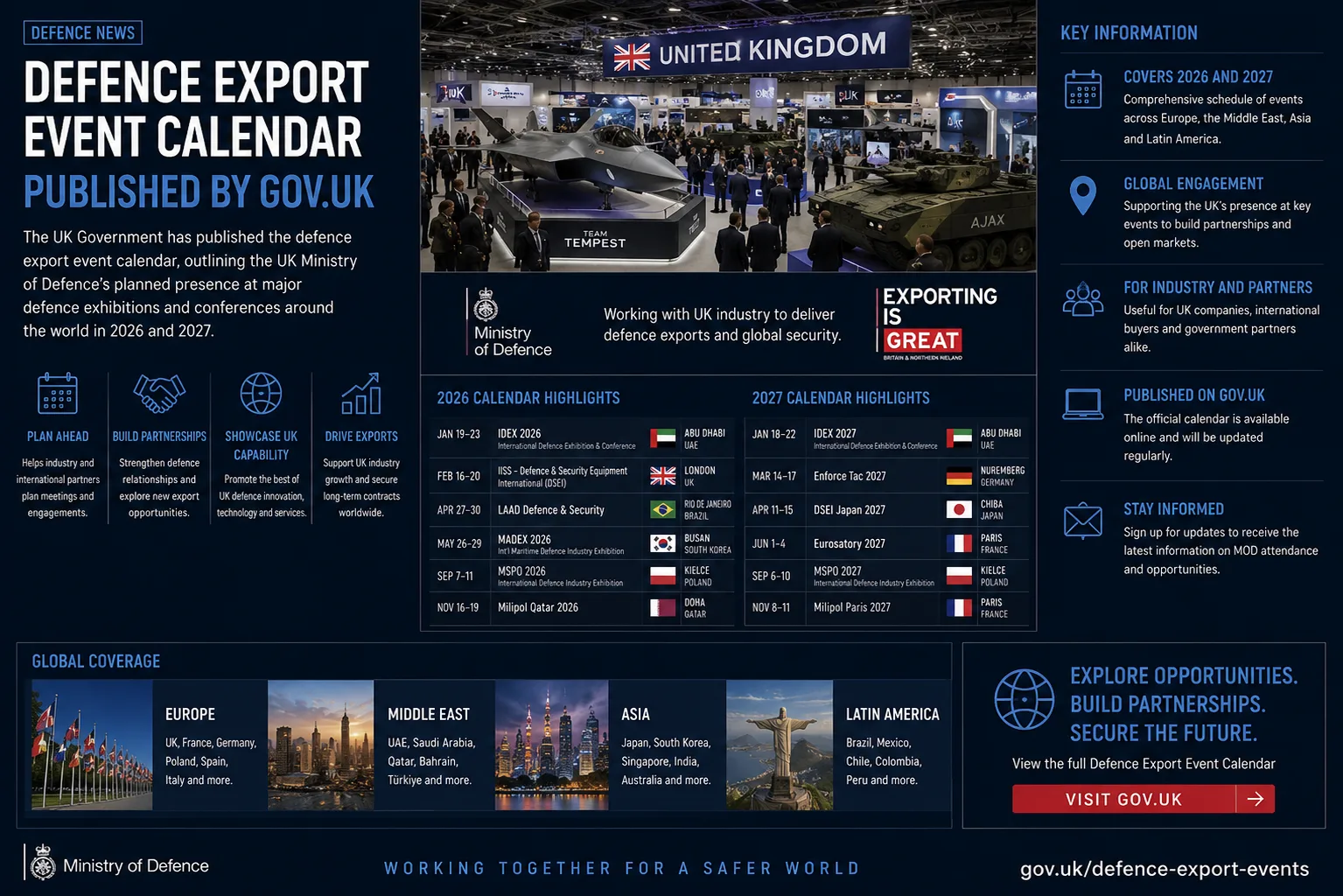
Defence export event calendar updates from GOV.UK show where the UK Ministry of Defence plans to support industry at selected defence exhibitions and events in 2026 and 2027.
The calendar, updated on 2 July 2026, lists MOD presence at major UK and international events, including Farnborough International Airshow, MSPO, ADEX, Milipol Qatar, EuroNaval, Expo Naval, Viet Nam Defence Expo, IDEX, SecD Day, Aero India and DSEI Germany.
The document is not only an events list. It shows how defence exhibitions are becoming part of a structured export-support architecture, linking government presence, company visibility, buyer access, capability showcases and international defence-industry engagement.
Defence Export Event Calendar Covers 2026 and 2027
GOV.UK says the Ministry of Defence will be present at selected UK and international defence events during 2026 and 2027. The listed 2026 events include Farnborough International Airshow in the UK, MSPO in Poland, ADEX in Azerbaijan, Milipol Qatar, Future Forces in Czechia, EuroNaval in France, Expo Naval in Chile and Viet Nam Defence Expo.
The 2027 list includes IDEX in the United Arab Emirates, SecD Day in Finland, Aero India in India and DSEI Germany. Several entries include early-expression-of-interest links, while some applications are already closed.
This gives UK companies a forward planning tool. It allows exporters to identify where MOD-backed presence may support customer engagement, capability demonstrations and international market access.
The Calendar Shows a Broad Geographic Export Map
The calendar covers Europe, the Middle East, Asia-Pacific and Latin America. That geographic spread is important because defence export growth increasingly depends on sustained presence across multiple regional markets rather than one-off exhibition participation.
Europe remains central through MSPO, Future Forces, EuroNaval, SecD Day and DSEI Germany. The Middle East is represented through Milipol Qatar and IDEX. Asia-Pacific appears through Viet Nam Defence Expo and Aero India, while Latin America is represented through Expo Naval in Chile.
This pattern suggests a deliberate mix of air, land, naval, security and multi-domain defence events. It also reflects the reality that export campaigns are increasingly tied to long-term government and industry relationships.
Event Support Is Part of the UK Export System
The calendar sits inside a wider MOD export-support structure. GOV.UK states that events and exhibitions are an important part of delivering defence export success, and that MOD offers event-based support to UK companies of all sizes at home and overseas.
That support can include exhibition pods within MOD-organised UK pavilions, MOD staff on stands, access to meeting rooms, on-stand refreshments and engagement with UK and international stakeholders.
For companies, this means the value of an exhibition is not only the physical stand. It is also the credibility, access and coordination that can come from being part of a government-supported export presence.
UK Pavilion Pods Offer Structured Market Access
One of the most practical tools in the GOV.UK guidance is the exhibition pod system. Companies can purchase a showcase pod as part of an MOD-organised UK pavilion at selected domestic or international events.
The benefits listed by GOV.UK include clear UK or His Majesty’s Government branding, cost effectiveness in stand space, stand visits from senior UK and international stakeholders, meetings with decision-makers and MOD staff alongside company representatives.
This model is especially useful for smaller firms that may lack the budget, brand recognition or international network to secure high-quality buyer engagement alone.
“Soldier on Stand” Adds Operational Credibility
The MOD guidance also highlights the “soldier on stand” concept. Companies can request a serving member of the British Army to accompany them to exhibitions, helping demonstrate products and provide operational insight based on real-world experience.
This matters because defence buyers often want to understand how a system performs in realistic military use, not only in marketing material. Operationally experienced personnel can help explain product relevance, use cases and tactical value.
For export campaigns, that kind of credibility can be decisive, especially when buyers compare similar systems from multiple countries.
Equipment Showcases Support Capability Demonstration
GOV.UK also says companies can purchase space at certain events to display equipment and capability supported by embedded military personnel.
This is important because many defence products are difficult to sell through brochures alone. Vehicles, sensors, communications systems, unmanned platforms, protective equipment and training systems often need physical demonstration and operational explanation.
Capability showcase areas can help companies move from passive exhibition presence to more active product demonstration.
DSIDs and Trade Missions Add Direct Buyer Engagement
The MOD export-support framework also includes Defence and Security Industry Days, supply-chain events and trade missions. These formats are important because they create more targeted engagement than general exhibition footfall.
DSIDs allow UK companies to display products onboard a Royal Navy vessel and draw on expert insight during demonstrations. Supply-chain events give companies opportunities to meet leading UK and overseas contractors, as well as government, military and industrial procurement officials.
Trade missions are also significant. GOV.UK says that when buying countries identify a particular export need, MOD supports groups of UK companies to meet the overseas buyer face to face in their home country.
Larkhill Gives the UK a Standing Capability Showcase
The Larkhill Exhibition Centre gives UK companies another route to display capabilities. GOV.UK describes it as a multi-purpose venue at Larkhill Garrison in Wiltshire, available to government and industry.
Companies can use the venue for product display, workshops, training, smaller events and private meetings. The Larkhill UK capability showcase also offers a dedicated location for businesses to display defence and security products to relevant audiences.
This matters because export campaigns do not only happen during major international shows. A standing national showcase can support visiting delegations, buyer education and longer-term engagement outside the exhibition calendar.
Why This Calendar Matters for Industry
The defence export event calendar matters because exhibitions remain a key point where government, military users, prime contractors, SMEs and international buyers meet in one place.
For UK companies, MOD presence can help increase visibility and reduce market-entry friction. It can also help align company messaging with government-backed export priorities and international relationship-building.
For overseas buyers, a government-supported pavilion can make it easier to identify credible UK capabilities and understand how industry offerings fit into wider defence relationships.
The Export Competition Is Becoming More Institutional
The calendar also reflects a wider trend in defence exports. Competition is no longer only company against company. It is increasingly national ecosystem against national ecosystem.
Countries that coordinate government support, export finance, military demonstrations, industrial partnerships and after-sales assistance can strengthen their companies’ international position.
The UK MOD event-support framework is one example of this institutional export model. It links exhibitions to export advice, buyer engagement, government-to-government relationships and capability showcasing.
A Practical Planning Tool for Defence Firms
For companies, the practical value of the calendar is planning. Defence exhibitions require early decisions on budget, product selection, travel, logistics, export-control preparation, customer targeting, demonstration material and follow-up strategy.
Early-expression-of-interest windows are therefore important. Firms that wait until the last moment may miss government-supported participation routes or lose the chance to align with delegation visits and buyer meetings.
Companies should treat the calendar not only as an event list, but as a campaign planning timeline.
What Companies Should Watch
Companies using the defence export event calendar should track four issues. First, which events match their target market and product domain. Second, whether expression-of-interest links remain open. Third, what type of MOD support is available at each show.
Fourth, companies should assess whether they need a simple stand presence, a capability demonstration, a government-supported meeting programme, a trade mission or a Larkhill showcase opportunity.
The strongest export campaigns will connect exhibition attendance with pre-event customer mapping and post-event follow-up.
Conclusion
The defence export event calendar gives a clear view of where the UK MOD plans to support industry at major defence events in 2026 and 2027.
Its significance goes beyond dates and locations. The calendar is part of a wider export-support model that uses exhibitions, pavilions, military expertise, trade missions, supply-chain events and capability showcases to strengthen UK defence-industry engagement overseas.
As global defence markets become more competitive, government-backed event strategies will remain an important tool for national defence-industrial positioning.
For further Defence Agenda coverage, read our defence industry, defence procurement and aerospace sections. Related analysis includes Farnborough Airshow 2026 and defence demand, GCAP partner deadlines and fighter-programme strategy and European defence cooperation and industrial scale.