ASELSAN, ROKETSAN Sign €1.23B Air Defence Deal
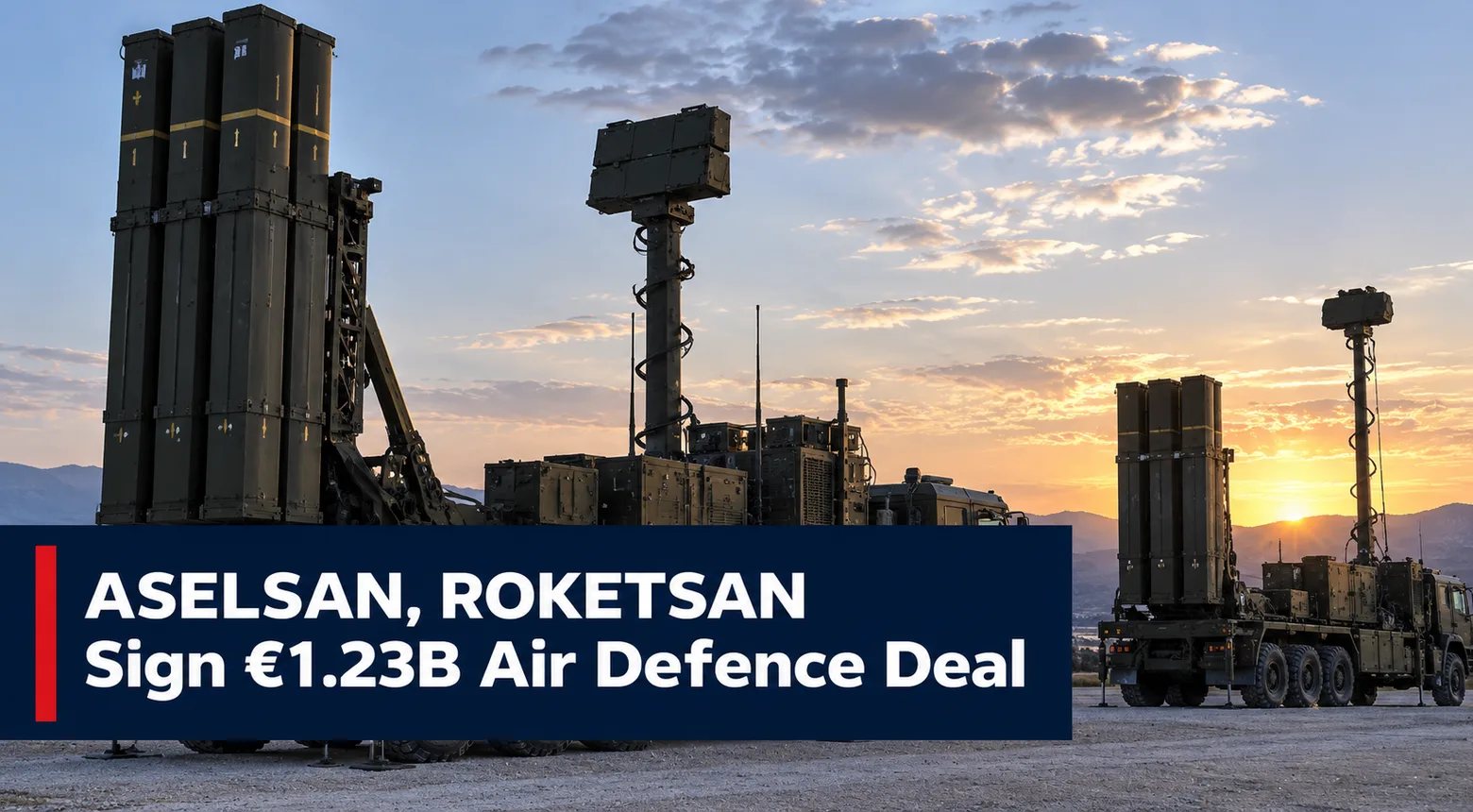
ASELSAN has disclosed a €1.23421 billion contract with ROKETSAN covering the supply of subsystems for air-defence systems. The filing, published through Türkiye’s Public Disclosure Platform on 23 September 2026, confirms a major industrial order and states that the new business relationship is expected to have a positive effect on ASELSAN’s revenue. What it does not do is identify the end system, quantity or delivery schedule, making that distinction central to how the contract should be reported.
The KAP filing identifies ROKETSAN as the customer
ASELSAN’s KAP disclosure lists ROKETSAN Roket Sanayi ve Ticaret AŞ as the customer and states that the agreement concerns the procurement of subsystems for air-defence systems. The filing gives the total value as €1,234,210,000 and records 23 September 2026 as the expected start date of the business relationship. It does not list special contract conditions.
The filing also provides useful commercial context that was missing from the earlier version of this article. ROKETSAN accounted for 4.03% of ASELSAN’s net sales in the company’s most recently disclosed income statement and 4.98% of trade receivables in the most recently disclosed balance sheet. Those figures do not describe the value or phasing of the new order, but they show that the two companies already had a material supplier-customer relationship before this contract was signed.
The disclosed value does not reveal the end-system mix
Neither the KAP filing nor Anadolu Agency’s report assigns the order to a named programme. There is no public breakdown for HİSAR, SİPER, GÜRZ, KORKUT or another specific configuration, and no published quantity of launchers, radars, command posts, missiles or other end items. The contract should therefore be treated as a confirmed subsystem order between two Turkish defence primes, not as a public inventory statement.
That caution matters because Türkiye’s layered air-defence architecture contains multiple sensors, command-and-control nodes, launch systems and effectors. ASELSAN supplies radar, electro-optics, communications, fire-control, command-and-control and selected weapon-system elements, while ROKETSAN develops and produces several interceptor and missile families. A large supplier contract between them can support more than one programme or production lot without the public filing revealing the precise allocation.
A supplier-to-prime order can drive a broad production chain
The significance of the contract is industrial as well as financial. Air-defence systems depend on repeatable production of electronics, seekers, guidance hardware, power and control units, communications equipment, launch-related subsystems, test equipment and software-enabled command elements. Even where the bill of materials is undisclosed, a €1.23421 billion order can create substantial workload below the prime-contractor level.
ASELSAN has separately been expanding production capacity to respond to a larger order book. On 18 September it commissioned a $56 million Guidance Systems Production Centre with 17,865 square metres of indoor space and additional robotics and automation. That investment should not be presented as evidence that the new ROKETSAN contract is allocated to a particular guidance product; it is relevant as wider evidence that the company is adding manufacturing capacity while large domestic orders continue to accumulate.
The contract sits inside Türkiye’s wider layered-air-defence build-up
Türkiye has been moving from individual system development towards larger-scale serial production and integration across multiple air-defence layers. ASELSAN and ROKETSAN already cooperate on national air-defence programmes, including SİPER alongside TÜBİTAK SAGE, while ASELSAN’s broader Steel Dome architecture is intended to connect sensors, command systems and effectors.
The new contract is consistent with that industrial direction, but the filing does not say that its full value belongs to Steel Dome or SİPER. The correct maturity description is narrower: ASELSAN and ROKETSAN have signed a binding subsystem-supply agreement for air-defence systems, with a disclosed value and expected positive revenue effect, while the programme-level distribution remains undisclosed.
Implications / Next
The next useful indicators will be later KAP disclosures, annual-report notes, official production announcements or delivery statements that connect the order to named systems. Revenue-recognition timing could also show how quickly the contract moves into production, although accounting recognition would still not reveal the underlying end-item quantities unless the companies provide additional programme detail.
For procurement offices and suppliers, the key point is therefore twofold. The order is real, signed and financially material; at the same time, no public evidence supports converting the €1.23421 billion value into a quantity of batteries, missiles or launchers. Until more detail is released, the contract is best understood as a major industrial workload package underpinning Türkiye’s air-defence production base rather than a disclosed end-system buy.