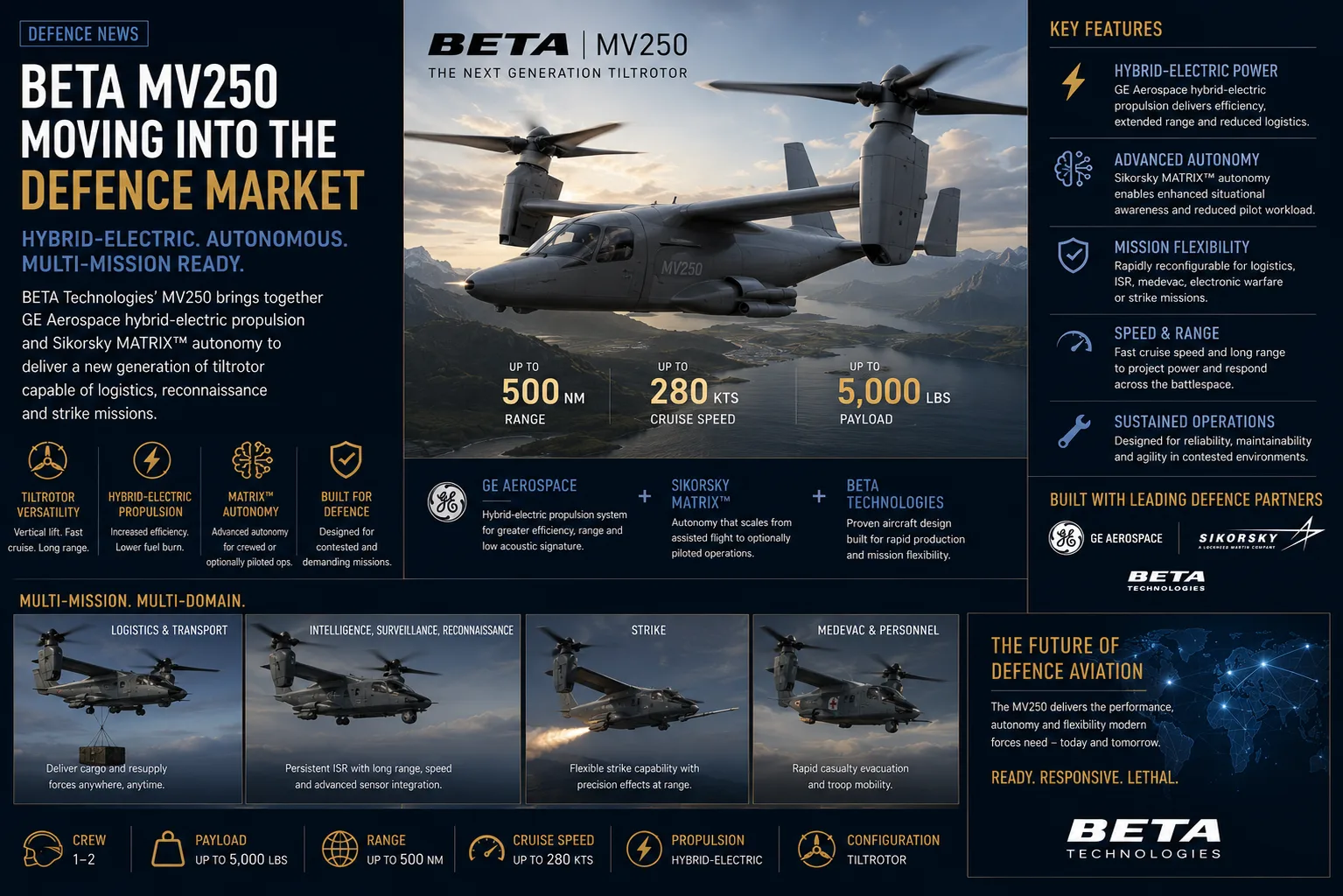
BETA MV250 is positioning hybrid-electric vertical takeoff and landing aircraft for military logistics, reconnaissance and strike missions, combining BETA Technologies’ aircraft architecture with GE Aerospace propulsion and Sikorsky autonomy.
Breaking Defense reported that BETA unveiled the militarized unmanned MV250 at Farnborough Airshow. The aircraft is based on the company’s all-electric A250 concept but adds a hybrid-electric powertrain to meet more demanding defence requirements.
The programme matters because military customers want uncrewed aircraft that can move useful payloads over longer distances, operate from dispersed locations and reduce risk to personnel. The MV250 is designed to address that middle ground between small drones and expensive crewed aircraft.
BETA MV250 Moves Advanced Air Mobility Into Defence
The BETA MV250 shows how advanced air mobility technologies are moving from commercial aviation into the military market. BETA’s civil aircraft work gives the company a flight-tested foundation, while the defence version adds range, endurance, autonomy and mission flexibility.
BETA describes the MV250 as an autonomous hybrid-electric VTOL aircraft for contested on- and off-airport logistics. This means the aircraft is not limited to runway operations and can support dispersed forces that need fast resupply, medical evacuation, sensor carriage or mission payload delivery.
The important shift is not only propulsion. It is the combination of aircraft commonality, autonomous flight, modular payloads and a lower-cost operating model.
GE Aerospace Provides the Hybrid-Electric Powertrain
GE Aerospace is central to the MV250’s military value proposition. BETA’s all-electric architecture supports quieter operations and simplified aircraft systems, but military missions often need more range and payload than battery-only designs can provide.
The hybrid-electric powertrain is therefore a performance enabler. According to BETA, the system uses a GE-developed turbogenerator based on CT7/T700 turbine technology. GE and BETA are using turbine, electrical power and manufacturing expertise to extend range and improve mission flexibility.
Breaking Defense reported that BETA CEO Kyle Clark said the hybrid-electric powertrain offers roughly eight times greater range than the all-electric baseline. That is the key reason the MV250 can be pitched for military use rather than only short-range civil missions.
Sikorsky MATRIX Adds the Autonomy Layer
Sikorsky, a Lockheed Martin company, is supplying the MATRIX autonomy suite for the MV250. MATRIX is significant because it is already used across several autonomous aircraft demonstrations, including pilotless Black Hawk work.
Sikorsky says MATRIX autonomy was integrated and flown on BETA’s CX300 aircraft within two weeks as a direct path toward MV250 development. That rapid integration is important because the MV250 uses a common flight-control architecture and a modular open systems approach.
For military users, the autonomy layer is as important as the airframe. It determines whether the aircraft can operate with fewer operators, support contested logistics and perform missions where crewed aircraft would be too risky or too expensive.
The Aircraft Targets Contested Logistics First
The clearest mission for the BETA MV250 is contested logistics. Modern forces need to move ammunition, spare parts, medical supplies, sensors and critical cargo across dispersed environments where runways may be unavailable or vulnerable.
A hybrid-electric VTOL aircraft can support this requirement by combining vertical access with longer-range cruise efficiency. BETA says the MV250 has a 1,300-nautical-mile reposition range and can carry a 2,000-pound payload within a 250-nautical-mile tactical range.
That places the aircraft in a useful operational category. It is not a small quadcopter resupply drone. It is also not a large crewed transport aircraft. It is a middleweight uncrewed logistics platform designed to reduce risk and expand reach.
Reconnaissance and Strike Expand the Mission Set
Breaking Defense reported that BETA is pitching the MV250 for logistics, reconnaissance and strike missions. That broader mission set matters because it turns the aircraft from a cargo drone into a multi-role military platform.
In reconnaissance configuration, the aircraft could carry sensors over long distances and operate without exposing pilots. In strike configuration, the same airframe could carry mission payloads for higher-risk tasks.
This multi-role approach will depend on payload integration, autonomy assurance, command-and-control links and operational doctrine. However, it also gives military customers more flexibility than a single-purpose cargo aircraft.
Cost Is a Major Part of the Pitch
Cost is central to the MV250 story. Breaking Defense reported that BETA’s Rob Dickerson described the aircraft as costing less than 10 million dollars, with economies of scale potentially improving the figure.
That price point would be important if the aircraft can deliver reliable military utility. Defence customers are looking for systems that can be bought and operated in meaningful numbers rather than small fleets of expensive niche platforms.
The MV250’s commonality with BETA’s civil aircraft architecture could support this cost argument. BETA says the aircraft uses major systems and production processes already tied to its existing product family, reducing development and validation costs.
Production Could Begin as Soon as 2028
Breaking Defense reported that BETA expects the MV250 to be ready for military exercises next year and enter production as soon as 2028. That schedule reflects the company’s strategy of adapting an existing aircraft family rather than launching a fully clean-sheet defence programme.
The timeline is ambitious. Military users will still require flight testing, mission-system integration, autonomy validation, safety evidence, sustainment planning and operational experimentation.
However, the aircraft’s civil-technology foundation could accelerate development if BETA can prove that the hybrid-electric and autonomy layers are mature enough for defence missions.
The Pentagon Is a Key Target Customer
BETA is targeting the Pentagon, including the U.S. Army, Air Force and Marine Corps. Each service has a different reason to evaluate this type of aircraft.
The Army could use it for distributed logistics, medical support and uncrewed resupply. The Air Force could examine it for agile combat employment and dispersed-base sustainment. The Marine Corps could assess it for expeditionary advanced base operations and contested island logistics.
The aircraft may also interest foreign buyers because many allied militaries face the same logistics problem: how to move useful payloads without relying only on crewed helicopters or vulnerable ground convoys.
Hybrid-Electric Aircraft Solve a Military Range Problem
All-electric aircraft have important benefits, including lower acoustic signature, reduced mechanical complexity and potential operating-cost advantages. However, battery-only aircraft can struggle with military range, payload and endurance requirements.
The MV250’s hybrid-electric design tries to solve this problem. A turbine-based generator can extend range while preserving the advantages of electric propulsion and distributed aircraft architecture.
This is why hybrid-electric aircraft may become more important in defence than in some near-term civil applications. Military users can accept specialised mission profiles if the aircraft delivers operational reach, payload and survivability benefits.
MOSA Architecture Supports Future Adaptation
BETA and Sikorsky both emphasise open architecture. BETA says the MV250 uses a modular open systems approach, while Sikorsky says MATRIX is designed for easy integration with other flight-control frameworks.
This matters because military aircraft must evolve. Customers may want different sensors, radios, mission computers, payloads, software, autonomy levels or national command-and-control interfaces.
A closed system would limit those options. An open architecture gives the MV250 a better chance of adapting across services, allied customers and mission types.
Autonomy Assurance Will Be a Key Test
Autonomy will be one of the most important evaluation points. A military logistics aircraft must be able to operate safely, predictably and securely in complex airspace and contested environments.
Operators will need confidence that the aircraft can manage route changes, degraded communications, emergency procedures, landing-zone selection and mission updates without creating unacceptable risk.
Sikorsky’s MATRIX experience gives the programme credibility. Still, the MV250 will need platform-specific testing before customers can rely on it for high-tempo military operations.
The Aircraft Could Reduce Risk to Personnel
The military value of the MV250 is not only cost or range. It is also risk reduction.
Logistics missions are often dangerous because they require aircraft or ground convoys to enter contested areas repeatedly. An unmanned aircraft can move cargo or sensors without exposing aircrew or convoy teams to the same level of danger.
This is especially relevant for operations against adversaries with long-range fires, drones, air defence, electronic warfare and persistent surveillance.
The MV250 Mirrors a Wider Defence Market Shift
BETA’s move into the military market mirrors a broader trend. Advanced air mobility firms are increasingly adapting civil technologies for defence use, while defence primes are seeking lower-cost uncrewed aircraft that can scale faster than traditional platforms.
At Farnborough, Anduril and Archer also presented a tiltrotor unmanned wingman concept called Thunder. This shows that the market is moving quickly toward hybrid, autonomous and vertical-lift aircraft for military roles.
The competitive question is which companies can turn prototypes into certified, operationally useful systems at scale.
Industrial Commonality Is a Strategic Advantage
BETA’s strongest argument may be industrial commonality. The company is not starting from a traditional defence prime model. It is adapting an aircraft family, electric-propulsion systems, software, batteries, controls and manufacturing processes already developed for wider use.
This could reduce cost and shorten timelines. It could also support faster production scaling if military demand grows.
However, the company must prove that commercial commonality can meet military durability, cybersecurity, logistics and survivability requirements.
What Customers Should Evaluate
Military customers should evaluate the BETA MV250 against five questions. First, can it deliver the advertised range and payload in realistic operating conditions?
Second, can the hybrid-electric powertrain be maintained in austere environments? Third, can the autonomy system operate safely under degraded communications, electronic warfare and changing mission conditions?
Fourth, can the aircraft integrate national payloads, datalinks and mission software? Fifth, can BETA produce, support and sustain the aircraft at the scale defence customers may require?
Why This Matters for NATO and Allied Forces
NATO and allied forces are increasingly focused on dispersed operations, contested logistics and lower-cost uncrewed systems. The MV250 fits directly into that operational problem.
If the aircraft performs as advertised, it could support rapid resupply, casualty evacuation support, sensor deployment, maritime-adjacent logistics, expeditionary base support and special mission payload delivery.
It could also create new partnership opportunities around hybrid-electric propulsion, autonomy, charging infrastructure, forward maintenance and allied logistics interoperability.
Conclusion
BETA MV250 brings together three important defence trends: hybrid-electric propulsion, autonomous flight and lower-cost uncrewed logistics.
GE Aerospace gives the aircraft a range and power pathway through hybrid-electric propulsion. Sikorsky adds MATRIX autonomy and operational credibility in uncrewed mission systems. BETA contributes a flight-tested aircraft architecture and a production model rooted in advanced air mobility.
The decisive question is execution. If the MV250 can demonstrate reliable performance in military exercises, prove autonomy safety and meet cost targets, it could become a serious new option for contested logistics, reconnaissance and selected strike missions.
For further Defence Agenda coverage, read our unmanned systems, drones and aerospace sections. Related analysis includes Brontanax and the CCA race, wingman aircraft and European rearmament and dual-use defence technologies and innovation.
Further Reading
- Breaking Defense: BETA teams with GE, Sikorsky for militarized unmanned aircraft
- BETA Technologies: MV250 unveiled for military logistics
- BETA Technologies: Sikorsky MATRIX autonomy for MV250
- Lockheed Martin: Sikorsky to integrate MATRIX into MV250
- GE Aerospace: GE and BETA partner on hybrid-electric flight