Lockheed Martin will build four additional Vectis collaborative combat aircraft as it works towards a first prototype flight by the end of 2027.
A larger development fleet
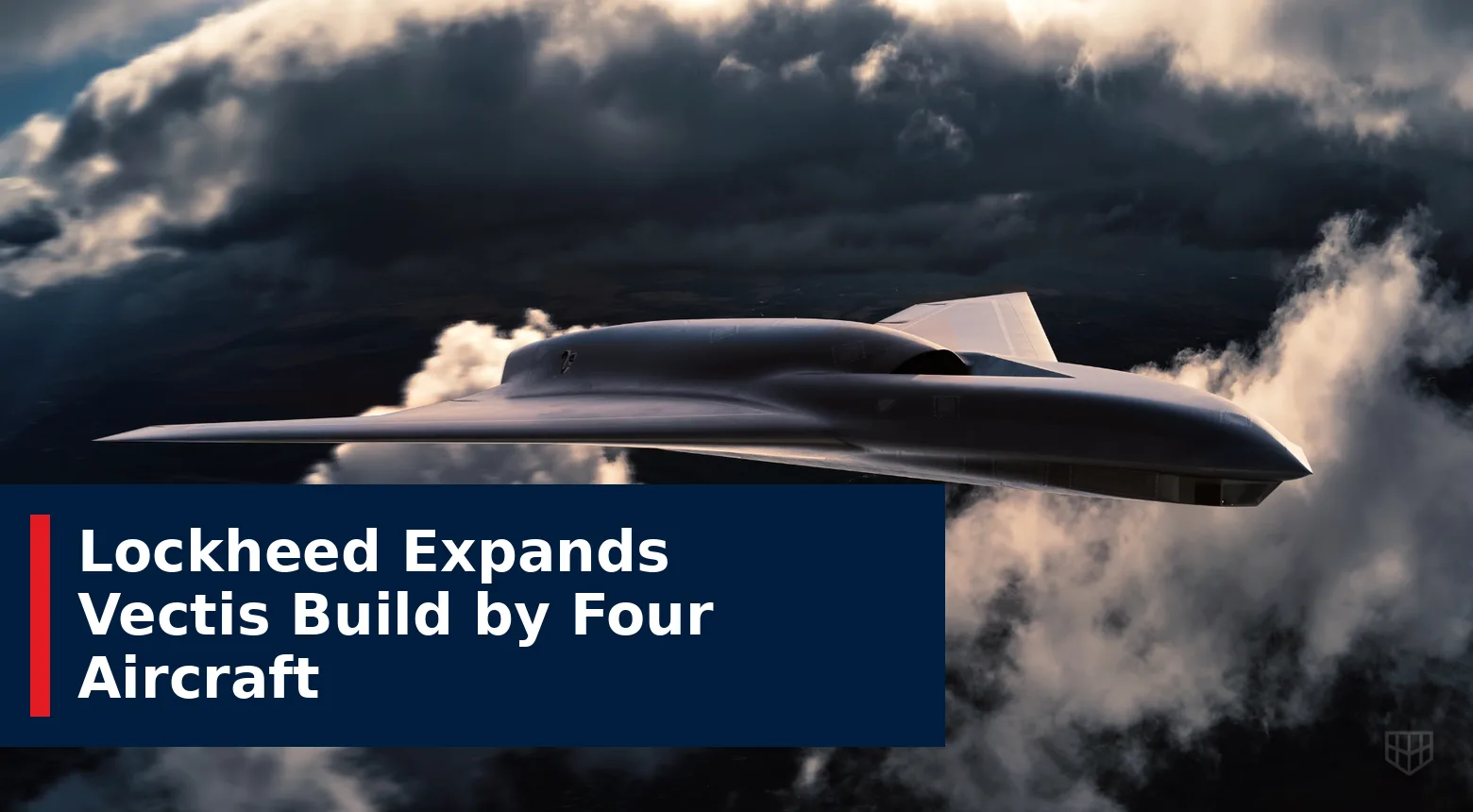
Lockheed Martin Skunk Works plans to build four additional Vectis aircraft as it advances the uncrewed system towards flight testing. The company announced the expansion on 14 September 2026 and maintained its target for the first prototype to fly by the end of 2027. It displayed a full-scale model at the Air, Space & Cyber Conference alongside the announcement.
The word production requires care in this context. Lockheed Martin is expanding the number of development vehicles it intends to manufacture; it has not announced serial production for an operational customer. No service selection, procurement quantity or fielding date accompanied the update. The new aircraft should therefore be treated as test assets supporting maturation and demonstration.
Speed through digital development
Lockheed Martin said the programme moved from its first drawing to a wind-tunnel fly-off in less than two months, completed a first digital build in six months and released its first part for manufacture after eight months. These are company-reported cycle times, but they show the development model Skunk Works wants to demonstrate: early digital definition, rapid physical iteration and a design prepared for repeatable manufacture.
Building several aircraft can make that approach more useful. Separate vehicles may be assigned to aerodynamic, mission-system, autonomy and integration work, allowing some test activity to proceed in parallel. It can also reduce the programme impact if one aircraft is unavailable for modification or inspection. The exact configuration and allocation of the four additional vehicles have not been disclosed.
Collaborative combat role
Vectis is presented as a multi-mission collaborative combat aircraft designed to operate with crewed platforms such as the F-35. In practice, that category can cover sensing, electronic warfare, communications relay, weapons carriage or other missions directed by a wider force. The value of any design depends on how well it connects to operational networks and how much autonomous behaviour is trusted and authorised.
A stealth-shaped airframe shown in company imagery does not by itself establish signature performance, payload, range or survivability. Lockheed Martin has not released the data needed for those assessments. Nor has it identified a committed weapon or sensor configuration. The current programme is best evaluated by its test pace and integration evidence rather than by assumptions drawn from the demonstrator’s external appearance.
What would turn Vectis into a programme of record
The first-flight target is the next visible milestone, followed by expansion of the flight envelope and demonstrations of mission-system and crewed-uncrewed teaming functions. Evidence of an open architecture, rapid payload changes and affordable operating concepts would be important because collaborative aircraft are expected to be fielded in meaningful numbers rather than as exquisite one-off systems.
A government-funded contract, formal competition entry or service selection would materially change Vectis’s acquisition status. Until then, the additional build is an industrial decision by Lockheed Martin that increases the scale of its test campaign. It strengthens the company’s ability to generate data and offer a more mature design, but it does not guarantee a customer or operational deployment.
Affordability will be tested by more than the advertised speed of design. A collaborative aircraft needs production methods, subsystems and maintenance concepts that remain economical when bought and operated at scale. Reusable test aircraft can prove performance, yet they may not reveal whether the final design meets a customer’s cost, attrition and sortie-generation assumptions. Lockheed Martin will therefore need to connect its digital-development claims to measured manufacturing hours, supplier lead times and repair demands. Demonstrations with representative mission software and external command networks would likewise show whether Vectis can integrate without a bespoke architecture. Those data points would make the four-aircraft expansion a bridge to an acquisition decision rather than an isolated company-funded experiment.