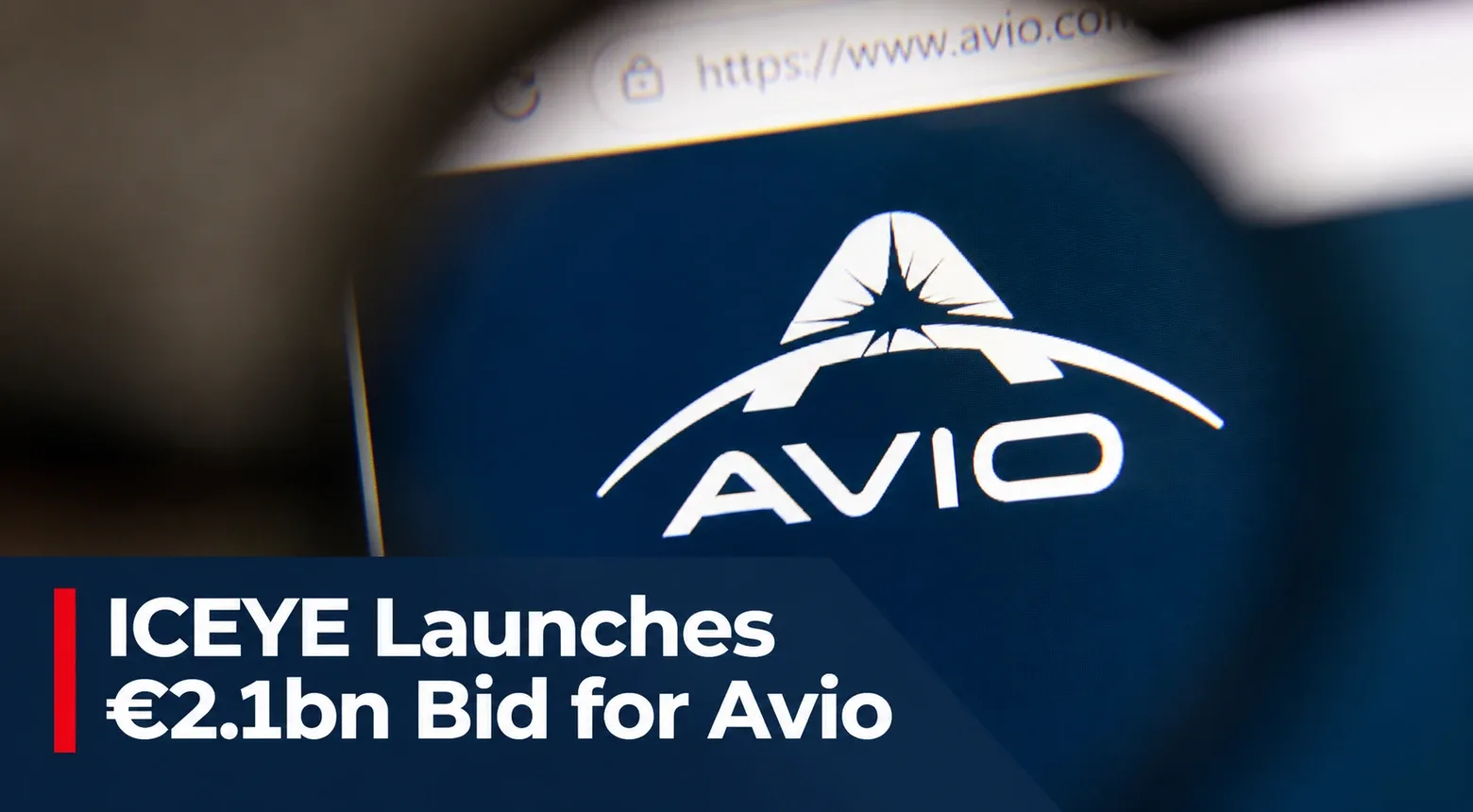
The ICEYE Avio takeover bid announced on 17 November 2026 would unite a Finnish synthetic aperture radar (SAR) satellite operator with an Italian rocket and propulsion manufacturer in a vertically integrated European space and defence group. ICEYE, acting through its indirectly wholly owned Italian subsidiary Iris 2, has offered €41 in cash for each Avio share, implying approximately €2.05 billion for the 50.06 million shares covered by the present capital structure. The offer is intended to take Avio private, but it remains conditional: Avio's board has yet to complete its review and regulatory approvals are outstanding. The strategic issue is whether European satellite operators can secure more of the launch and industrial capacity on which sovereign space services depend.
ICEYE Avio Takeover Bid: Price, Structure and Industrial Logic
The formal Article 102 offer notice identifies Iris 2 S.p.A. as the bidder, wholly owned by Iris 1 S.p.A., which is itself wholly owned by ICEYE Oy. The voluntary public tender offer concerns Avio's ordinary shares listed on Euronext STAR Milan and seeks their eventual delisting. It covers up to 50,064,811 existing shares, including 1,127,577 treasury shares; additional shares may arise under incentive plans. Multiplying the stated existing share count by the €41 consideration yields approximately €2.053 billion before any additional incentive-plan issuance or other transaction adjustments. This is an equity purchase valuation, not the annual expenditure on the Vega launcher programme.
The proposed €41 consideration is 21.3% above Avio's closing price on 16 November 2026, according to the bidder-related stock-exchange disclosure and the 17 November Reuters report. Reuters also reported a 34.8% premium to the three-month volume-weighted average price. A separate 29.6% premium cited in Italian reporting refers to the one-month average: the figures are not competing estimates for the same observation window. The bid is all-cash for selling shareholders, with ICEYE intending to finance the acquisition using a combination of available balance-sheet cash and acquisition debt.
The industrial rationale is to put satellite manufacturing, constellation operations and intelligence services alongside rocket launch and propulsion capabilities. ICEYE already supplies space-derived intelligence and sovereign SAR satellite systems to governments. Avio is the prime contractor for the Vega launcher family and a participant in European launch and propulsion supply chains. In a December 2025 company disclosure, Avio announced Vega C launch-service agreements valued at more than €100 million, covering planned missions between 2028 and 2031. That existing business provides useful context for the acquirer's interest in launch frequency, although those contracts would not automatically become new ICEYE orders.
ICEYE says it intends to spend a further €1 billion in Italy over five years following completion, beyond Avio's existing investment plans. Its stated priorities include expanding manufacturing, research and development, testing, intellectual property, local supplier capacity and the frequency of Vega launches. Company communications also refer to the potential creation of up to 400 high-skilled jobs, a projection rather than an already realised employment increase. ICEYE has pledged to retain Avio's brand and current workforce, keep Italy central to launch and propulsion operations, honour commitments to European and US customers, and continue Avio's planned US investments. These are announced intentions contingent on the transaction and subsequent execution, not binding evidence that all expansion targets will be reached.
The bid follows a period of capability expansion in European defence space. On 16 November 2026, ICEYE announced its Gen5 SAR architecture, describing higher-resolution imaging and onboard processing potential for government users. Those manufacturer-reported performance characteristics help explain its demand for space infrastructure, but Gen5 is a separate product announcement, not a capability created by acquiring Avio. ICEYE and Avio would also bring different industrial and programme relationships into a combined group; integration would have to respect existing third-party customer commitments rather than presume exclusive access to every launch slot or propulsion output.
For comparison, Defence Agenda's reporting on Isar Aerospace's Spectrum orbital flight describes a different route to European launch resilience: independent launch-vehicle development rather than corporate integration. Its broader 2026 military-space programme review examines how sovereign sensing, communications and access to orbit contribute to defence readiness. Neither case demonstrates that owning a launch manufacturer inevitably guarantees cheaper or faster launches; launch cadence remains dependent on qualified vehicles, industrial capacity, payload demand, range access and mission acceptance.
Regulatory Conditions, Execution Risks and Next Milestones
The central near-term question is regulatory rather than technical. Italian market reporting on the terms of the tender offer identifies a 66.67% shareholding threshold and the requirement for Italian government review under its strategic-investment Golden Power regime. The published conditions also reference foreign-investment and competition reviews involving France, the United Kingdom, the European Union and the United States. These are jurisdiction-specific requirements: a notification, application or anticipated clearance should not be described as an approval already received. Any waiver or modification of an offer condition would need to follow the applicable legal framework and the bid documents.
Avio's defence propulsion work, European institutional launch commitments and US-related business add sensitivity beyond a conventional industrial acquisition. The company has obligations to government and commercial customers that could constrain the speed and structure of integration. The market notice also includes material-adverse-change terms, while the reported offer documents contemplate safeguards for the bidder if circumstances change significantly. Editorially, this reinforces the distinction between the announcement of a voluntary offer on 17 November and the later steps of tender acceptance, regulatory clearance, settlement and delisting.
There are plausible benefits for both parties if the transaction closes. A combined group could align satellite production and launch planning more closely, strengthen internal engineering interfaces and direct investment towards bottlenecks across the space supply chain. The proposed €1 billion programme could increase Italian industrial capacity, and Avio's existing customer base could provide continuity during the transition. Yet vertical integration also brings risks: investment may compete with debt-servicing requirements; customers may expect equitable access rather than preferential launch allocation; and managerial integration across two regulated national defence ecosystems could be slow.
An alternative model is continued cooperation through contracts or memoranda of understanding without common ownership. That approach can preserve independent governance and customer neutrality, but may offer less direct control over capital expenditure or production priorities. The acquisition therefore represents a strategic trade-off, not a demonstrated operational improvement on day one. Similar European military-space programmes, including Germany's SATCOMBw4 satellite initiative, show that procurement schedules and sovereign-control objectives can remain challenging regardless of the ownership model selected.
Avio's board said it would assess the bid. That review is not the same as recommending acceptance; nor has ICEYE disclosed an unconditional settlement date. The next verifiable milestones will be the formal offer timetable, any Avio board opinion, regulatory filings and decisions, shareholder acceptances against the required threshold, and—only after successful completion—the implementation of investments and the proposed delisting. As of 17 November 2026, the €2.05 billion equity proposal and the five-year €1 billion investment intention are separate figures, and neither should be reported as a completed acquisition or committed government procurement.
Further Reading
- Avio Article 102 tender-offer notice — 17 November 2026
- Reuters: ICEYE launches bid for Italian rocket maker Avio — 17 November 2026
- Seraphim Space Investment Trust RNS: ICEYE announces Avio tender offer — 17 November 2026
- Borsa Italiana/Radiocor: Offer threshold and Golden Power requirements — 17 November 2026
- Defence Agenda: Isar Aerospace Reaches Orbit on Spectrum's Second Flight
- Defence Agenda: Space Warfare 2026 — The New Military Race in Orbit
- Defence Agenda: SATCOMBw4 Satellite Project Faces Delay Warning in Germany