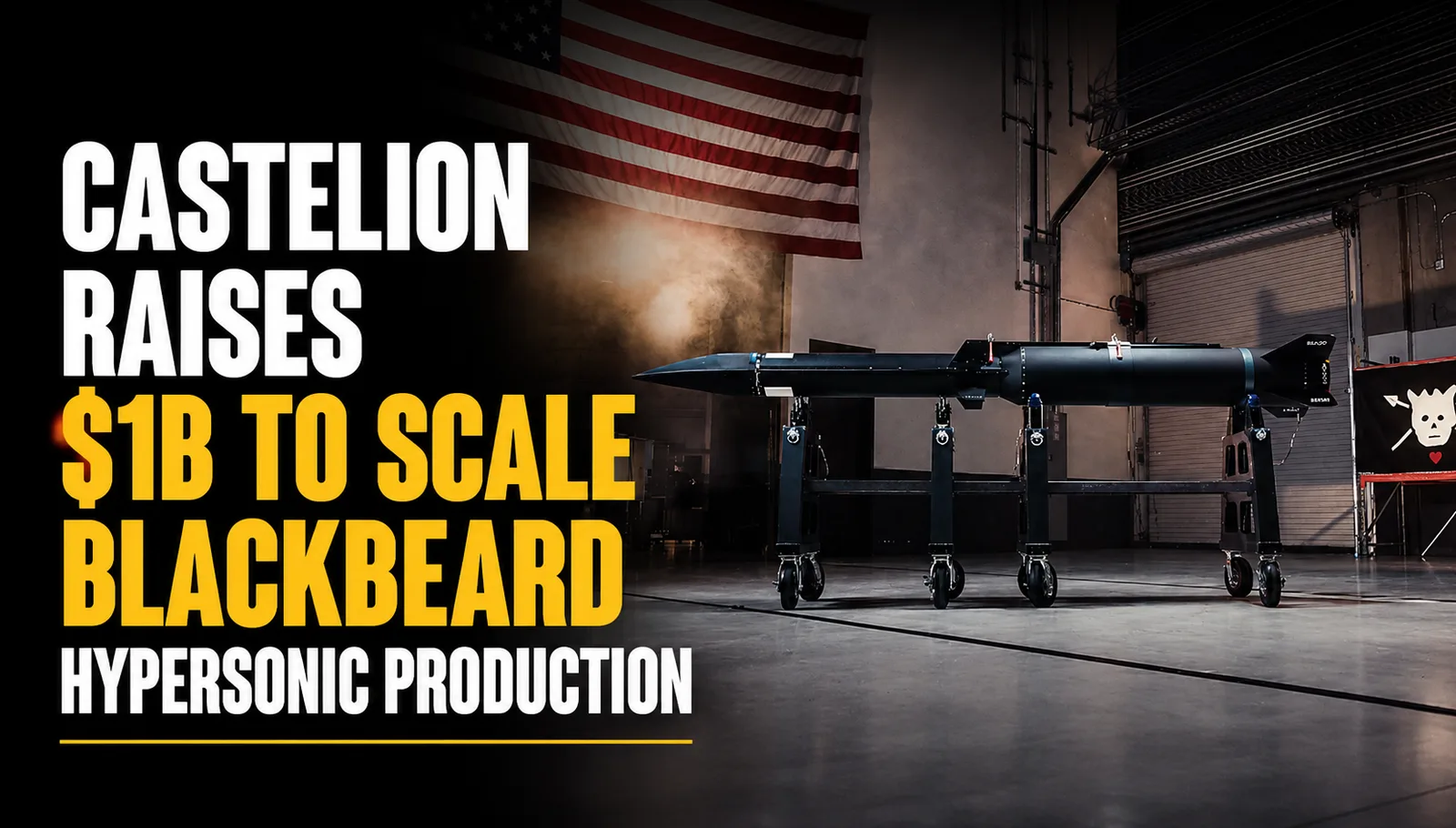
U.S. defence technology company Castelion has announced a $1 billion Series C financing package to expand production of its Blackbeard low-cost hypersonic strike weapon, accelerate a longer-range precision-strike system and develop lower-cost air and missile-defence products.
The 19 August 2026 financing announcement comes as Blackbeard moves from rapid development and flight testing toward early operational capability and larger-scale production. Castelion says the round values the company at $13 billion. The disclosed financing components are $800 million in equity plus $250 million in committed revolving-credit capacity, meaning the components total $1.05 billion even though the company markets the transaction as a $1 billion Series C.
Key Facts
- Company: Castelion
- Financing announcement: 19 August 2026
- Headline Series C: $1 billion
- Equity financing: $800 million
- Committed revolving credit facility: $250 million
- Post-money company valuation: $13 billion
- Primary weapon: Blackbeard low-cost hypersonic strike missile
- Project Ranger: 1,000-acre manufacturing campus in Sandoval County, New Mexico
The Financing Structure Is More Than an Equity Round
Castelion and investor Carlyle describe the transaction as a $1 billion Series C, but the financing structure is not purely equity. The company says $800 million is equity financing and another $250 million is committed financing for a revolving credit facility.
The equity component was co-led by JPMorganChase’s Strategic Investment Group, Andreessen Horowitz and funds managed by Carlyle. Other participating investors include Lightspeed Venture Partners, Lavrock Ventures, Altimeter, General Catalyst, Interlagos and T. Rowe Price Associates.
Because the disclosed components total $1.05 billion, the headline figure should be understood as the company’s rounded financing label rather than a precise arithmetic total. The $250 million credit facility is also debt capacity rather than an equity investment and should not be combined with the $800 million equity component when discussing shareholder capital alone.
The round values Castelion at $13 billion, according to the company and Carlyle.
Blackbeard Is the Immediate Production Priority
Castelion says the largest near-term use of the financing will be expansion of Blackbeard manufacturing capacity. The company describes Blackbeard as a low-cost, mass-producible hypersonic strike missile designed from the outset for high-rate manufacturing rather than boutique production.
Public sources do not disclose Blackbeard’s exact operational range, maximum speed, warhead, seeker architecture or unit production cost. Castelion’s public positioning focuses instead on manufacturability, vertical integration, rapid flight-test iteration and lower cost relative to traditional hypersonic programmes.
The company says Blackbeard moved from a clean-sheet design to a programme of record in under four years and is targeting fielding in 2027. That programme-of-record transition received further official support on 25 August, when the U.S. Navy awarded Castelion a new $89.997 million firm-fixed-price SBIR Phase III order to advance Blackbeard to Early Operational Capability.
The Latest Navy Order Adds 50 EOC Weapons
The Department of War’s 25 August contract announcement provides the most current official procurement milestone. The Navy awarded Castelion $89,997,162 under order N6833526F1192 to provide engineering, technical, logistics and manufacturing services for Blackbeard.
The contract includes development of 50 Early Operational Capability weapons, Defense Exportability Features design modifications and work to transition Blackbeard to a Navy Program of Record. Performance is expected through August 2028.
The full $89.997 million was obligated at award through a combination of fiscal 2025 and fiscal 2026 research, development, test and evaluation funds. Unlike the private Series C financing, this is direct U.S. government programme funding tied to Blackbeard development and fielding.
The 25 August order follows earlier 2026 Navy awards that progressively moved Blackbeard toward operational use.
Blackbeard’s 2026 Contract Path
| Date | Official action | Value | Purpose |
|---|---|---|---|
| 25 February 2026 | Navy firm-fixed-price order | $49.998 million | Full-scale prototypes, flight testing, integration and early operational capability |
| 24 April 2026 | Navy contract modification | $104.999 million | Final EOC requirements, F/A-18 integration/test configurations and live-fire events |
| 13 May 2026 | Department of War production framework | Future procurement framework | Minimum 500 Blackbeard missiles annually after testing and validation |
| 11 June 2026 | Navy firm-fixed-price order | $23.35 million | 50 EOC pre-production prototypes and 50 storage/shipping containers |
| 25 August 2026 | Navy SBIR Phase III order | $89.997 million | 50 EOC weapons, exportability modifications and transition to Navy Program of Record |
These contract actions should not automatically be summed as if they were entirely separate production purchases. Some are sequential orders or modifications supporting the same development and integration pathway. They nevertheless show a clear progression from prototype development toward operationally relevant production.
The Pentagon Wants Hundreds, Potentially Thousands
The most consequential demand signal came on 13 May 2026, when the Department of War announced a framework agreement with Castelion to scale low-cost hypersonic production.
Under the framework, once Blackbeard completes testing and validation, the Department says it intends to award a two-year multiyear procurement contract for a minimum of 500 missiles per year, with options that could extend the arrangement to five years.
The Department also said it was seeking the authorisations and appropriations needed to purchase more than 12,000 Blackbeard missiles over five years. That figure is not an approved current order. It is a prospective acquisition objective dependent on testing, validation, congressional authority, appropriations and successful scale-up.
The distinction is important. A guaranteed future rate of 500 missiles per year becomes operative only after the specified technical gates are passed and the subsequent procurement contract is awarded.
Project Ranger Is the Industrial Core
Much of the Series C is intended to expand Castelion’s Project Ranger manufacturing campus in Sandoval County, New Mexico. The facility covers approximately 1,000 acres and is being developed to manufacture solid rocket motors, conduct static testing, assemble components and produce finished hypersonic rounds.
At the January 2026 groundbreaking, the New Mexico Economic Development Department described Project Ranger as a $220 million private investment expected to create approximately 300 high-wage jobs and generate more than $650 million in state economic output over the following decade.
Castelion’s August financing announcement gives a higher current infrastructure figure, saying the company had already committed more than $250 million in private spending at Project Ranger and would invest hundreds of millions more. These figures reflect different announcement dates and project scopes rather than necessarily contradictory programme values.
Castelion says Project Ranger is intended to support production measured in thousands of hypersonic weapons per year. That production-rate ambition remains a company target rather than a demonstrated sustained manufacturing output.
Private Capital Is Replacing Part of the Traditional Factory-Funding Model
Castelion’s financing model is strategically notable because the company is using large amounts of private capital to build weapons-production infrastructure before the U.S. government has placed orders equal to the full planned production capacity.
The Department of War highlighted this approach in May, describing Castelion and other new entrants as examples of suppliers reaching production scale without direct Department investment in their facilities. The government provides a long-term demand signal, while private investors carry a significant portion of the near-term capital expenditure and scaling risk.
This differs from the traditional model in which major defence primes often expand production capacity after receiving long-duration contracts, government-furnished equipment or direct industrial-base investment.
If successful, the model can accelerate factory construction and reduce the time between prototype maturity and high-rate production. The commercial risk is that private investors are financing capacity before all future government procurement has been authorised or appropriated.
Why Low-Cost Hypersonics Matter
The central strategic thesis behind Blackbeard is magazine depth. Hypersonic weapons offer speed, reduced response time and challenging engagement geometry, but many existing hypersonic programmes are expensive and produced in relatively limited quantities.
Castelion is attempting to change that cost-volume relationship by applying vertically integrated propulsion, guidance and manufacturing methods designed for industrial-rate production.
The Department of War has separately identified scaled hypersonics as one of its priority technology areas and is pursuing multiple lower-cost missile programmes under its Arsenal of Freedom acquisition approach.
A lower-cost hypersonic weapon does not need to replace every high-end strike system. It could instead create a larger inventory tier for targets that justify high speed but do not require the performance, range or specialised payload of the most expensive strategic hypersonic weapons.
Longer-Range Strike Is the Second Use of Capital
Castelion says the Series C will also accelerate a substantially longer-range precision-strike weapon that has already been in development for several years.
The company says the system will reuse core technologies, components and manufacturing techniques developed for Blackbeard. No public name, range, speed, launch platform, warhead, customer or development schedule has been disclosed.
The programme therefore remains a company development effort rather than a publicly confirmed U.S. military programme of record.
Industrial reuse is significant, however. If propulsion, guidance, production tooling and supply-chain elements can be shared across multiple missiles, Castelion may be able to spread fixed development and manufacturing costs across a larger product family.
Defensive Systems Create a Third Product Line
The financing will also support lower-cost air and missile-defence systems. Castelion says it intends to transfer the manufacturing and rapid-iteration methods developed for Blackbeard into defensive applications focused on lower cost, higher production rates and deeper interceptor magazines.
The company has not publicly identified the interceptor architecture, target class, speed, range, seeker, launch system or government customer for these future defensive products.
Defence Agenda therefore treats this as an announced strategic development direction rather than a mature missile-defence programme.
F/A-18 Integration Provides the Near-Term Operational Path
The U.S. Navy is pursuing Blackbeard integration with the F/A-18E/F Super Hornet. On 24 April, the Navy awarded Castelion a $104.999 million contract modification covering final early-operational-capability requirements, test and integration configurations and live-fire events in the Indo-Pacific Command area of responsibility.
Castelion says this work is intended to support an Early Operational Capability in 2027 and includes safety, certification, flight-test and carrier-integration activity.
The F/A-18 path matters because it ties Blackbeard to an existing carrier-air-wing platform rather than requiring a new dedicated launch aircraft. Public sources do not yet disclose the final carriage configuration, number of weapons per aircraft or operational release envelope.
Ground and Maritime Launch Options Broaden the Architecture
Blackbeard is also being developed for other launch concepts. Castelion announced Army and Navy platform-integration awards in October 2025, while Department of War FY2027 budget material includes funding for Blackbeard ground-launch development and testing.
In June 2026, Castelion and Saronic separately announced plans to demonstrate Blackbeard from Saronic’s Marauder medium autonomous surface vessel in 2027. The demonstration has not yet occurred and should not be described as an operational naval weapon configuration.
If multiple launch modes mature, Blackbeard could evolve into a family of distributed strike options across aircraft, ground launchers and autonomous maritime platforms. The extent of component commonality between those configurations has not been publicly disclosed.
Industrial Impact
The Series C is one of the largest recent private-capital raises in the defence-technology sector and materially expands the amount of private financing available for missile manufacturing infrastructure.
For the U.S. defence industrial base, the strategic question is whether venture-backed and private-capital-funded entrants can convert software-style iteration speed into reliable high-volume munitions production.
Missiles impose manufacturing disciplines that cannot be bypassed by financing alone: energetic materials, solid rocket motors, guidance electronics, thermal protection, quality assurance, safe storage, environmental testing, supplier qualification and explosive-handling infrastructure all become constraints as production increases.
Project Ranger is therefore the central test of Castelion’s thesis. Raising capital establishes the means to build capacity; repeatable yield, quality and delivery performance will determine whether the company can actually sustain the production rates it advertises.
Limitations and Counterpoint
The financing announcement contains several figures that require careful interpretation. Castelion calls the transaction a $1 billion Series C, while the disclosed $800 million equity component and $250 million committed credit facility total $1.05 billion. The company has not publicly explained the rounding convention in the headline figure.
The $13 billion valuation is a financing-round valuation rather than a measure of annual revenue, profit or government backlog.
Likewise, the Department of War’s potential purchase of more than 12,000 Blackbeard missiles is not an existing funded order. The minimum 500-per-year production framework remains conditional on testing and validation and requires subsequent procurement action.
Castelion’s description of Blackbeard as low-cost and capable of production at a fraction of the cost of legacy hypersonic weapons remains a company claim. No public Blackbeard unit price or independently audited cost comparison is available.
The company’s stated goal of thousands of hypersonic weapons per year also remains a planned manufacturing capacity rather than demonstrated sustained output.
Implications / Next
The most important near-term milestone is Blackbeard’s transition to Early Operational Capability. Navy development, live-fire and F/A-18 integration activity through 2027 and 2028 will determine whether the weapon clears the gates required for the larger Department of War production framework.
The second milestone is Project Ranger throughput. Completion of facilities, solid-rocket-motor production, manufacturing yield and delivery of the first 50 pre-production rounds will provide measurable evidence of whether Castelion can convert private capital into reliable weapons output.
The third is the first multiyear production contract under the May framework. A funded order for at least 500 missiles per year would represent the clearest transition from venture-backed industrial expansion to sustained government demand.
Finally, disclosure of the longer-range strike system and defensive portfolio will show whether Castelion can extend Blackbeard’s manufacturing architecture into a broader missile family or whether the company remains primarily dependent on one flagship programme.
Conclusion
Castelion’s Series C is significant not simply because of its size, but because the financing is being directed at a different model of weapons industrialisation: private capital builds the factory, rapid government contracts mature the weapon and a long-term demand signal is intended to support production measured in hundreds or thousands rather than dozens.
Blackbeard is already moving through a sequence of Navy prototype, integration and early-operational-capability awards, and the 25 August contract formally supports 50 EOC weapons and transition to a Navy Program of Record.
The remaining question is execution. Castelion has raised the capital and secured a government demand pathway, but the strategic value of the model will depend on whether Project Ranger can achieve repeatable high-rate production, Blackbeard completes testing and validation, and Congress funds the scale of procurement envisioned by the Department of War.