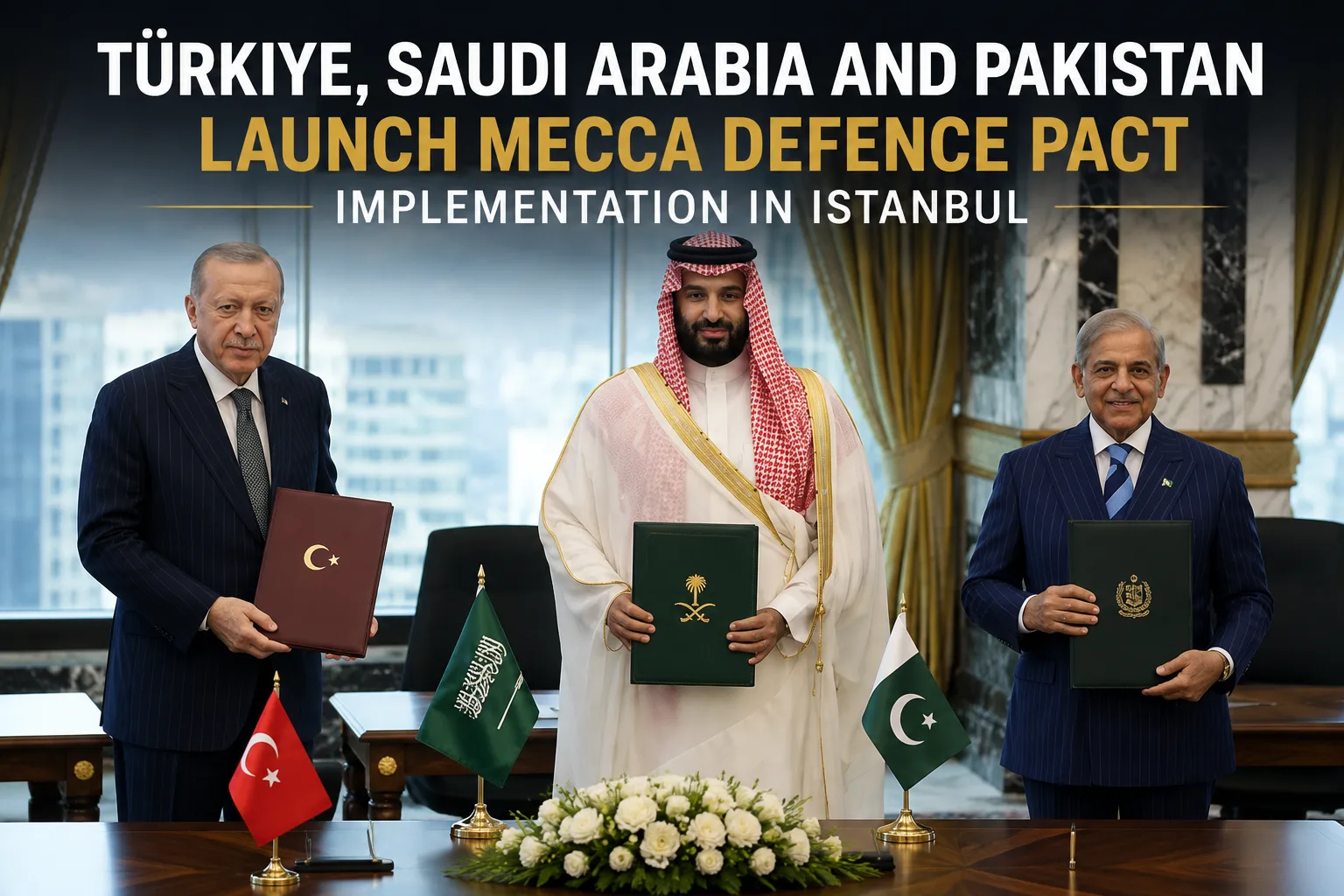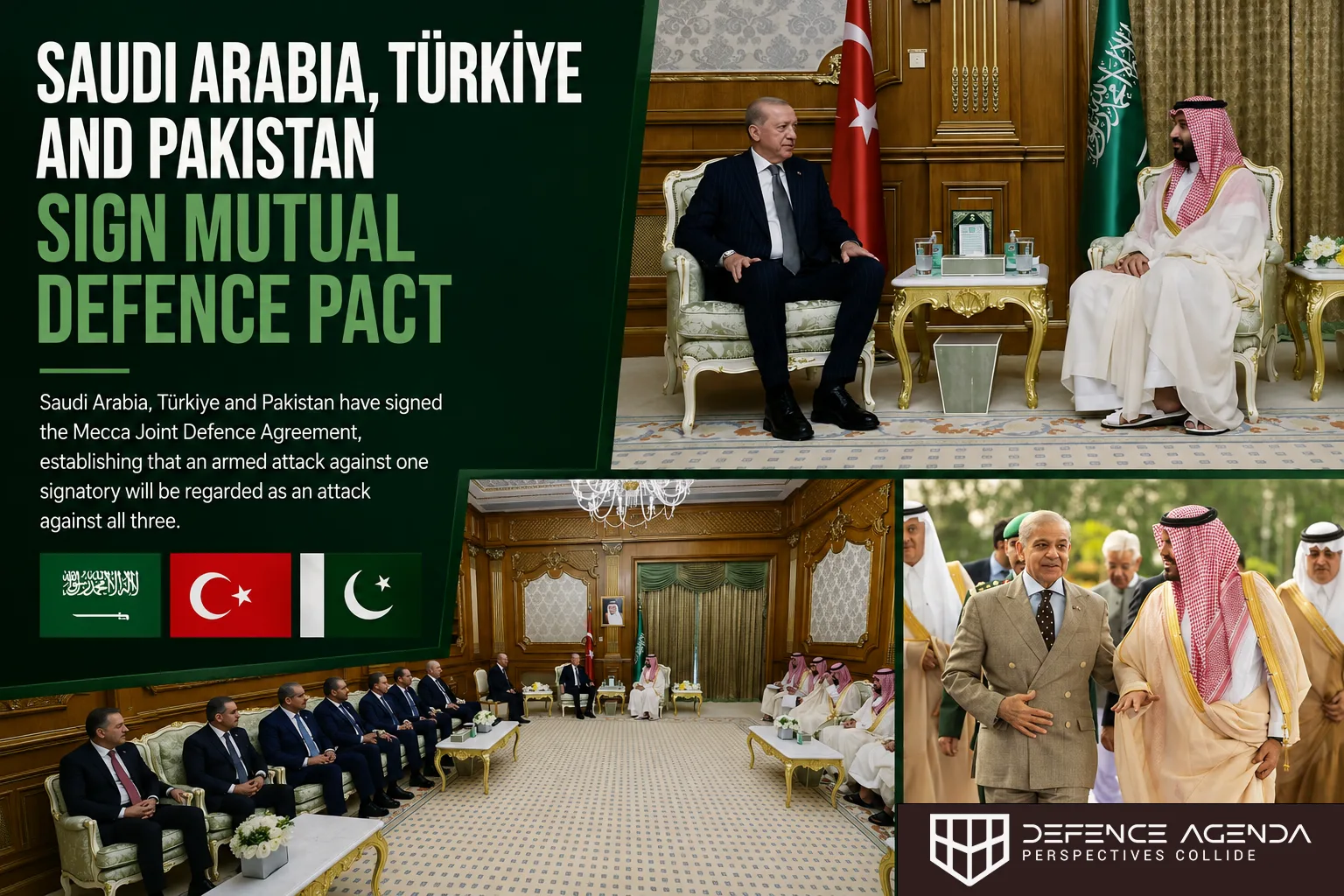
Saudi Arabia, Türkiye and Pakistan have signed a trilateral mutual defence agreement establishing that an armed attack against one of the three countries will be regarded as an attack against all three.
The Mecca Joint Defence Agreement was signed in Saudi Arabia on 7 August 2026 as the three regional powers moved to formalise a security framework that had been under negotiation for nearly a year.
According to Reuters reporting on the agreement, the pact is intended to strengthen collective deterrence and promote security and stability in the region and beyond.
The agreement contains a significant collective-defence commitment but does not publicly specify how the three countries would translate that commitment into military action.
A Turkish official described the agreement as purely defensive, said it was not directed against any specific country and stressed that it would not replace Türkiye’s existing bilateral or multilateral security arrangements.
Key Facts
- Agreement: Mecca Joint Defence Agreement.
- Signatories: Saudi Arabia, Türkiye and Pakistan.
- Signing date: 7 August 2026.
- Signing location: Mecca, Saudi Arabia.
- Core principle: An armed attack against one signatory will be regarded as an attack against all three.
- Purpose: Strengthening collective deterrence and security.
- Character: Described by a Turkish official as purely defensive.
- Target: Not directed against any specific actor, according to the Turkish official.
- Membership: Open to other regional countries.
- Existing commitments: Does not replace existing bilateral or multilateral arrangements.
- Negotiation period: Approximately one year.
- Operational commitments: Not publicly disclosed.
- Integrated command: Not publicly announced.
- Nuclear commitment: Not publicly established.
What Did Saudi Arabia, Türkiye and Pakistan Sign?
The three countries signed a formal collective-defence framework known as the Mecca Joint Defence Agreement.
The most consequential publicly disclosed provision states that an armed attack against Saudi Arabia, Türkiye or Pakistan will be considered an attack against all three countries.
This moves the relationship beyond general defence cooperation and creates a political commitment to collective deterrence.
The public statement, however, does not explain what military assistance would automatically follow an attack.
No details have been released on force commitments, deployment timelines, command arrangements or the process through which the three governments would determine their response.
What Does the Collective-Defence Clause Mean?
The clause creates a common deterrence message: an adversary considering military action against one signatory must account for the possibility of a response involving the other two.
That principle can increase the political and military cost of aggression even before the parties establish extensive permanent military structures.
The practical strength of the commitment will depend on how the agreement defines consultation, military assistance, force availability and decision-making.
Those provisions have not been made public.
Is the Mecca Agreement a NATO-Style Alliance?
The agreement contains language that resembles the central concept of collective defence, but the available information does not support describing it as institutionally equivalent to NATO.
| Feature | Mecca Joint Defence Agreement | Publicly Established? |
|---|---|---|
| Collective-defence principle | Attack against one treated as attack against all three | Yes |
| Permanent political council | No structure disclosed | No |
| Integrated military command | No structure disclosed | No |
| Permanent combined force | Not announced | No |
| Common defence budget | Not announced | No |
| Expansion to additional members | Agreement described as open to other regional countries | Yes, in principle |
The collective-defence clause is therefore strategically important, but the agreement currently appears less institutionalised than NATO based on publicly available information.
What Does the Pact Mean for Türkiye’s NATO Membership?
Türkiye remains a NATO member, and the new agreement does not replace its existing multilateral commitments.
A Turkish official told Reuters that the Mecca agreement does not abrogate or substitute any existing bilateral or multilateral arrangement.
This distinction is important because Türkiye now participates in two different collective-security contexts: the established North Atlantic Alliance and the newly created trilateral framework with Saudi Arabia and Pakistan.
The public text does not explain how overlapping commitments would be managed during a crisis involving parties outside the three-country agreement.
Is the Pact Directed Against Iran or Israel?
Officially, no specific state has been identified as the target of the agreement.
The Turkish official cited by Reuters said the pact was not directed against any particular actor.
The regional context nevertheless matters. The agreement was signed during a period of heightened conflict involving Iran, Iranian-aligned groups, Israel and several Gulf states.
Saudi Arabia has experienced missile and drone threats against its territory and critical infrastructure, increasing Riyadh’s focus on strengthening regional defence relationships.
Strategic context should not be confused with treaty language. The available agreement summary establishes collective defence against aggression rather than identifying a pre-designated enemy.
How Long Had the Three Countries Been Negotiating?
The trilateral framework had been under discussion for approximately a year before the August signing.
In January 2026, Pakistan’s Minister for Defence Production Raza Hayat Harraj told Reuters that draft versions of the proposed agreement were already being considered by Pakistan, Saudi Arabia and Türkiye.
At the time, Turkish Foreign Minister Hakan Fidan confirmed that discussions had taken place but said no agreement had yet been signed.
Fidan framed Türkiye’s broader approach around building a more inclusive regional security-cooperation platform capable of increasing trust and reducing instability.
The August agreement therefore represents the transition from negotiations to a signed trilateral security framework.
How Does the Agreement Build on Existing Saudi–Pakistan Defence Ties?
Saudi Arabia and Pakistan already maintained a separate bilateral mutual-defence relationship before the trilateral agreement was signed.
The earlier arrangement also contained a collective-defence principle under which aggression against either party would be treated as aggression against both.
Reuters reported in May 2026, citing security and government sources, that Pakistan had deployed a substantial military contingent to Saudi Arabia under the bilateral framework.
| Reported Pakistani Deployment | Reuters Reporting | Important Qualification |
|---|---|---|
| Personnel | Approximately 8,000 troops | Reported from security and government sources |
| Combat aircraft | A squadron of around 16 aircraft, mostly JF-17 fighters | Associated with the bilateral Saudi–Pakistan framework |
| Drones | Two squadrons reported by two security officials | Not publicly detailed by the governments |
| Air defence | HQ-9 system reported | Reported under the bilateral relationship |
Those forces should not automatically be described as assets assigned to the new trilateral pact.
What Existing Defence Links Connect Türkiye and Pakistan?
Türkiye and Pakistan also entered the agreement with a long-standing military relationship rather than starting from zero.
Reuters notes that the two countries have previously exchanged warships and training aircraft and have developed broader defence-industrial ties.
These existing relationships could provide practical foundations for deeper trilateral cooperation, although the Mecca agreement does not publicly define new procurement or industrial programmes.
What Existing Defence Links Connect Türkiye and Saudi Arabia?
Türkiye and Saudi Arabia have also expanded bilateral defence-industrial cooperation in recent years.
In 2023, Saudi Arabia agreed to purchase Turkish unmanned aircraft in what Ankara described at the time as Türkiye’s largest defence-export contract.
The new trilateral agreement creates a strategic framework above those bilateral defence relationships, but it does not disclose new weapons orders or industrial workshare.
Does the Agreement Create a Pakistani Nuclear Umbrella?
No public evidence establishes that the Mecca Joint Defence Agreement extends Pakistan’s nuclear deterrent to Saudi Arabia or Türkiye.
Pakistan is a nuclear-armed state, which inevitably affects strategic perceptions of any defence agreement involving Islamabad.
However, the publicly released information contains no nuclear-sharing clause, nuclear guarantee, basing commitment or command arrangement.
An expert cited by Reuters assessed that the trilateral accord was unlikely to include a nuclear component. That assessment is analytical rather than an officially released treaty provision.
The pact should therefore be described as a conventional collective-defence framework unless the parties publish additional information.
Could Other Countries Join the Agreement?
Potentially.
A Turkish official told Reuters that the agreement is open to other regional countries.
No formal accession criteria, application process or list of prospective members has been publicly released.
The ability to expand could become one of the agreement’s most strategically important features if additional states eventually join.
Until an accession is formally announced, however, the framework consists of Saudi Arabia, Türkiye and Pakistan.
What Military Capabilities Could the Three Countries Bring?
The three signatories possess complementary strategic characteristics, but the agreement does not allocate specific military roles among them.
| Country | Relevant Strategic Characteristic | Role Assigned by Agreement? |
|---|---|---|
| Türkiye | Large NATO military, developed defence-industrial base and regional military presence | No specific role disclosed |
| Pakistan | Large armed forces, established Saudi military ties and significant defence-production capability | No specific trilateral role disclosed |
| Saudi Arabia | Major defence spender, strategic Gulf location and expanding defence-industrial investment | No specific role disclosed |
The complementary nature of these capabilities may strengthen deterrence, but any division of responsibilities remains speculative until an implementation structure is published.
Could the Agreement Accelerate Defence-Industrial Cooperation?
The agreement creates a political environment in which defence-industrial cooperation could expand, particularly given the existing capabilities of Türkiye and Pakistan and Saudi Arabia’s investment ambitions.
Potential areas could include unmanned systems, air defence, naval platforms, ammunition, sensors, electronics and training.
Those sectors represent analytical possibilities rather than programmes announced under the Mecca agreement.
No new trilateral procurement programme, joint venture, production facility or technology-transfer arrangement was identified in the Reuters report.
What Has Not Been Disclosed?
- The full treaty text
- The precise legal obligations of each signatory
- Military response timelines
- Consultation mechanisms following an attack
- Rules for authorising military action
- A joint command structure
- A permanent headquarters
- Common force-generation requirements
- Pre-assigned military units
- Permanent basing rights
- Intelligence-sharing mechanisms
- Joint air-defence architecture
- Maritime-security responsibilities
- Logistics and sustainment arrangements
- Defence-spending obligations
- Common procurement requirements
- A nuclear guarantee
- Accession requirements for additional members
- Withdrawal or termination procedures
Saudi–Türkiye–Pakistan Defence Pact Timeline
| Date | Development | Significance |
|---|---|---|
| September 2025 | Saudi Arabia and Pakistan establish a bilateral strategic mutual-defence framework | Provides part of the bilateral foundation preceding the trilateral agreement |
| January 2026 | Pakistan publicly confirms draft trilateral agreement under discussion | Confirms negotiations involving Pakistan, Saudi Arabia and Türkiye |
| May 2026 | Reuters reports substantial Pakistani deployment to Saudi Arabia under bilateral arrangements | Demonstrates depth of existing Saudi–Pakistan military cooperation |
| 6 August 2026 | Reuters reports signing expected the following day | Negotiations reach final stage |
| 7 August 2026 | Mecca Joint Defence Agreement signed | Formal trilateral collective-defence framework established |
What Should Be Watched Next?
- Publication of the complete agreement text
- Creation of a permanent trilateral consultation mechanism
- Establishment of a joint military committee
- Any announcement of a combined headquarters
- Joint exercises conducted specifically under the new pact
- Air-defence interoperability initiatives
- Maritime-security cooperation
- Intelligence-sharing agreements
- Trilateral defence-industry projects
- New procurement agreements involving the three countries
- Deployment of Turkish or Pakistani forces under the trilateral framework
- Clarification of how the pact interacts with Türkiye’s NATO commitments
- Requests by additional regional states to participate
- Any official clarification of the pact’s nuclear dimension
- Use of the collective-defence mechanism during a future security crisis
Conclusion
The Mecca Joint Defence Agreement marks a significant formalisation of security cooperation between Saudi Arabia, Türkiye and Pakistan.
Its most important publicly disclosed provision is straightforward: an armed attack against one of the three signatories will be regarded as an attack against all.
The agreement therefore creates a new collective-deterrence framework linking a major Gulf power, a NATO member with a substantial defence-industrial base and one of South Asia’s largest military powers.
Its practical military significance cannot yet be fully assessed because the parties have not disclosed force commitments, command arrangements, response procedures or permanent military structures.
The agreement is officially described as defensive, is not directed against a specific actor and does not replace Türkiye’s existing bilateral or multilateral commitments.
The next phase will determine whether the Mecca framework remains primarily a political deterrence commitment or develops into an institutionalised military architecture involving exercises, interoperability, defence-industrial cooperation and operational planning.
Further Reading
- Reuters: Saudi Arabia, Türkiye and Pakistan sign joint defence agreement
- Reuters: Trilateral defence agreement negotiations confirmed in January 2026
- Reuters: Pakistani military deployment to Saudi Arabia under bilateral arrangements
- Associated Press: Saudi Arabia, Türkiye and Pakistan defence agreement