Türkiye, Saudi Arabia and Pakistan have convened the first meeting of the Strategic Political and Defence Committee created under the Mecca Joint Defence Agreement, moving the three-country pact from a political commitment into an implementation phase focused on military interoperability, defence-industrial cooperation, joint production and counter-terrorism.
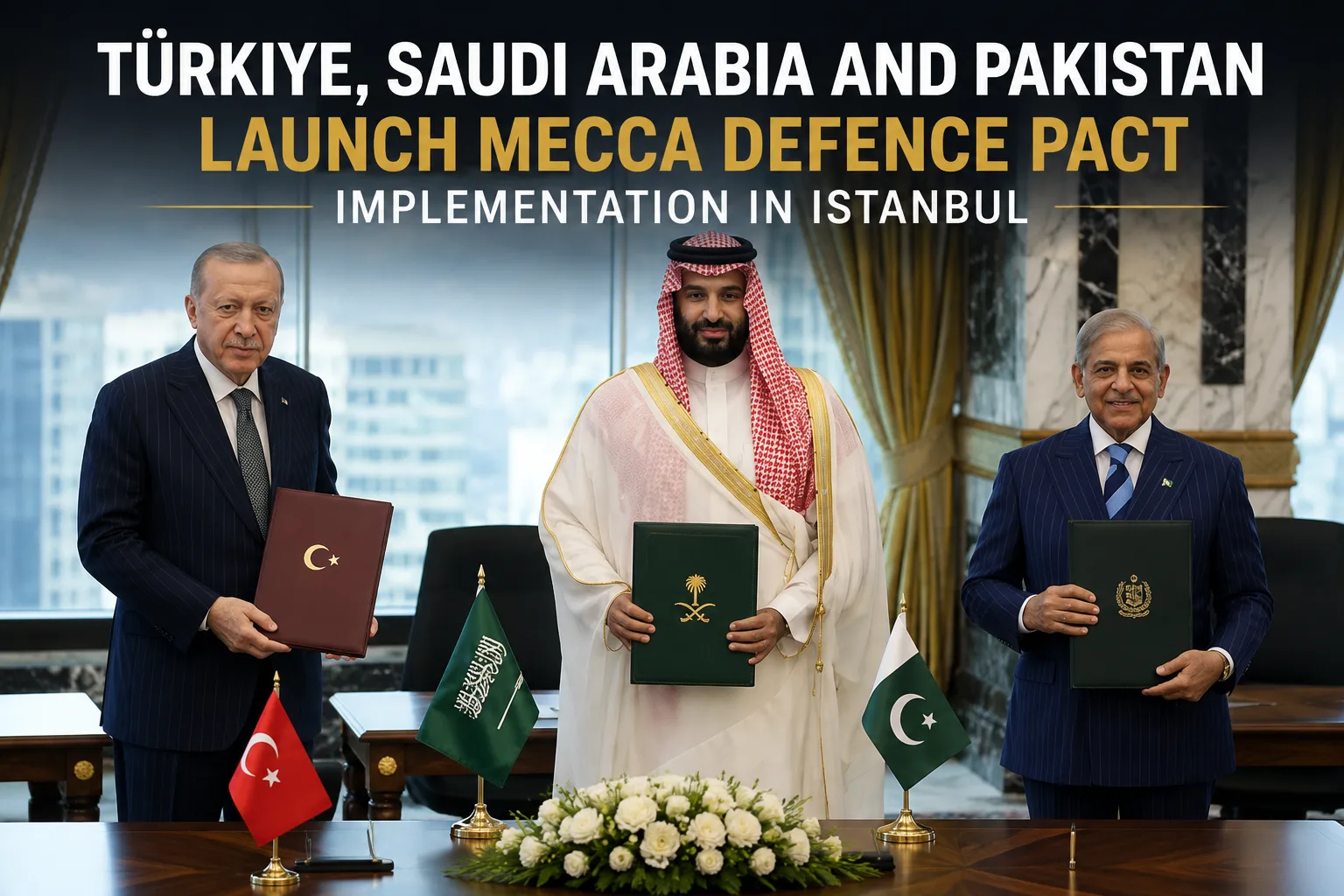
The committee met in Istanbul on 31 August 2026, less than four weeks after President Recep Tayyip Erdoğan, Saudi Crown Prince Mohammed bin Salman and Pakistani Prime Minister Shehbaz Sharif signed the agreement in Mecca on 7 August. The pact establishes that an armed attack against one signatory will be regarded as an attack against all three, while leaving the specific military response subject to national decision-making.
The Pact Has Moved From Signature to Implementation
The 31 August meeting is the first institutional test of the Mecca agreement. The agreement was signed on 7 August 2026 at Safa Palace in Mecca and was presented as a framework for strengthening collective deterrence, regional security and defence cooperation.
The Istanbul meeting created the first formal implementation layer beneath the three national leaderships. According to Türkiye’s Ministry of Foreign Affairs and Anadolu Agency, the committee is intended to provide strategic direction for activities under the agreement and to define the mechanisms needed to turn the political framework into recurring cooperation.
Political and Military Leadership Sit in the Same Structure
The committee combines foreign ministers, defence ministers and the senior military leadership of all three states. Türkiye was represented by Hakan Fidan, Yaşar Güler and General Selçuk Bayraktaroğlu. Pakistan’s delegation included Ishaq Dar, Khawaja Muhammad Asif and Field Marshal Syed Asim Munir. Saudi Arabia was represented by Faisal bin Farhan, Khalid bin Salman and General Fayyadh bin Hamed Al-Ruwaili.
This architecture allows diplomacy, defence policy, industrial cooperation and military requirements to be coordinated inside the same governance mechanism rather than through disconnected bilateral channels.
Joint Production and R&D Are Explicit Agenda Items
For the defence industry, the most consequential part of the Istanbul agenda is the explicit inclusion of joint production and research and development.
Turkish Foreign Ministry sources said the committee would examine ways to deepen defence-industrial cooperation, including joint production and R&D, alongside measures to increase military interoperability and defence capacity.
No specific trilateral missile, aircraft, naval, ammunition, sensor or vehicle programme was announced. Any claim that particular platforms have already been selected would therefore be premature.
Türkiye Brings a Broad Industrial Base
Türkiye enters the framework with a diversified defence-industrial base spanning unmanned aircraft, naval combatants, guided weapons, air-defence systems, armoured vehicles, radars, electronic warfare, communications and ammunition.
That gives Ankara potential roles as platform designer, systems integrator, subsystem supplier and technology-transfer partner in future trilateral programmes.
Saudi Arabia Adds Capital and Localisation Demand
Saudi Arabia’s Vision 2030 localisation policy creates another layer of complementarity. Riyadh has already expanded industrial cooperation with Turkish suppliers, including Baykar’s AKINCI programme and related localisation activity involving Turkish defence companies.
Saudi Arabia therefore brings procurement demand, investment capacity and a policy requirement to build more defence production inside the Kingdom.
Pakistan Adds Operational and Industrial Depth
Pakistan and Türkiye already maintain a substantial bilateral defence relationship. The four-ship Pakistan Navy MİLGEM programme combines construction in Türkiye and Pakistan, while the two armed forces continue joint training and exercises.
Pakistan also brings an established missile, aerospace and shipbuilding base. Those capabilities could support future trilateral work, although no workshare has been announced under the Mecca agreement.
Interoperability Is a Separate Objective From Procurement
The committee also aims to increase interoperability among the three armed forces. This can include common procedures, communications, training standards, logistics, exercises and compatible command systems.
Industrial commonality can reinforce interoperability, but the three countries operate very different equipment mixes. Türkiye uses NATO-standard systems alongside national platforms, Pakistan operates a mix of Western and Chinese-origin systems, and Saudi Arabia relies heavily on Western equipment.
Future exercises and communications integration will show how far the parties intend to move toward practical operational compatibility.
The Agreement Contains a Collective-Defence Clause
The most politically significant provision remains the statement that an armed attack against one signatory will be regarded as an attack against all three.
Turkish officials have linked the provision to collective self-defence under Article 51 of the United Nations Charter. However, the public agreement does not establish an automatic military-response mechanism.
Turkish officials have specifically said participation does not mean Turkish forces will automatically be sent to every regional crisis. Decisions on military action remain subject to national constitutional and political procedures.
No Integrated Command Has Been Announced
No integrated headquarters, permanent combined command, standing trilateral force, force-generation schedule or basing arrangement has been announced.
The Strategic Political and Defence Committee is currently the highest visible implementation mechanism beneath the political leadership. The Istanbul meeting was expected to define a Secretariat and additional mechanisms, but public reporting available at the time of publication had not disclosed their final structure, location or authority.
Fidan Frames the Pact as a New Security Architecture
After the Istanbul meeting, Foreign Minister Hakan Fidan said the agreement had begun the process of establishing a new security and cooperation architecture in the region.
He also said the alliance was created with expansion in mind. This confirms that the structure is not necessarily intended to remain limited to the three founding states.
No fourth member has been formally announced, and detailed accession procedures have not been published.
The Framework Is Presented as Complementary to NATO
Türkiye has stated that the Mecca agreement does not replace NATO or its other existing security commitments. Turkish officials describe regional partnerships and NATO membership as complementary rather than competing frameworks.
No public source indicates that the Mecca agreement has authority over NATO planning, NATO forces or Türkiye’s Alliance obligations.
Counter-Terrorism Is Part of the Formal Programme
Counter-terrorism is another explicit committee agenda item. The three states maintain different threat priorities, but all possess substantial counter-terrorism institutions and military experience.
The Istanbul meeting did not announce a specific trilateral counter-terrorism task force, so future cooperation mechanisms remain to be defined.
Industry May Produce the Earliest Measurable Results
Collective-defence arrangements can take years to mature into operational planning. Defence-industrial cooperation may generate earlier measurable outcomes.
All three states have incentives to expand domestic production, diversify suppliers and secure access to ammunition, missiles, electronics and platforms. Joint production can also increase the political durability of the pact by giving each participant an industrial stake.
Potential sectors include unmanned systems, naval platforms, air defence, ammunition, guided weapons, sensors and communications based on existing national capabilities. Those sectors are analytical possibilities rather than programmes announced by the committee.
The Secretariat Will Show Institutional Depth
One of the main tasks identified for the Istanbul meeting was to define the framework for the Secretariat and other mechanisms that will guide common activity.
A recurring secretariat could convert summit-level declarations into programme management by tracking decisions, coordinating working groups and preparing future meetings.
If specialised working groups later emerge for operations, intelligence, procurement or defence industry, that would indicate a more institutionalised model.
Limitations and Counterpoint
The full treaty text has not been published in the sources reviewed for this package.
No standing command, permanent force, basing arrangement, common procurement budget, nuclear guarantee or automatic deployment mechanism has been announced.
No specific trilateral defence-industrial programme was announced at the first committee meeting.
Statements describing the framework as a new regional security architecture reflect official political framing. Its actual strategic impact will depend on implementation, membership and the depth of military integration achieved over time.
Implications / Next
The first indicator to watch is publication of the committee’s roadmap and the organisational structure of its Secretariat.
The second is defence industry: a named trilateral production or R&D programme would provide the clearest evidence that the pact is moving beyond consultation.
The third is military interoperability. Joint exercises involving all three armed forces, particularly with integrated command-and-control, would show whether the arrangement is acquiring operational depth.
The fourth is expansion. Formal accession talks with another state would test Fidan’s statement that the structure was designed to grow.
Conclusion
The first Strategic Political and Defence Committee meeting marks the transition of the Mecca Joint Defence Agreement from a leader-level declaration into an institutional process.
The framework combines a collective-defence commitment with an implementation agenda covering interoperability, defence capacity, joint production, R&D and counter-terrorism.
For the defence industry, the most significant development is that joint production and research are now formal agenda items rather than speculative extensions of the pact.
But the arrangement remains at an early stage. No integrated command, standing force or trilateral procurement programme has yet been announced.