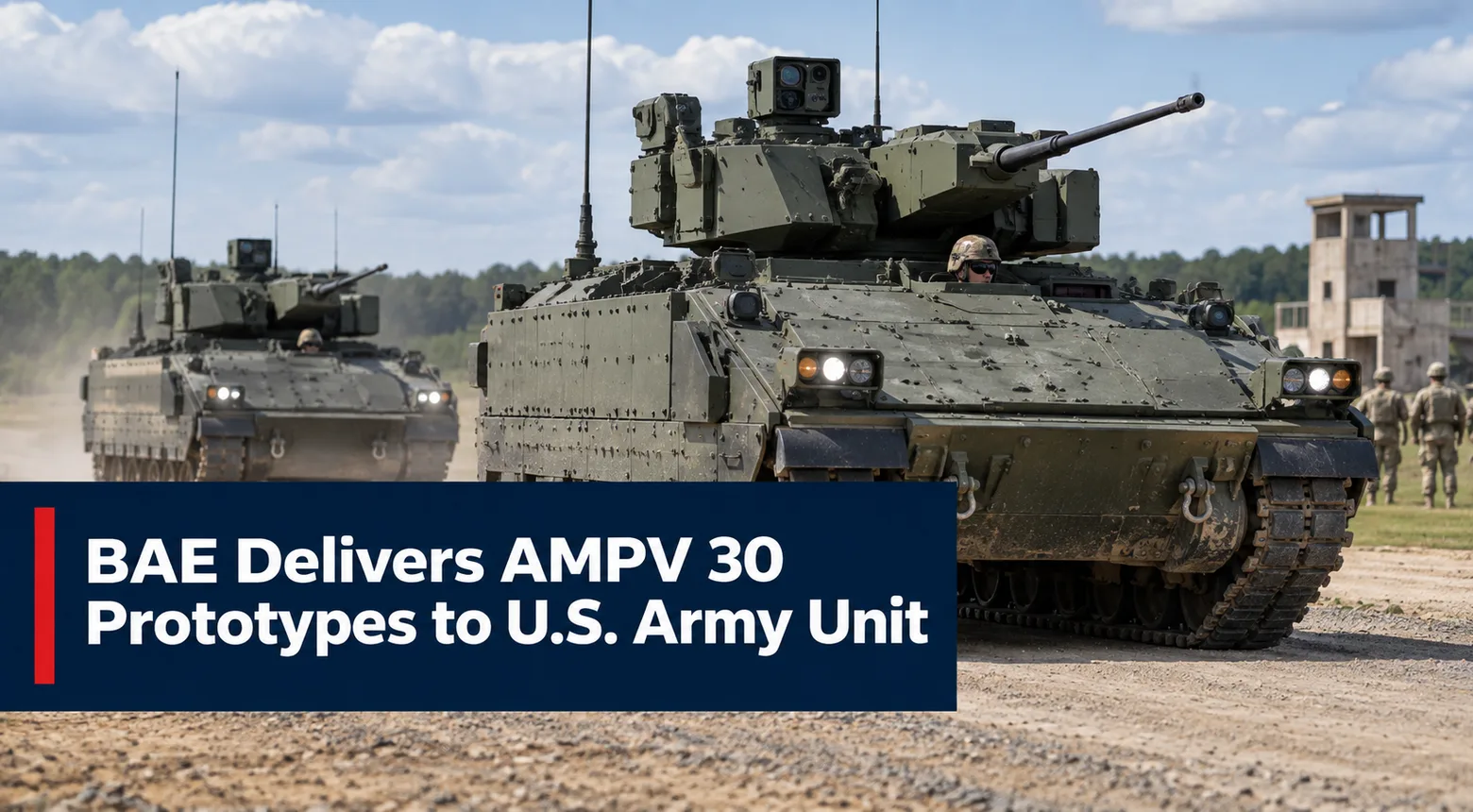
BAE Systems has disclosed that two AMPV 30 concept vehicles were delivered to a U.S. Army Transformation in Contact 2.0 unit in April 2026 and have since undergone field evaluation, including live-fire testing. The prototypes combine the AMPV chassis with KONGSBERG’s Medium Caliber Turret and a 30 mm cannon.
BAE has moved a self-funded concept into Army field evaluation
BAE Systems has disclosed the delivery of two AMPV 30 concept infantry fighting vehicles to a U.S. Army Transformation in Contact 2.0 unit, giving soldiers a production-derived tracked chassis with a 30 mm remote turret for field evaluation. The company announced the programme on 22 September 2026 and said the vehicles had actually been delivered in April, allowing several months of Army testing before the public update.
BAE funded the development with $17 million in internal research and development, using the existing Armored Multi-Purpose Vehicle chassis as the base. The rapid approach is intended to demonstrate that a production vehicle can accept new capability packages without waiting for a full clean-sheet development cycle.
The turret package changes AMPV’s role
The standard AMPV family was designed primarily to replace M113-based support variants in Armored Brigade Combat Teams. The AMPV 30 concept pushes the chassis toward a more direct fighting role by integrating KONGSBERG’s Medium Caliber Turret and a 30 mm Mk44 Bushmaster II cannon. That combination gives the vehicle substantially more direct-fire capability than support configurations centred on protected mobility and mission-specific equipment.
The important procurement question is not whether a 30 mm turret can be mounted on the chassis; the prototype has already demonstrated that. The question is whether the Army sees enough value in the configuration to define a formal requirement, fund additional testing and ultimately procure a production baseline.
Transformation in Contact is being used as a requirements laboratory
Transformation in Contact gives operational units new technology early so soldiers can test it against real training problems and feed results back into acquisition decisions. That model can expose integration issues, crew workload and sustainment demands sooner than a conventional sequence in which users see a mature design only after years of formal development.
BAE says the AMPV 30s have undergone rigorous field evaluation including live fire. Defence Blog reports that the Army has not committed to procurement and that additional prototypes are expected in early 2027. This is exactly the maturity line editors need to preserve: the programme has moved beyond a company demonstrator, but it has not crossed into a production award.
Modularity is becoming part of the AMPV business case
BAE has been promoting AMPV as a chassis that can accept modular “capability kits” for autonomy, weapons and other mission systems. The company’s separate work with Forterra on an autonomous AMPV reinforces that strategy. Reusing a common chassis can simplify training, logistics and automotive sustainment while allowing mission packages to evolve on shorter technology cycles.
The risk is that every new kit adds weight, power, cooling and software-integration demands. A turreted configuration also changes ammunition stowage, crew procedures and tactical employment. Army evaluation will therefore need to measure not only firepower but reliability, mobility, maintainability and the effect of the new mission package on the vehicle’s existing support ecosystem.
Programme maturity and verification
For acquisition and programme-management teams, the milestone is most useful when separated from the claims that usually surround it. The confirmed event establishes technical or contractual progress, while production scale, operational availability, unit adoption and future performance still require their own evidence. That distinction keeps the programme baseline stable as new announcements arrive.
Implications / Next
The next milestones are delivery of additional prototypes, formal Army requirements activity, comparative testing and any funded production decision. Until then, AMPV 30 remains a soldier-tested prototype configuration rather than an adopted infantry fighting vehicle variant.