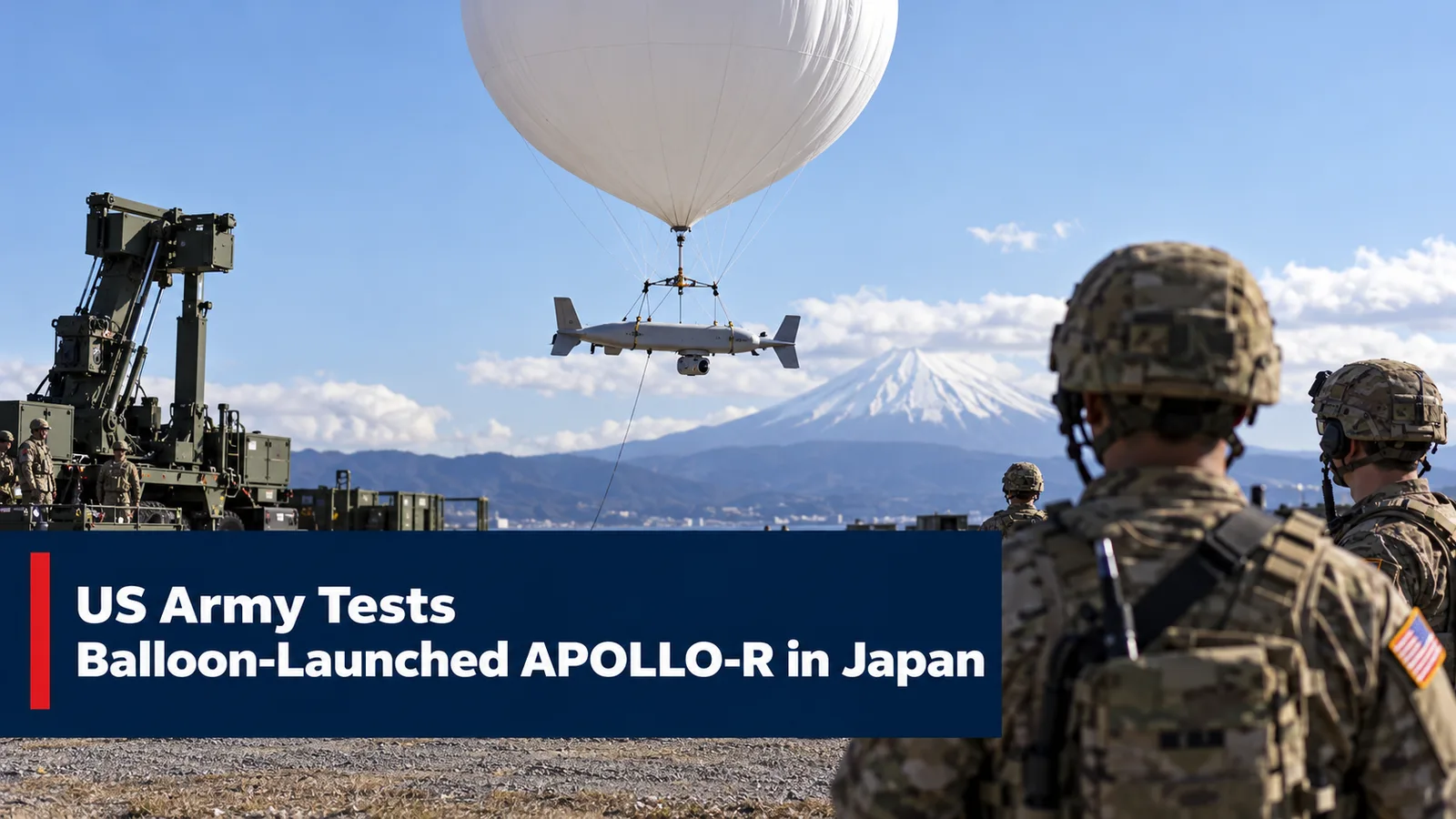
U.S. Army personnel demonstrated a micro-High-Altitude Balloon launch carrying an APOLLO-R drone at Yausubetsu Training Area in Hokkaido, Japan, during Exercise Orient Shield 26. U.S. Army imagery posted on 21 September 2026 documents the 18 September event and shows personnel from the 3d Multi-Domain Task Force preparing the APOLLO-R and the balloon system in front of observers from allied and partner forces.
Official imagery confirms the APOLLO-R and balloon integration
DVIDS imagery identifies an APOLLO-R drone being connected by 3d Multi-Domain Task Force personnel before the balloon launch demonstration. Additional photographs show the micro-High-Altitude Balloon with the APOLLO-R attached as it rises over the Yausubetsu Training Area. The official captions place the activity on 18 September 2026 during Orient Shield 26.
That evidence is more precise than describing the event generically as a balloon trial. The Army demonstrated a payload integration involving an identified drone, but public material does not disclose the complete mission profile, altitude, endurance, sensor configuration or recovery concept. Those performance parameters should therefore remain undisclosed rather than inferred from the high-altitude-balloon label.
The concept fits a wider multi-domain experimentation pattern
High-altitude balloons can offer persistence and comparatively low launch complexity, while unmanned aircraft can provide mobility after release. Combining the two can create options for sensing, communications relay or other missions in which a payload must be moved economically across a wide area. The Army’s decision to demonstrate the concept during a major exercise also places it inside a broader command-and-control and interoperability environment rather than an isolated laboratory test.
Orient Shield 26 runs from 17 to 24 September and brings U.S. forces together with Japan and Australia, with additional partner observation. Official descriptions emphasise integrated fires, manoeuvre, sustainment, interoperability and command and control. The balloon-and-drone event should be understood within that experimentation framework rather than as a declaration that APOLLO-R has entered routine operational service.
Allied observation matters, but it is not adoption
The DVIDS material notes observation by Japanese, British and Australian personnel. Exposure to the demonstration can help partners understand the system’s employment concept and assess whether similar capabilities might fit their own requirements. It can also support interoperability discussions around airspace, communications and data sharing.
Observation does not equal procurement. No partner purchase, joint development contract or fielding commitment was announced with the demonstration. Likewise, public imagery confirms physical integration but does not establish combat effectiveness. A meaningful follow-on milestone would require test data, an operational evaluation, a contract or a formally disclosed service adoption decision.
Implications / Next
The next questions concern what mission set the Army assigns to the balloon-drone combination, how the APOLLO-R transitions from balloon carriage to independent flight, and how the architecture performs in contested electromagnetic and air-defence environments. Recovery, payload capacity, command links and logistics will also determine whether the concept offers a meaningful advantage over conventional launch methods.
For now, the Orient Shield event is best classified as an exercise demonstration. It provides direct visual evidence that the Army is experimenting with APOLLO-R as part of a micro-high-altitude-balloon concept, while leaving the system’s future acquisition status open.
The exercise setting provides another layer of value because it exposes the concept to partner observers and to the practical constraints of a field-training environment. Transport, helium supply, launch preparation, weather, airspace coordination and communications all affect whether a balloon-enabled system is useful outside a controlled test site. None of those factors is resolved by a successful launch image, but observing them in a multinational exercise can help the Army identify integration problems earlier. That is why the event is best treated as experimentation with an employment concept rather than proof of an operationally mature system.