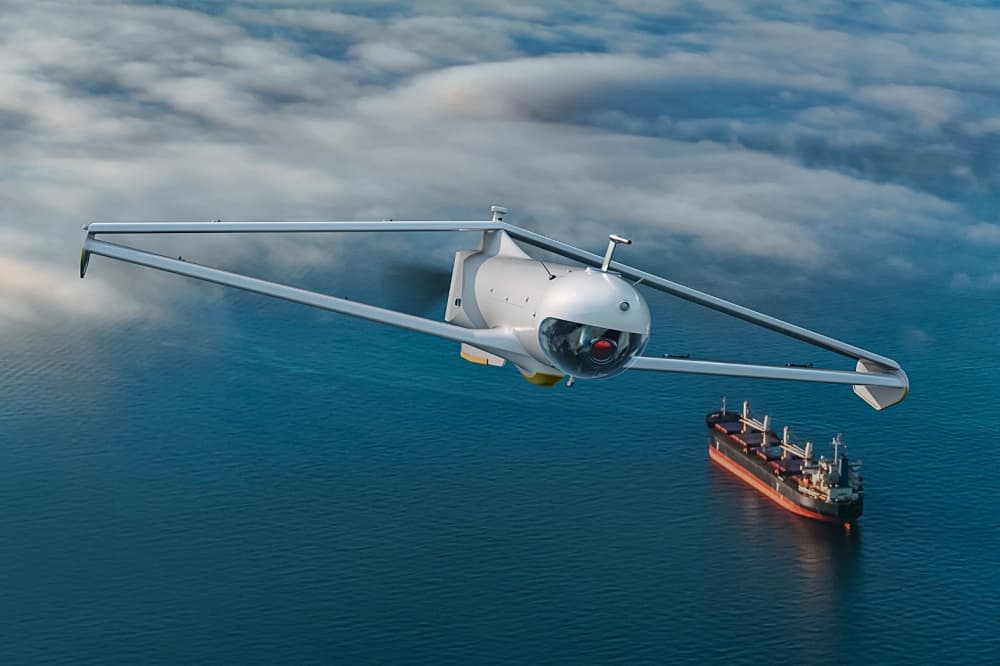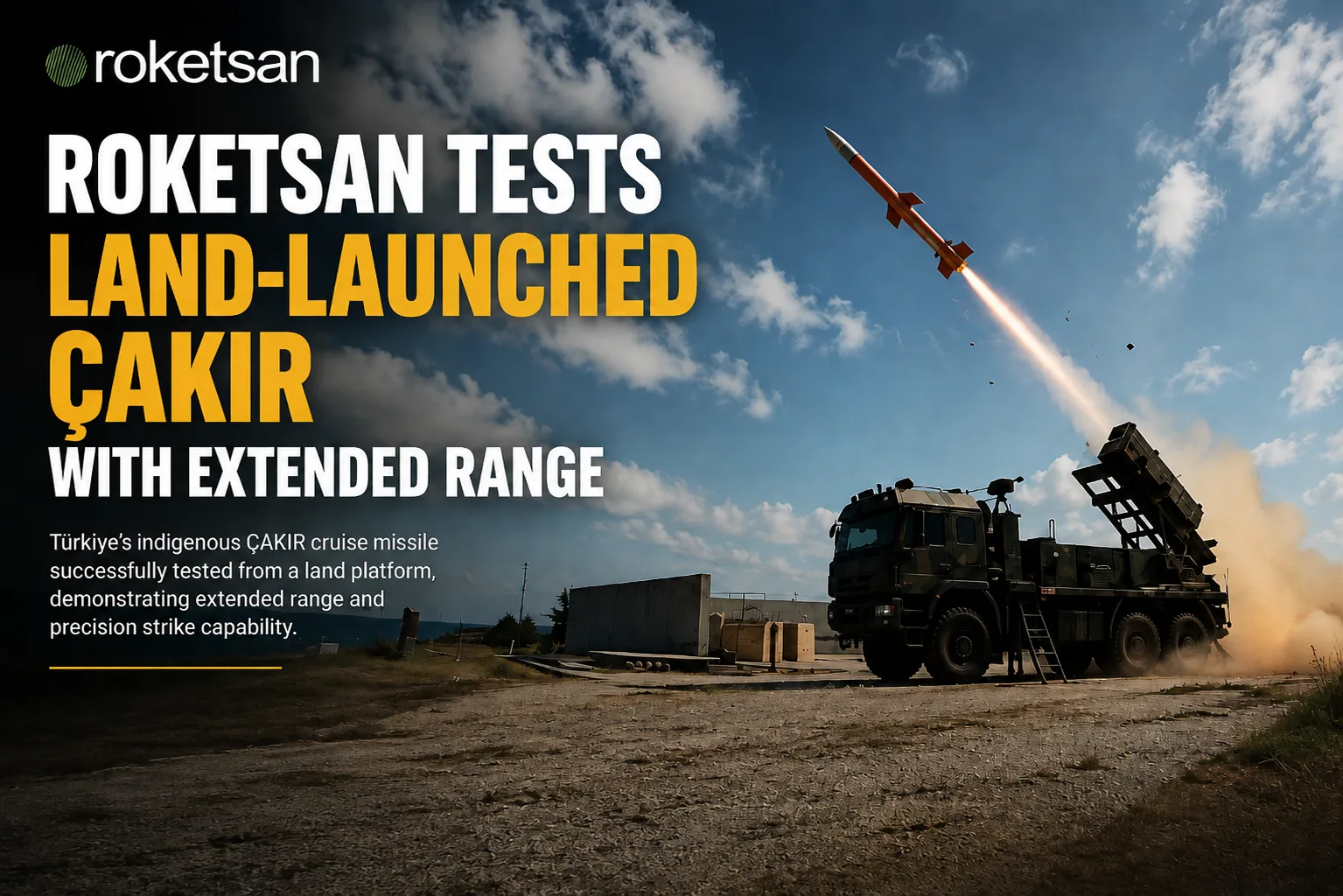
ROKETSAN has completed two new firing tests of its ÇAKIR cruise missile from a land vehicle, striking both a ground target and a maritime target while validating a new fuel system and an extended-range configuration.
The 27 August 2026 tests expand ÇAKIR’s demonstrated multi-platform architecture beyond its earlier air-launched trials. The missile used a new-generation Imaging Infrared seeker in both firings. ROKETSAN and Anadolu Agency did not disclose the exact firing distances, so the new land-launched range should not be inferred from older catalogue figures.
Two Tests Validate Land and Maritime Strike
According to Anadolu Agency, ÇAKIR was fired from the ground on two separate days and struck both a land target and a maritime target with its new-generation IIR seeker. The same campaign successfully tested a new fuel system and an extended-range configuration.
The dual-target campaign is significant because it confirms that the land-launched configuration is being developed for both land-attack and anti-surface missions. It also demonstrates another launch route for a missile family designed from the outset for aircraft, unmanned surface vessels, tactical wheeled vehicles and naval platforms.
The Exact New Land Range Remains Undisclosed
ROKETSAN has confirmed that range increased, but no public source reviewed for this article states the exact distance achieved during the August 2026 land firings.
A 2024 ROKETSAN catalogue listed the surface-launched ÇAKIR at 100+ km and the air-launched configuration at 150+ km. ROKETSAN’s current product page now lists ÇAKIR generally at 150+ km and includes tactical wheeled land vehicles among compatible launch platforms.
The most defensible conclusion is therefore that ROKETSAN has validated an extended-range surface-launched configuration. It would be premature to state that the August firing itself took place at exactly 150 km or another specific distance.
Surface Launch Requires a Different Energy Profile
Air-launched cruise missiles begin flight with altitude and forward velocity. A land-launched missile must accelerate from zero speed and climb into an efficient cruise profile, normally requiring a booster and additional energy during the initial phase.
ROKETSAN’s earlier catalogue reflected this difference. The 2024 surface-launched ÇAKIR was listed as heavier and longer than the air-launched configuration. The company’s current product page lists up to 275 kg without booster and up to 330 kg with booster, with overall length up to 4.1 metres in boosted configuration.
The August test announcement attributes the range improvement to a new fuel system. It does not say that ÇAKIR received a new flight engine.
KTJ-1750 Remains the Confirmed Turbojet
ÇAKIR is powered by Kale Jet Engines’ domestically developed KTJ-1750 turbojet. Kale identifies ÇAKIR as the engine’s current missile application and lists the KTJ-1750 among engines covered by its cruise-missile serial-production supply agreement with ROKETSAN.
Kale publishes 1,750 N qualified sea-level-static thrust, 22.5 kg total engine weight including controls and accessories and a specific fuel consumption of 1.17 kg/h/daN under its published test condition. The engine supports Jet A-1, JP-8 and JP-10.
No public source explains whether the 2026 range extension results from additional missile fuel capacity, revised tank geometry, fuel-management changes or another missile-level modification.
New-Generation IIR Seeker Adds Terminal Flexibility
The latest campaign also validates a new-generation Imaging Infrared seeker against two different target classes.
ROKETSAN’s broader ÇAKIR architecture supports IIR, RF and hybrid seeker options. Its published guidance suite includes inertial navigation, anti-jam GNSS, terrain-referenced navigation, radar altimeter and barometric altimeter functions.
The company has not published the model name, sensor resolution, recognition range or processing architecture of the new-generation IIR seeker used in the August tests.
Data Link Supports Target Update and Mission Abort
ÇAKIR uses a network-based bidirectional data link. ROKETSAN advertises target update, man-in-the-loop control, attack or re-attack against targets of opportunity and mission-abort functionality.
These functions are especially relevant against moving maritime targets, where off-board sensor updates can help maintain an accurate intercept solution after launch.
Public sources do not disclose data-link range, waveform, encryption details or the operational sensor network intended to provide updates.
Land Launch Adds a Distributed Coastal-Strike Option
A tactical land launcher gives ÇAKIR a role that differs from air launch. Mobile launchers can disperse, remain concealed and stay on alert without depending on aircraft sortie generation.
The maritime-target firing is particularly relevant to coastal defence. A land-based ÇAKIR unit connected to external targeting sensors could provide a mobile anti-surface strike layer while retaining land-attack capability.
No Turkish Armed Forces battery structure, launcher quantity or formal operational fielding status for land-launched ÇAKIR has been publicly disclosed.
ÇAKIR Complements Heavier Turkish Cruise Missiles
ÇAKIR is lighter than Türkiye’s heavier anti-ship and land-attack cruise missiles. ROKETSAN lists a 70 kg warhead and supports high-explosive semi-piercing, blast-fragmentation and thermobaric configurations.
Its compact architecture allows integration on platforms that may carry multiple missiles or could not accommodate larger weapons in the same numbers. This makes ÇAKIR complementary to systems such as ATMACA rather than a direct replacement.
AKINCI Demonstrated the Air-Launched Route
Bayraktar AKINCI had already demonstrated ÇAKIR from the air. Anadolu Agency reported that AKINCI fired a ÇAKIR on 29 February 2024 and struck a Black Sea target at approximately 100 km.
The August 2026 land tests therefore extend an existing missile core into a second demonstrated launch architecture. Shared propulsion, guidance and warhead components across air, land and maritime users could support larger production scale and reduce integration cost.
Industrial Significance
ÇAKIR is important for Türkiye’s missile-industrial sovereignty because both the missile and its turbojet propulsion are controlled within the domestic industrial base.
Kale Jet Engines says its serial-production engine supply agreement with ROKETSAN includes high quantities of KTJ-1750, KTJ-3200A, KTJ-3200S and KTJ-3700 engines for ÇAKIR, ATMACA, SOM and KARA ATMACA.
Domestic propulsion reduces one of the most important external dependencies in cruise-missile production and gives Türkiye greater control over production planning, upgrades and potential export configurations.
Limitations and Counterpoint
The exact August 2026 land-test range is unknown. “Extended range” confirms improvement but does not quantify it.
The new fuel system is also technically undefined, and the new-generation IIR seeker has not been publicly identified in detail.
There is no public confirmation in the reviewed sources that a dedicated land-launched ÇAKIR battery has entered Turkish Armed Forces operational service.
Finally, manufacturer maximum-range figures describe capability envelopes and should not be treated as the achieved distance of every launch profile.
Implications / Next
The next important disclosure would be an updated ROKETSAN platform-specific range for surface-launched ÇAKIR.
A second milestone would be confirmation of an operational land-launcher programme, including battery architecture and command-and-control integration.
Further live-fire testing from naval vessels or armed unmanned surface vehicles would also strengthen ÇAKIR’s multi-platform concept.
Conclusion
ÇAKIR’s latest campaign expands the missile from an air-launched precision weapon into a demonstrated land-launched cruise-missile architecture capable of engaging both ground and maritime targets.
The major technical change is validation of an extended-range configuration using a new fuel system together with a new-generation IIR seeker. The exact range, however, remains undisclosed.
If operational fielding follows, ÇAKIR could become a common light cruise-missile layer across Türkiye’s air, land and maritime strike architecture.