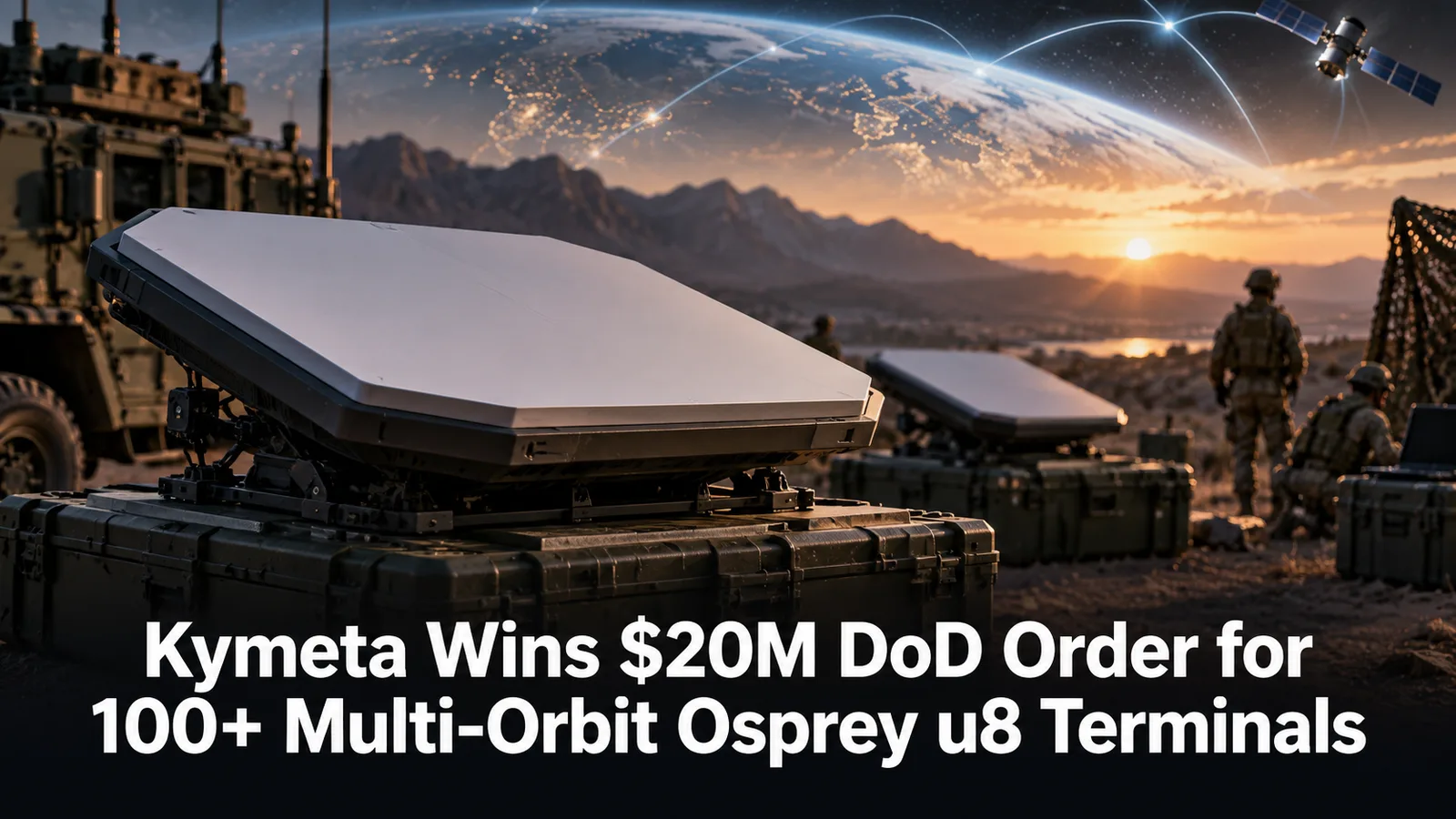
Kymeta has received a $20 million order from the U.S. Department of Defense for more than 100 Osprey u8 flat-panel satellite terminals together with multi-orbit connectivity services.
The order combines hardware and service, giving the undisclosed DoD branch access to GEO and LEO connectivity through Kymeta Broadband rather than treating the terminal as a stand-alone antenna procurement.
Order Scope and Multi-Orbit Communications Architecture
Kymeta says the $20 million package includes more than 100 Osprey u8 terminals together with connectivity on its global KBB network, making the award a combined hardware-and-service package rather than a simple terminal purchase. Because connectivity services are included, dividing the headline value by the terminal count would not produce a reliable unit hardware price. The order adds meaningful volume to the defence market for low-profile electronically steered terminals while reinforcing a procurement model in which hardware, network access and edge software are delivered as one operational communications service.
Osprey u8 is designed to support multiple network paths from a rugged, low-profile antenna suitable for vehicles and vessels. Kymeta says deployed terminals can move between GEO and LEO services and between TRANSEC and non-TRANSEC networks, supporting a PACE model in which units retain primary, alternate, contingency and emergency communications paths. The flat-panel architecture also avoids the large mechanically steered reflector associated with many traditional tactical SATCOM terminals, making on-the-move integration easier on constrained platforms.
Army Context, Customer Uncertainty and AutoPACE
Kymeta’s earlier selection for the U.S. Army’s Next Generation Command and Control pilot provides useful context because it shows Osprey was already being evaluated in mobile command-and-control concepts before the September 2026 order. The company says the latest customer is a branch of the Department of Defense and adds that it has delivered more than $30 million in terminals and services to the same branch during 2026, but it does not identify the service. Defence Agenda therefore does not infer Army, Navy, Marine Corps, Air Force or Space Force attribution without direct disclosure.
Kymeta is also developing AutoPACE, a software layer intended to automate movement among available communications paths rather than requiring operators to manage every change manually. That capability could strengthen resilience when one satellite service is degraded, congested or unavailable, but the September order confirms terminals and services rather than full deployment of every future AutoPACE function. The practical maturity of automated path selection will therefore need to be judged from later fielding or programme disclosures.
Limitations and Counterpoint
The Department of Defense has not publicly released a contract document identifying the customer branch, service period, per-terminal hardware price or detailed performance thresholds for this order. Kymeta’s descriptions of battle-tested resilience, GNSS-denied functionality and network agility remain company claims unless separately supported by government test data. The order is commercially significant, but the lack of programme-level disclosure limits conclusions about fleet-wide adoption or operational scale.
Implications / Next
The next points to watch are identification of the customer branch, follow-on quantities and evidence of Osprey fielding inside NGC2 or other distributed command formations. Operational use of automated network selection would be especially important because it would show the system moving beyond multi-orbit hardware into software-managed communications resilience. Additional orders would also indicate whether the current package is a one-time buy or part of a broader transition toward flat-panel multi-orbit terminals.