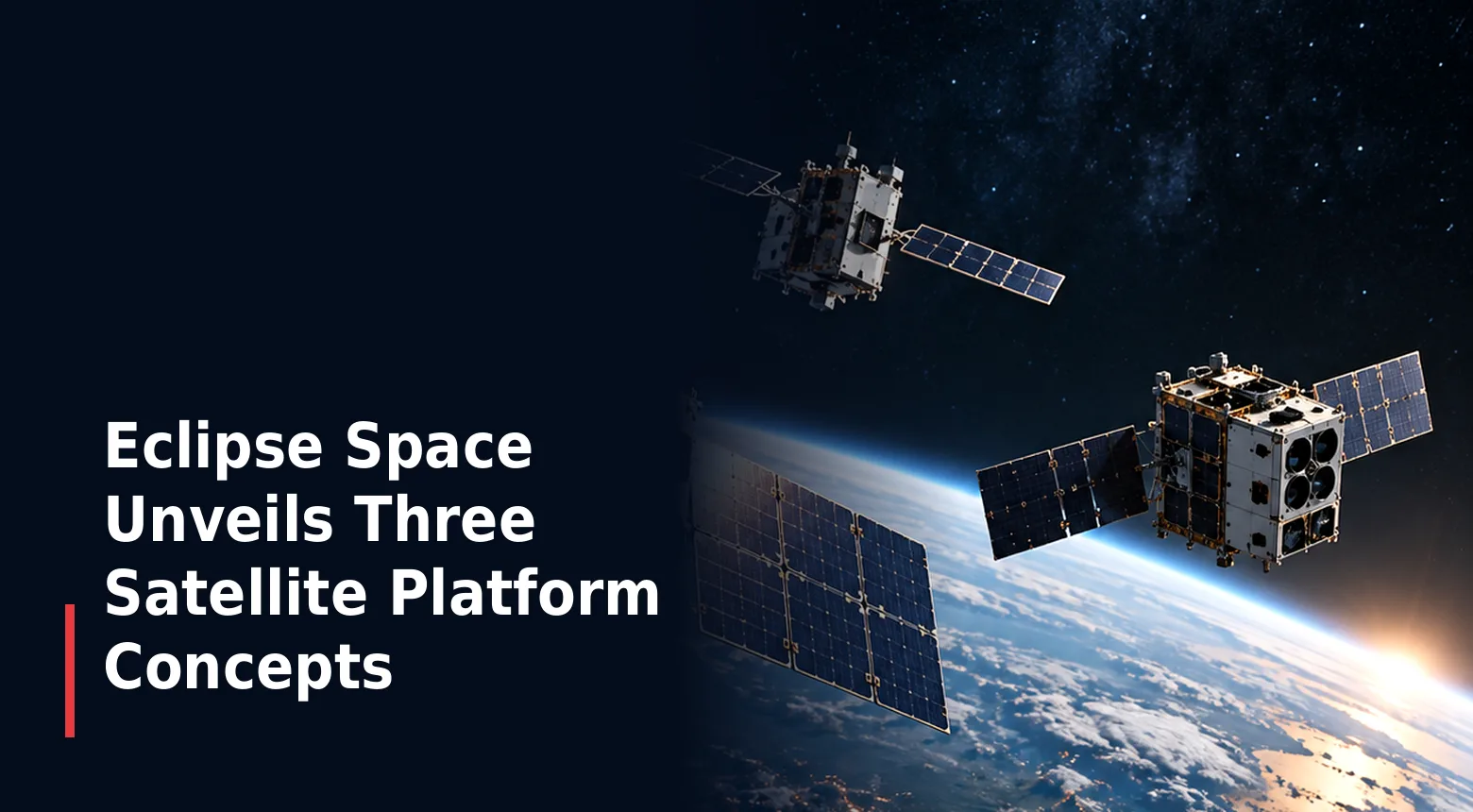
Eclipse Space unveiled three proposed flat-pack satellite platforms on 9 September 2026, targeting direct-to-device communications, high-throughput broadband and orbital computing. The CitraSat, SliceSat and SurgeSat concepts illustrate how the company hopes to sell complete constellation infrastructure rather than individual spacecraft; they are product announcements, not evidence of satellites already operating in orbit.
Three designs address different orbital markets
CitraSat is the initial commercial priority. Payload Space reports an S-band phased-array payload intended to connect directly to compatible mobile devices, with E-band backhaul, V-band inter-satellite connectivity and solar arrays advertised at 6 kW peak power. The business proposition is to place connectivity closer to ordinary handsets, but practical coverage will depend on spectrum rights, terminal compatibility, network capacity and authorisations in each market. A platform specification should not be confused with a signed mobile-network service agreement.
SliceSat is positioned as a broadband spacecraft using Ku-band phased arrays and higher-capacity V/E-band backhaul links. Eclipse describes an 8 kW peak solar configuration, which signals a different payload power budget from the direct-to-device model. The relevant competition is not simply over the spacecraft bus: network operators must assess spectrum access, inter-satellite routing, ground-segment costs and the deployment density needed to serve users profitably. No independently verified throughput, launch manifest or signed constellation order was established in the September unveiling.
SurgeSat introduces a much more demanding power and thermal problem
SurgeSat is designed around orbital computation rather than conventional communications alone. The company describes a planned 100 kW-class dual-array power system and a radiator area of around 400 square metres. Those headline specifications suggest an ambitious attempt to support workloads that would otherwise be processed in terrestrial data centres, but they remain design claims rather than tested orbital performance. In vacuum, rejecting waste heat is a structural and operational challenge as important as generating electrical power.
The common-platform narrative should therefore be assessed carefully. Reusing spacecraft design elements may offer economies of scale, but a radio-frequency communications payload and an orbital computing payload impose different thermal, radiation, redundancy and power-management requirements. Each mission class will need its own qualification evidence, deployment plan and business case. Eclipse's proposed partnership with French space firm Gama on scalable power technology underscores how much depends on specialised suppliers beyond the satellite developer itself.
The constellation-as-a-service model shifts integration responsibility
Eclipse is pitching a turnkey network architecture that includes spacecraft, deployment and operations, rather than leaving the customer to assemble multiple contractor interfaces. According to its chief executive, the goal is to offer a complete infrastructure product to organisations seeking networks on the scale of established satellite constellations. That is commercially interesting because satellite manufacture is only part of total network cost: gateways, licensing, operating software and lifecycle replenishment can be major cost drivers.
The industrial approach is reportedly partnership-led instead of replicating every manufacturing capability internally. This model could lower fixed investment during early development, but it transfers substantial risk into supply-chain management, component qualification and configuration control. For potential government customers, sovereignty would also require clarity about encryption, data location, control of ground infrastructure and legal access to services. Eclipse stated its near-term focus was predominantly commercial, despite positioning some products for sovereign operators.
Demonstration timing is the next credibility test
Payload Space reported that Eclipse had shifted its initial demonstration mission from 2027 to 2028. That revision matters more than the visual appeal of three spacecraft concepts: a flight demonstration is where the company can begin validating attitude control, power systems, thermal behaviour, payload interfaces and real communications links. Until those results exist, technical specifications and service economics are forecasts made by the developer, not verified on-orbit performance.
Potential customers will also need evidence about launch packaging, manufacturing yield, regulatory compatibility and the ability to replace failed units at sustainable cost. The company has not publicly established a deployment cadence for each platform in the sources used for this report. The reasonable editorial conclusion is that Eclipse has set out an ambitious product roadmap, while its operational and commercial maturity remains to be proven.
Implications / Next
The milestones to watch are a confirmed 2028 demonstration launch contract, flight hardware, independent test results, spectrum coordination and signed customer commitments. Any published comparison with incumbent systems should distinguish declared design objectives from measured mission performance.